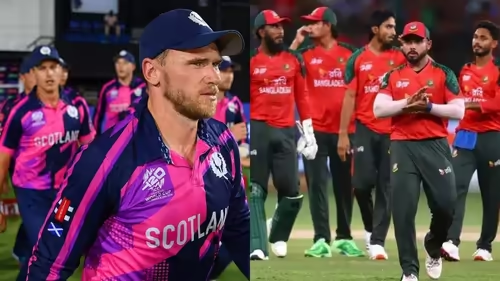
Scotland Replaces Bangladesh in T20 World Cup: A Historic Shift
In one of the most unexpected developments in recent cricket history, **Scotland has officially replaced Bangladesh** in the 2026 ICC Men’s T20 World Cup. The International Cricket Council (ICC) confirmed the move after determining that the Bangladesh Cricket Board’s (BCB) conditions for participation were incompatible with its overarching tournament regulations .
This landmark decision not only reshapes the competitive landscape of **Group C**—where matches will be held in Kolkata and Mumbai—but also underscores the ICC’s firm stance on maintaining consistent standards across all participating nations. For fans and analysts alike, the question isn’t just *who* is in, but *why* Bangladesh was out—and why Scotland was the clear choice to step in.
Table of Contents
- Why Did the ICC Remove Bangladesh?
- Why Scotland Was Chosen as the Replacement
- The Rise of Scottish Cricket on the Global Stage
- How This Changes Group C Dynamics
- Fan and Expert Reactions to the Swap
- Conclusion: A New Chapter for Associate Nations
- Sources
Why Did the ICC Remove Bangladesh?
According to ICC CEO Sanjog Gupta, the BCB submitted a set of “non-standard” demands regarding their participation in the tournament—requests that deviated from the uniform framework applied to all other Full Member nations . While the exact nature of these demands remains undisclosed, sources suggest they may have involved financial guarantees, logistical accommodations, or political assurances that the ICC could not endorse without compromising its neutrality and fairness.
The ICC’s position was clear: no nation, regardless of status or past performance, would be granted exceptions that undermine the integrity of the event. When the BCB refused to withdraw its conditions, the ICC had no choice but to revoke Bangladesh’s automatic qualification—a rare but precedent-backed move under Article 7.3 of the ICC Event Regulations.
Why Scotland Was Chosen as the Replacement
With Bangladesh out, the ICC needed a qualified, ready, and deserving team to fill the vacant spot. Enter **Scotland**—the highest-ranked Associate nation not already in the tournament, currently sitting at **No. 14 in the ICC T20I rankings** .
Several factors made Scotland the obvious choice:
- Consistent Performance: Scotland has defeated Full Members like England, West Indies, and Zimbabwe in recent years, proving they can compete at the highest level.
- Tournament Readiness: The squad is active, well-coached, and has been preparing for major events through the ICC’s development pathway.
- Geographic & Logistical Fit: As a European team with experience playing in subcontinental conditions, Scotland poses minimal disruption to the existing schedule in India.
- Merit-Based Selection: The ICC emphasized that Scotland was “the most deserving associate team,” aligning with its mission to reward excellence beyond Full Member status .
The Rise of Scottish Cricket on the Global Stage
Scotland’s inclusion isn’t a fluke—it’s the culmination of decades of strategic investment in grassroots cricket, professional coaching, and international exposure. Since gaining ODI status in 2014, Cricket Scotland has built a competitive core featuring players like Richie Berrington, Michael Leask, and Safyaan Sharif.
Their historic win over England in the 2018 ICC Cricket World Cup Qualifier sent shockwaves through the sport. More recently, they’ve consistently topped the ICC’s Associate rankings, earning praise from global commentators for their disciplined play and tactical intelligence. Their promotion to the T20 World Cup main draw is both a reward and a validation of their progress.
How This Changes Group C Dynamics
Originally, **Group C** featured a mix of powerhouses and emerging teams. With Bangladesh—a side known for spin-heavy attacks and volatile batting—out, and Scotland—a disciplined, pace-oriented unit—in, the group’s balance shifts significantly.
Scotland will now face opponents in high-stakes matches in **Kolkata and Mumbai**, venues known for passionate crowds and challenging pitches. While they may lack the star power of some rivals, their underdog spirit and tactical flexibility could make them a dark horse. For fans, this adds a fresh narrative: can an Associate nation not just participate, but *compete*?
Fan and Expert Reactions to the Swap
Reactions have been polarized. Bangladeshi fans expressed outrage and disappointment, calling the BCB’s stance “self-sabotaging.” Meanwhile, Scottish supporters celebrated what many are calling a “once-in-a-generation opportunity.”
Cricket analysts like Harsha Bhogle noted, “This is a watershed moment for Associate cricket. If Scotland performs well, it could accelerate calls for expanding the World Cup format to include more non-Test nations.” Others, however, worry about the precedent—could political or administrative disputes now routinely override sporting merit?
Conclusion: A New Chapter for Associate Nations
The decision that **Scotland replaces Bangladesh T20 World Cup** is more than a roster change—it’s a statement. The ICC has signaled that adherence to global standards trumps historical entitlement, and that meritocracy now extends to the sport’s biggest stages. For Scotland, it’s a chance to prove they belong. For Bangladesh, it’s a harsh lesson in diplomacy and governance. And for cricket fans worldwide, it’s a reminder that the game is evolving—fast, fairly, and sometimes, unexpectedly. Stay updated on all T20 World Cup action with our coverage at [INTERNAL_LINK:t20-world-cup-2026].
Sources
- Times of India: ‘Bangladesh out of T20 World Cup: Why Scotland are chosen as replacement‘
- ICC Official Website: ‘International Cricket Council‘
- ESPNcricinfo: ‘Scotland cricket team profile‘
- Cricbuzz: ‘T20 World Cup 2026 Group C schedule‘