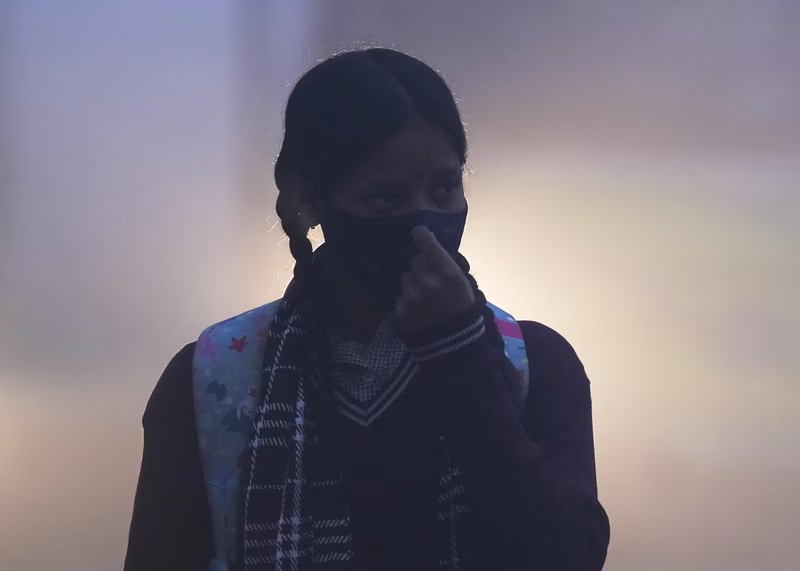
As icy winds bite and thick fog blankets entire districts, thousands of students across India are getting an unexpected—and necessary—winter break. Citing severe cold wave conditions and dangerously low visibility, state governments in Rajasthan, Jharkhand, Tripura, and others have announced widespread school closures to protect children from frostbite, respiratory illnesses, and travel hazards .
While kids enjoy a few days at home, the situation is far from a holiday for educators and administrators, who are mostly required to report to schools. Meanwhile, high-stakes examinations in several regions are proceeding as scheduled—a decision that’s drawing both praise for academic continuity and concern for student well-being. With temperatures in parts of North India dipping below 5°C and fog reducing visibility to under 50 meters, these closures aren’t just precautionary—they’re a public health imperative.
Table of Contents
- School Closures India: Full State-Wise List
- Why Cold Waves Are Dangerous for Children
- Exams Go On, Staff Report—Despite Student Holidays
- How Schools Are Adapting to Extreme Winter
- What Parents Should Do During School Closures
- Long-Term Solutions for Climate-Resilient Education
- Conclusion: Balancing Safety and Learning
- Sources
School Closures India: Full State-Wise List
As of Tuesday, January 6, 2026, the following states have officially announced school closures due to cold wave and fog:
- Rajasthan: All government and private schools closed for Classes 1–8 in 15 districts including Jaipur, Ajmer, and Kota until January 10. Classes 9–12 remain open, but attendance is optional .
- Jharkhand: State-wide holiday for Classes 1–10 until January 8. Staff must report daily for administrative duties. Board exams for Class 10 and 12 continue as per schedule .
- Tripura: Schools closed for all grades until January 7 due to dense fog and temperatures near 8°C. Online classes recommended where feasible .
- Uttar Pradesh: Partial closures in western districts (Meerut, Ghaziabad) for primary classes; senior schools operate with flexible hours.
- Punjab & Haryana: Advisory issued for schools to avoid morning assemblies and outdoor activities; full closures possible if AQI drops further.
Note: District-level decisions may vary. Parents are advised to check official state education department portals or school WhatsApp groups for real-time updates.
Why Cold Waves Are Dangerous for Children
Children are especially vulnerable during cold waves due to their developing immune systems and higher surface-area-to-body-mass ratio, which causes them to lose heat faster than adults . Key risks include:
- Hypothermia: Core body temperature drops dangerously low.
- Respiratory infections: Fog often carries pollutants, triggering asthma and bronchitis.
- Travel accidents: Dense fog leads to reduced visibility, increasing road collision risks for school buses and pedestrians.
- Frostnip: Early stage of frostbite affecting ears, fingers, and nose.
The India Meteorological Department (IMD) has issued “Cold Day” and “Severe Cold Day” alerts across North and Central India, with minimum temperatures expected to remain below 10°C for the next week .
Exams Go On, Staff Report—Despite Student Holidays
A notable aspect of these closures is the distinction between student and staff attendance. In Jharkhand and Rajasthan, while students stay home, teachers and non-teaching staff are required to be present for:
- Exam preparation and invigilation
- Administrative tasks (report cards, grant documentation)
- Emergency coordination in case of weather-related incidents
Meanwhile, board examinations for Classes 10 and 12 are proceeding without delay. “Academic calendars cannot be derailed by seasonal weather,” stated a Jharkhand Education Department official, though critics argue this places undue stress on students already battling health risks .
How Schools Are Adapting to Extreme Winter
Forward-thinking institutions aren’t just closing—they’re innovating:
- Hybrid learning: Schools in urban Tripura are shifting to Google Classroom or Zoom for core subjects.
- Winter safety kits: Some private schools distributed thermal gloves, masks, and vitamin C supplements before closures.
- Delayed start times: Where schools remain open, timings are shifted to 10 a.m. to avoid peak fog hours.
[INTERNAL_LINK:best-online-learning-tools-for-indian-students] can help parents keep kids engaged during closures.
What Parents Should Do During School Closures
Don’t treat this as just a break. Use it wisely:
- Limit outdoor exposure between 6 a.m. and 10 a.m., when fog is thickest.
- Keep children hydrated—cold, dry air increases dehydration risk.
- Maintain study routines to avoid academic regression.
- Check school communication channels daily for reopening updates.
Long-Term Solutions for Climate-Resilient Education
As extreme weather becomes more frequent due to climate change, India needs systemic fixes:
- Flexible academic calendars that account for regional climate patterns.
- National policy on weather-related closures to standardize decisions.
- Investment in digital infrastructure so rural schools can pivot to online learning.
- Weatherization of school buildings with better heating and air filtration.
The World Bank has flagged climate vulnerability as a major barrier to education in South Asia—a challenge India must address proactively .
Conclusion: Balancing Safety and Learning
The current wave of school closures India-wide is a necessary response to an immediate health threat. While it disrupts routines, it underscores a vital truth: a child’s safety must always come before the school bell. As winter tightens its grip, these closures aren’t a sign of chaos—they’re a sign of responsible governance. The real test will be how quickly and equitably the system can bounce back once the fog lifts and the sun returns.
Sources
- Times of India. “Schools closed in these states due to cold wave and fog: Check full list of holidays here.” https://timesofindia.indiatimes.com/…
- India Meteorological Department (IMD). “Cold Wave Advisory – January 2026.” https://mausam.imd.gov.in/…
- Rajasthan Education Department. Official Circular No. ED/HS/2026/01. https://rajeduboard.rajasthan.gov.in/…
- Jharkhand Academic Council. “Winter Holiday Notice.” https://jac.jharkhand.gov.in/…
- World Bank. “Climate-Smart Education in South Asia.” https://www.worldbank.org/…