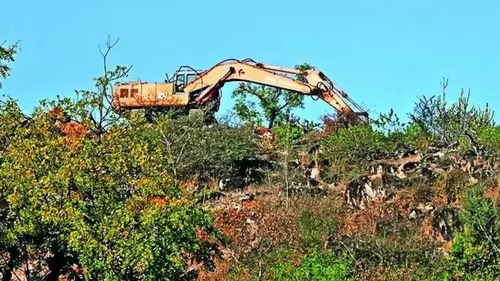
The ancient Aravali hills, a silent guardian against the encroaching Thar Desert for millennia, have just been thrown a lifeline by India’s highest court. In a decisive and urgent order, the Supreme Court has commanded the states of Delhi, Haryana, and Rajasthan to halt all forms of Aravali illegal mining immediately, citing the “irreversible” ecological damage being inflicted on this vital natural heritage .
This isn’t just another bureaucratic notice; it’s a final warning. The Court has gone a step further by announcing the formation of a new, multidisciplinary expert panel. This body will be tasked with conducting a comprehensive, scientific examination of the entire Aravali range to define its boundaries, assess its structural integrity, and chart a sustainable path forward . Until this panel delivers its findings, the mining must stop—no exceptions.
Table of Contents
- Why the Aravalis Matter: The Ecological Heart of North India
- The Supreme Court’s Decisive Action on Aravali Illegal Mining
- A History of Destruction: The Long Fight Against Illegal Mining
- What the New Expert Panel Will Do
- Conclusion: A Last Chance to Save the Aravalis
- Sources
Why the Aravalis Matter: The Ecological Heart of North India
For many, the Aravalis are just a scenic backdrop. But ecologically, they are a non-negotiable asset for the entire northern plains. These ancient hills are far more than rock and soil; they are a complex, life-sustaining system.
First and foremost, the Aravalis act as a crucial barrier against desertification. They stand as a bulwark, preventing the eastward expansion of the Thar Desert into the fertile agricultural lands of Haryana and beyond . Without them, vast swathes of North India could face a dusty, arid future.
Secondly, they are a primary groundwater recharge zone. The forested patches and natural aquifers within the range are essential for replenishing the water tables that millions of people and countless farms depend on . Destroying the hills means destroying the region’s water security.
Finally, they serve as the “green lungs” for the National Capital Region (NCR) and surrounding areas. Their forests help moderate local climates, reduce urban heat islands, and act as a massive pollution buffer, filtering the air for tens of millions of residents [[9], [11]]. The ecological cost of their destruction is simply too high to bear.
The Supreme Court’s Decisive Action on Aravali Illegal Mining
The Supreme Court’s latest intervention is a direct response to the persistent and brazen flouting of its previous orders. A bench led by Chief Justice Surya Kant has made it clear that enough is enough. The directive to stop all illicit mining activities “at all costs” leaves no room for ambiguity or state-level lethargy .
The Court’s frustration is palpable. It has recognized that piecemeal solutions and weak enforcement have failed. The rampant quarrying and excavation have caused what the Court itself describes as “irreversible” damage, scarring the landscape and destabilizing the very geological structure of the range .
This new order is not just a stop-gap measure. It is a strategic pause, enforced by the highest judicial authority, to allow for a proper, science-based assessment. The message to the state governments is unambiguous: your primary duty is to protect this national treasure, not to facilitate its plunder.
A History of Destruction: The Long Fight Against Illegal Mining
The battle to save the Aravalis is decades old. Despite a blanket ban on mining in the Gurgaon, Faridabad, and Nuh districts of Haryana imposed by the Supreme Court as far back as 2009, illegal operations have continued unabated .
The scale of the problem is staggering. A 2018 report from a previous SC-appointed committee revealed that a shocking 25% of the Aravali range in Rajasthan alone had been lost to illegal mining since 1967-68 . Another study warned that if the current rate of destruction continues, the region could lose up to 22% of its remaining hills by 2059 .
Reports from 2025 indicate that there were nearly 2,100 illegal mining cases in Rajasthan’s Aravalis over just five years, highlighting the systemic failure of local authorities to enforce the law . This entrenched culture of illegal mining, often backed by powerful interests, is precisely why the Supreme Court has now taken such a direct and forceful stance.
What the New Expert Panel Will Do
The newly constituted expert panel is the centerpiece of the Court’s strategy. It’s designed to cut through the political and bureaucratic noise and provide an objective, scientific foundation for future policy. Its mandate is expected to include:
- Redefining the Aravali Range: Using modern satellite imagery and geological surveys to establish a clear, legally binding definition of the Aravali’s geographical extent, closing loopholes used by miners.
- Assessing Ecological Damage: Conducting a thorough audit of the environmental and structural damage already caused by decades of mining.
- Recommending a Sustainable Framework: Proposing a long-term, holistic plan for the conservation, restoration, and potential regulated use of the range, prioritizing its ecological integrity above all else [[5], [7]].
The panel will likely include experts from diverse fields—environmental scientists, geologists, legal scholars, and possibly even representatives from local communities who have been on the front lines of this fight . Its recommendations will carry the weight of the Supreme Court, making them impossible for state governments to ignore.
Conclusion: A Last Chance to Save the Aravalis
The Supreme Court’s order is a pivotal moment for the Aravali hills. It represents a final, authoritative call to action for the governments of Delhi, Haryana, and Rajasthan. The directive to stop Aravali illegal mining is not a request; it’s a command from the highest court in the land. The formation of the expert panel offers a rare opportunity to replace decades of destructive chaos with a plan rooted in science and sustainability. The fate of this ancient ecological shield, and the future of North India’s environment, now hangs in the balance. This is the last chance to get it right.
Sources
- Times of India: SC to set up expert panel on Aravalis, tells states to stop illegal mining ‘at all costs’
- SC Observer: Supreme Court Constitutes Expert Panel to Tackle “Irreversible” Damage
- Live Law: Supreme Court to Form Expert Panel on Aravalli Mining [[4], [5]]
- Down To Earth: Ecological and Historical Significance of Aravalli Hills [[9], [11], [13], [17]]
- India Today: Protecting the Aravalli Range – Explained [[22], [24]]
- The Hindu: 2096 Illegal Mining Cases in Rajasthan’s Aravalis in 5 Years
- Hindustan Times: 8% of Aravali hills gone since 1975, 22% loss likely by 2059