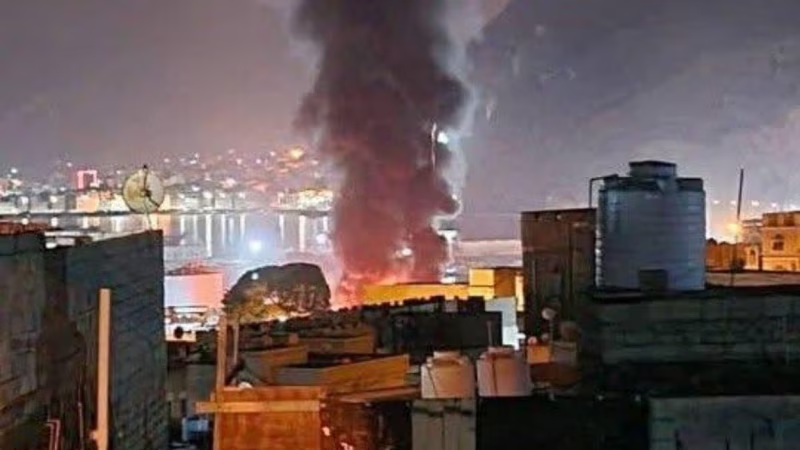
In a move that has sent shockwaves through the Gulf, Saudi Arabia carried out a precision airstrike on Yemen’s Mukalla port—targeting what it claims was a weapons shipment arriving from the United Arab Emirates (UAE) destined for separatist militias. Officially labeled a “limited military operation,” the attack is far from routine: it exposes a deepening rift between two Arab powerhouses who once presented a united front in Yemen’s brutal civil war .
Far from a minor border skirmish, this strike reveals how competition for influence in southern Yemen has fractured the Saudi-UAE alliance. With Riyadh backing the internationally recognized Yemeni government and Abu Dhabi quietly arming the Southern Transitional Council (STC), the region is slipping into a proxy power struggle—one that could reignite full-scale conflict.
Table of Contents
- What Happened in Mukalla Port?
- Saudi Arabia’s Official Justification
- The UAE’s Role and Ties to Yemeni Separatists
- How the Saudi-UAE Alliance Is Fracturing
- Yemen’s War: From Houthi Focus to Southern Fractures
- Broader Regional and Global Implications
- What Happens Next?
- Conclusion: A New Fault Line in the Gulf
- Sources
What Happened in Mukalla Port?
On December 29, 2025, Saudi-led coalition aircraft bombed strategic infrastructure at Mukalla, a key port city in Yemen’s Hadhramaut governorate. The target: a cargo vessel reportedly carrying advanced weaponry—anti-tank missiles, drones, and small arms—shipped from the UAE and destined for the Southern Transitional Council (STC), a UAE-backed separatist group seeking independence for south Yemen .
While no casualties were immediately reported, the strike damaged port facilities and sent a clear message: Riyadh will not tolerate arms flows that undermine its vision for Yemen’s unity.
Saudi Arabia’s Official Justification
The Saudi Ministry of Defense described the operation as “limited, precise, and necessary” to “neutralize an imminent threat to regional security.” In a rare public statement, it accused the UAE of violating prior understandings within the coalition by “covertly supplying arms to non-state actors in southern Yemen” .
Crucially, Saudi officials emphasized that this was not an attack on the UAE itself—but a defensive measure against weaponized fragmentation. “We remain committed to Gulf unity,” a Riyadh spokesperson said, “but not at the cost of Yemen’s sovereignty.”
The UAE’s Role and Ties to Yemeni Separatists
While the UAE officially withdrew most of its troops from Yemen in 2019, it never truly left. Instead, it shifted to a strategy of proxy influence—primarily through the Southern Transitional Council, which controls much of southern Yemen, including Aden and Mukalla.
The STC, though nominally part of Yemen’s Saudi-backed government under the Riyadh Agreement, has increasingly acted autonomously—often clashing with government forces. Intelligence reports suggest the UAE provides the STC with training, funding, and arms to maintain a strategic foothold near vital shipping lanes like the Bab el-Mandeb Strait .
This latest arms shipment, if confirmed, would mark a significant escalation in Abu Dhabi’s covert support—prompting Saudi Arabia’s unusually direct military response.
How the Saudi-UAE Alliance Is Fracturing
Once hailed as the “axis of stability” in the Gulf, the Saudi-UAE partnership has grown increasingly transactional. Key points of divergence include:
- Yemen Strategy: Saudi Arabia seeks a unified Yemen under President Rashad al-Alimi; the UAE prioritizes a pliable south Yemen buffer zone.
- Economic Rivalry: Both vie to become the Gulf’s trade and logistics hub—Mukalla’s port is strategically valuable.
- Foreign Policy: The UAE has pursued independent diplomacy with Iran, Turkey, and even Russia—often against Riyadh’s wishes.
As one Middle East analyst put it: “They’re allies of convenience, not conviction.”
Yemen’s War: From Houthi Focus to Southern Fractures
Since 2015, the Yemen conflict has been framed as a Saudi-led coalition vs. Iran-backed Houthis. But the reality is far more complex. With the Houthis now entrenched in the north and engaged in sporadic peace talks, the real battleground has shifted south—where Saudi and Emirati visions for post-war Yemen collide .
The STC’s recent military advances toward oil-rich regions like Shabwa have alarmed Riyadh, which views these moves as UAE-engineered land grabs. The Mukalla strike is essentially Saudi Arabia drawing a red line.
For deeper context on the conflict’s evolution, see our analysis on [INTERNAL_LINK:yemen-civil-war-timeline].
Broader Regional and Global Implications
This incident could have ripple effects beyond Yemen:
- Oil Markets: Escalation near Bab el-Mandeb could disrupt 10% of global seaborne oil trade.
- US Policy Dilemma: Washington has urged Gulf unity; this rift complicates its Yemen exit strategy.
- Iran’s Opportunity: Tehran may exploit Gulf disunity to strengthen Houthi positions.
The United Nations has already called for restraint, warning that renewed conflict could derail fragile humanitarian progress .
What Happens Next?
Several scenarios could unfold:
- Diplomatic De-escalation: Behind-the-scenes talks between Riyadh and Abu Dhabi could contain the fallout.
- Proxy Escalation: STC and Yemeni government forces may clash openly, dragging both Gulf powers deeper into conflict.
- New Coalition Realignment: Saudi Arabia might seek closer ties with Oman or even re-engage with moderate Houthis to counter UAE influence.
One thing is certain: the era of seamless Gulf cooperation in Yemen is over.
Conclusion: A New Fault Line in the Gulf
The Saudi Arabia Yemen port strike is not just about a weapons shipment—it’s about competing visions for the future of the Arabian Peninsula. What began as a counter-Houthi coalition has splintered into a contest for control, with southern Yemen as the prize.
For global observers, this is a reminder that even among allies, strategic interests can diverge violently. And in a region already scarred by war, a new front may be opening—one where former partners become silent adversaries.
Sources
- Times of India: ‘Limited military op’: Saudi bombs Yemeni port; targets alleged arms shipment from UAE
- Al Jazeera: Saudi Arabia strikes Yemen port targeting UAE arms shipment
- Reuters: Saudi-UAE tensions flare over Yemen arms shipment
- International Crisis Group: Yemen Conflict Updates – December 2025
- United Nations: UN Office for the Coordination of Humanitarian Affairs – Yemen