Table of Contents
- A ‘Blessed’ Time in Tech
- Why Satya Nadella Believes the Tech Industry Is Thriving
- The AI Arms Race as a Catalyst, Not a Threat
- Tech’s Growing Share of Global GDP
- Lessons from Microsoft’s Own Transformation
- What This Means for the Future of Innovation
- Conclusion: Embracing the ‘Blessed’ Chaos
- Sources
A ‘Blessed’ Time in Tech
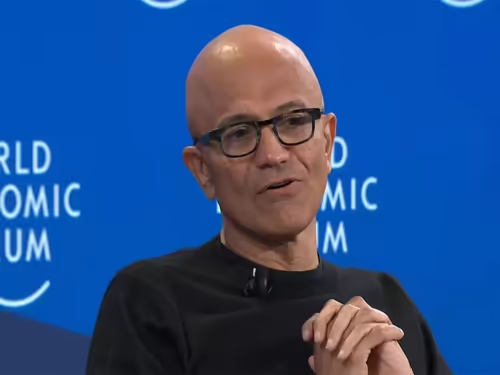
In an industry often defined by disruption, layoffs, and existential dread over AI, Microsoft CEO Satya Nadella offered a strikingly hopeful perspective. Speaking recently, he declared that we are living in a “blessed” era for the Satya Nadella tech industry—a time where intense competition, particularly around artificial intelligence, isn’t a danger but a driving force for progress .
This isn’t just corporate optimism. It’s a strategic worldview rooted in decades of observing how technology reshapes economies. For Nadella, the current frenzy isn’t noise—it’s the sound of an industry expanding its role in the global fabric.
Why Satya Nadella Believes the Tech Industry Is Thriving
Nadella’s confidence stems from two core beliefs:
- Competition breeds agility. In his view, the fierce rivalry among tech giants—whether it’s Microsoft, Google, Amazon, or OpenAI—forces companies to move faster, think smarter, and stay relentlessly customer-focused.
- Technology’s economic footprint is only growing. He predicts that the tech sector’s contribution to global GDP will continue to rise as digital tools become embedded in every industry—from healthcare to agriculture to manufacturing.
“We are blessed to be in this industry, where the share of the global economy that technology touches is going to keep increasing,” Nadella said . This isn’t just about selling more software; it’s about enabling entire sectors to become more efficient, creative, and resilient through digital transformation.
The AI Arms Race as a Catalyst, Not a Threat
While many executives express caution—or even fear—about the rapid pace of AI development, Nadella sees it differently. He frames the so-called “AI arms race” as a necessary and healthy dynamic.
Rather than leading to a winner-takes-all scenario, he believes competition ensures that no single company becomes complacent. It pushes everyone to innovate responsibly, improve safety protocols, and deliver real value—not just hype. This aligns with Microsoft’s own strategy of embedding AI across its ecosystem (Windows, Azure, Office) while partnering with leaders like OpenAI to accelerate R&D.
[INTERNAL_LINK:ai-ethics-and-responsible-innovation] could be a natural next read for those interested in how companies balance speed with responsibility.
Tech’s Growing Share of Global GDP
Nadella’s assertion about technology’s expanding economic role is backed by data. According to the U.S. Bureau of Economic Analysis, the digital economy accounted for 10.3% of U.S. GDP in 2023—a figure that has steadily climbed over the past decade . Globally, the World Economic Forum estimates that by 2030, digital technologies could contribute up to $100 trillion to the global economy .
This isn’t just about Big Tech profits. It’s about how cloud computing enables small businesses to scale, how AI helps doctors diagnose diseases earlier, and how automation frees workers from repetitive tasks. In Nadella’s vision, the Satya Nadella tech industry isn’t a siloed sector—it’s the nervous system of the modern economy.
Lessons from Microsoft’s Own Transformation
Nadella’s outlook is deeply informed by his own experience. When he took over as CEO in 2014, Microsoft was seen as a legacy player, struggling to adapt to mobile and cloud computing. His famous memo declaring “mobile-first, cloud-first” marked a cultural reset.
Under his leadership, Microsoft embraced open-source, invested heavily in Azure, and later pivoted decisively toward AI. The result? A market cap that soared from under $300 billion to over $3 trillion—a testament to what’s possible when a company leans into change rather than resists it.
That journey reinforces his belief: pressure creates diamonds. The current competitive environment isn’t a threat to Microsoft—it’s the very condition that allows it to thrive.
What This Means for the Future of Innovation
If Nadella is right, we’re not heading toward a tech bubble—but toward a deeper integration of intelligent systems into daily life. Expect to see:
- More vertical AI solutions: Tailored models for law, finance, education, and logistics.
- Hybrid human-AI workflows: Where professionals use AI as a co-pilot, not a replacement.
- Increased regulatory collaboration: As governments work with tech firms to establish guardrails without stifling innovation.
The key, Nadella suggests, is to focus on empowerment, not displacement. Technology should amplify human potential, not replace it.
Conclusion: Embracing the ‘Blessed’ Chaos
Satya Nadella’s message is both a reassurance and a challenge. Yes, the pace is relentless. Yes, the stakes are high. But this moment—fueled by AI, driven by competition, and expanding into every corner of the economy—is not something to fear. It’s a rare opportunity.
For businesses, developers, and policymakers, the takeaway is clear: adapt, collaborate, and build with purpose. In Nadella’s words, we are indeed “blessed” to be part of an industry that doesn’t just reflect the future—but actively shapes it.
Sources
- Times of India: Microsoft CEO Satya Nadella says: We are blessed to be in this industry, where …
- U.S. Bureau of Economic Analysis: Digital Economy Accounts
- World Economic Forum: The Future of Jobs Report 2023