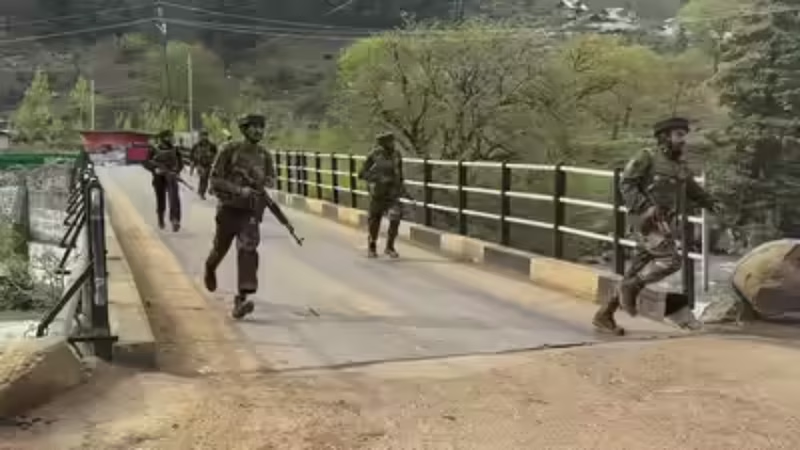
In the tense, moonlit landscape of Jammu’s frontier, a silent digital whisper triggered a thunderous response. A suspicious satellite communication (sat-com) signal, detected by India’s sophisticated electronic surveillance network, prompted an immediate and large-scale search operation near the international border in the Kanachak area . This isn’t a scene from a spy thriller; it’s the new reality of modern border security, where the battle against infiltration is increasingly fought in the invisible realm of radio frequencies and data streams.
The operation, spearheaded by the Border Security Force (BSF), highlights a crucial shift in India’s defensive strategy. No longer relying solely on physical patrols and fencing, the country is now leveraging cutting-edge signals intelligence to pre-empt threats before they materialize on the ground. But what does a ‘sat-com alert’ really mean, and why did it warrant such a significant mobilization of troops in the sensitive Kanachak sector?
Table of Contents
- The Sat-Com Alert Jammu Incident: What Happened?
- Why Kanachak? A Strategic and Vulnerable Sector
- Decoding the Threat: What is a Suspicious Sat-Com Signal?
- The BSF Response: A Show of Force and Vigilance
- The Evolving Tech Arms Race on the India-Pakistan Border
- Conclusion: How Digital Intelligence is Shaping Border Security
- Sources
The Sat-Com Alert Jammu Incident: What Happened?
According to official sources, specialized technical units monitoring the airwaves along the International Border (IB) intercepted an unusual and encrypted satellite communication signal originating from or directed towards the general vicinity of Kanachak in Jammu district .
Satellite phones and communication devices are banned for civilians in most border areas due to their ability to operate beyond the range of conventional cellular networks, making them a preferred tool for smugglers, spies, and terrorists to coordinate activities without being traced through local towers. The detection of such a signal is treated as a top-priority security breach.
Acting swiftly on this sat-com alert Jammu, the BSF launched a comprehensive combing operation, deploying multiple companies of troops, dog squads, and thermal imaging drones to scour the area for any sign of infiltrators, hidden caches, or the source of the transmission.
Why Kanachak? A Strategic and Vulnerable Sector
Kanachak is not just any point on the map. It’s a strategically vital location in the Jammu region, known for its challenging terrain of riverine belts and nullahs (seasonal streams). This geography has historically been exploited by hostile elements for infiltration attempts from across the border.
The sector has witnessed numerous encounters and seizure operations in the past, making it a constant focus of security attention. Any unusual activity here, especially one as serious as a potential sat-com link, is met with the highest level of operational readiness.
Decoding the Threat: What is a Suspicious Sat-Com Signal?
For the uninitiated, a satellite phone works by connecting directly to orbiting satellites, bypassing all terrestrial infrastructure. In a conflict zone like the India-Pakistan border, their use is almost exclusively associated with nefarious activities:
- Coordinating Infiltration: Guiding groups of terrorists or smugglers across the border in real-time.
- Relaying Intelligence: Sending information about troop movements or vulnerabilities back to handlers.
- Triggering Devices: In extreme cases, potentially used to remotely activate explosive devices.
Detecting these signals requires highly specialized equipment and trained personnel. India’s Defence Research and Development Organisation (DRDO) and other agencies have been working for years to enhance this capability, which is now proving its worth in real-world scenarios .
The BSF Response: A Show of Force and Vigilance
The BSF’s reaction was textbook perfect, demonstrating a seamless integration of intelligence and ground operations. The search operation involved:
- Area Domination: Sealing off the entire suspected zone to prevent any escape.
- Grid-by-Grid Search: Teams meticulously combed through every inch of the designated area.
- Technological Augmentation: Using night-vision goggles, thermal imagers, and drone surveillance to cover blind spots.
- Inter-Agency Coordination: Working in close liaison with military intelligence and technical surveillance units.
While initial reports suggest no arrests or recovery of major contraband were made during the operation, the very act of launching such a large-scale response serves as a powerful deterrent. It sends a clear message that every digital footprint is being watched.
The Evolving Tech Arms Race on the India-Pakistan Border
This incident is a microcosm of a larger trend. The India-Pakistan border has become a testing ground for a technological arms race. While India invests in AI-powered surveillance, radar fences, and signals intelligence, adversaries are constantly seeking new, low-tech or high-tech methods to circumvent these defenses.
The use of satellite communication is just one example. Drones for smuggling weapons and narcotics have become another major challenge. The security establishment’s ability to adapt and stay one step ahead is now a matter of national security paramountcy.
[INTERNAL_LINK:india-border-security-technologies] explores the various high-tech systems deployed along India’s frontiers.
Conclusion: How Digital Intelligence is Shaping Border Security
The recent sat-com alert Jammu and the subsequent search operation in Kanachak mark a pivotal moment. It shows that India’s border security is no longer just about boots on the ground; it’s about bytes in the sky. The ability to detect, analyze, and act upon a single anomalous signal can prevent a much larger crisis. As technology continues to evolve, so too will the strategies of both defenders and those who seek to breach our borders. For now, the vigilance of our technical and ground forces remains our strongest shield.
Sources
- Times of India. “Satellite communication prompts search operation near international border in Jammu’s Kanachak.” January 12, 2026.
- Border Security Force (BSF) Official Website. “Mandate and Operations.”
- Defence Research and Development Organisation (DRDO). “Annual Report 2024-25.” Ministry of Defence, Government of India.
- The Hindu. “The rising challenge of drone and sat-phone threats on India’s borders.” November 30, 2025.