Table of Contents
- An Amateur Diver’s Stunning Discovery
- The World’s Largest Late Roman Hoard
- What the Coins Reveal About the Roman Empire
- The Mystery of the Sunken Treasure
- Conclusion: A Window into Antiquity
- Sources
Imagine a quiet dive off the picturesque coast of Sardinia, just near the town of Arzachena. For one amateur scuba diver in 2023, this routine underwater excursion turned into a moment of history-making significance. Hidden beneath the sand, he stumbled upon a treasure that had lain undisturbed for over 1,600 years: a massive cache of ancient Roman coins [[3]].
This wasn’t just any collection of old currency. Experts are now calling it the world’s largest late Roman hoard, with initial estimates suggesting a staggering count between 30,000 and 50,000 bronze coins [[1]]. The discovery has sent shockwaves through the archaeological community and offers an unprecedented glimpse into the final centuries of the Western Roman Empire.
An Amateur Diver’s Stunning Discovery
The story begins with a simple act of curiosity. While exploring the seabed in the clear waters of northeastern Sardinia, the diver noticed something unusual—a glint of metal peeking out from the sand. Upon closer inspection, he realized he was looking at a single ancient coin. But as he carefully dug around it, he uncovered more… and more… and more [[3]].
Recognizing the potential importance of his find, the diver immediately alerted local authorities. Archaeologists from the Superintendency of Archaeology, Fine Arts and Landscape for the province of Sassari were quickly dispatched to the site. Their initial assessment confirmed the magnitude of the discovery: this was no ordinary find, but a treasure trove of immense historical value [[5]].
The World’s Largest Late Roman Hoard
The term late Roman hoard refers to collections of coins, jewelry, or other valuables buried or hidden during the later period of the Roman Empire, typically from the 3rd to the 5th centuries AD. These hoards are often linked to periods of political instability, economic crisis, or military threat, when people would hide their wealth for safekeeping, hoping to retrieve it later—a hope that was often never fulfilled.
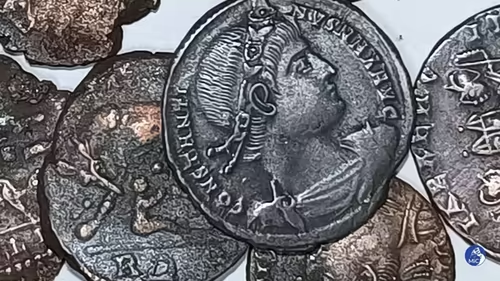
What makes the Sardinian find so extraordinary is its sheer scale. With an estimated 30,000 to 50,000 coins, it dwarfs most other known hoards from this era [[1]]. The coins themselves are primarily bronze folles, a common denomination during the late Empire, minted under various emperors of the 4th century AD [[6]]. Their excellent state of preservation, thanks to the protective layer of seabed sediment, provides a pristine snapshot of the period’s numismatic art and imperial propaganda.
What the Coins Reveal About the Roman Empire
These aren’t just pieces of metal; they are tiny time capsules. Each coin is a miniature work of art, bearing the image and name of the ruling emperor, along with symbols of power, deities, and imperial achievements. By studying the specific emperors represented and the mints where the coins were produced, historians can piece together a detailed picture of the political and economic landscape of the time.
The presence of such a vast quantity of 4th-century Roman coins in Sardinian waters speaks volumes about the island’s strategic importance in the late Roman world. Sardinia was a crucial hub for maritime trade routes connecting Italy, North Africa, and the western Mediterranean. This hoard likely belonged to a merchant ship or a state treasury vessel that met its end in a storm or a pirate attack, sinking its valuable cargo to the seafloor [[2]].
The Mystery of the Sunken Treasure
One of the biggest questions surrounding the late Roman hoard is how it ended up on the seabed. Was it part of a shipwreck? Or was it deliberately hidden in a coastal location that was later submerged due to geological changes? Archaeologists are meticulously mapping the site to search for any remnants of a ship’s structure, which would confirm the shipwreck theory [[5]].
Another intriguing aspect is the uniformity of the coins. The fact that they are all from the same general period suggests they were a single, consolidated payment or tax collection, rather than a personal savings stash accumulated over many years. This points to a significant, official transaction gone awry, offering a dramatic narrative of loss and forgotten wealth [[6]].
For those fascinated by ancient history, this discovery opens a new chapter. You can learn more about other significant Roman finds in our guide on [INTERNAL_LINK:roman-archaeological-discoveries]. To understand the broader context of the Roman Empire’s decline, the Encyclopaedia Britannica’s entry on ancient Rome is an excellent resource.
Conclusion: A Window into Antiquity
The discovery of the world’s largest late Roman hoard near Arzachena is far more than a sensational news story. It is a profound scientific event that will fuel research and debate for years to come. It reminds us that the Mediterranean Sea still holds countless secrets from antiquity, waiting to be discovered by a curious eye or a dedicated team of archaeologists. This incredible find not only adds a new chapter to Sardinia’s rich history but also provides invaluable data for understanding the complex final decades of one of the world’s greatest empires.
Sources
- [[1]] ArchaeoReporter: Exceptional Roman Coin Hoard Unearthed in Sardinian Waters
- [[2]] Earth.com: Amateur diver finds 50,000 coins from the 4th century hidden under the sand
- [[3]] Splash Travels: A scuba diver off the coast of Sardinia discovered a trove
- [[4]] Biblical Archaeology Society: Tens of Thousands of Roman Coins Discovered
- [[5]] Archaeology Magazine: Tens of thousands of ancient Roman bronze coins in Sardinia
- [[6]] CoinsWeekly: Archaeologists in Awe at the Sight of Sardinia’s Folles Hoard
- [[7]] Indian Defence Review: Diver Uncovers Biggest Treasure Ever Found in the Mediterranean Sea