Table of Contents
- The Controversial Claim That Shook Mumbai
- Sanjay Raut Mumbai Shutdown Threat: Context and History
- Fadnavis Strikes Back: ‘Empty Threats’ and Past Failures
- Why This Rhetoric Matters in Maharashtra’s Political Climate
- Public and Expert Reactions
- What Next for Mumbai’s Political Stability?
- Conclusion: A City Caught in a Power Struggle
- Sources
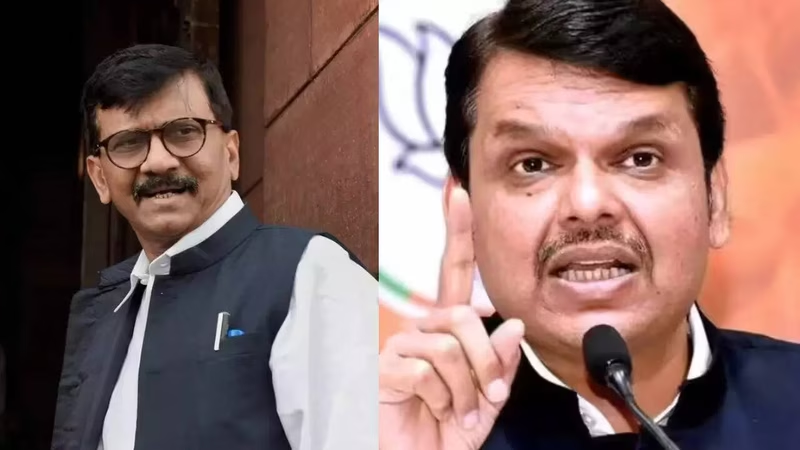
“We can shut down Mumbai in 10 minutes.” Those six words, spoken by Shiv Sena (UBT) MP Sanjay Raut, didn’t just echo through a press conference—they sent shockwaves across Maharashtra’s political ecosystem. In a defiant assertion of his faction’s street power, Raut called this ability “our biggest achievement.” But before the dust could settle, Chief Minister Devendra Fadnavis fired back, dismissing the statement as nothing more than an “empty threat” from a weakened opposition. What may seem like routine political posturing is, in fact, a flashpoint in an ongoing battle for control, legitimacy, and public perception in India’s financial capital.
The Controversial Claim That Shook Mumbai
Raut made the remark during a media interaction on January 11, 2026, while criticizing the current Maharashtra government led by the BJP-Shiv Sena (Shinde faction) alliance . He framed the alleged capacity to halt the city’s operations—not through violence, but through mass mobilization—as proof that the UBT (Uddhav Balasaheb Thackeray) faction still commands grassroots influence. “Even today, if we decide, Mumbai will come to a standstill in 10 minutes,” he declared, invoking the legacy of the original Shiv Sena’s famed ability to enforce bandhs (strikes) in the 1980s and 1990s . The comment was widely interpreted as both a warning and a nostalgic rallying cry to his base.
Sanjay Raut Mumbai Shutdown Threat: Context and History
To understand the weight of this statement, one must look back. For decades, the Shiv Sena built its identity on its unmatched organizational muscle in Mumbai—organizing transport strikes, shop closures, and street protests that could bring India’s busiest metropolis to its knees. This “bandh culture” was central to its political strategy . However, since the party’s 2022 split, the UBT faction has struggled to replicate that dominance. Recent attempts to protest Chief Minister Eknath Shinde’s return to Mumbai after key political events have largely fizzled, with minimal public participation and swift police intervention . Raut’s latest claim appears to be an effort to reclaim that lost aura of invincibility.
Fadnavis Strikes Back: ‘Empty Threats’ and Past Failures
Chief Minister Devendra Fadnavis wasted no time in countering Raut’s bravado. In a sharp retort, Fadnavis stated, “I am not afraid of empty threats,” directly challenging the UBT’s current clout . He reminded the public of recent failed attempts by the UBT to disrupt normalcy, particularly referencing their inability to stop Shinde’s convoy or mobilize significant crowds during previous demonstrations. “Their strength is in social media posts, not on the streets,” Fadnavis quipped, underscoring the government’s confidence in its administrative control and public support . This exchange isn’t just personal—it’s a calculated narrative battle ahead of upcoming local elections.
Why This Rhetoric Matters in Maharashtra’s Political Climate
This verbal duel carries high stakes for several reasons:
- Legitimacy Battle: Both factions of Shiv Sena are vying to be seen as the “real” heir to Bal Thackeray’s legacy. Street power is a key metric.
- Public Perception: Citizens are weary of disruptions. Rhetoric about shutting down Mumbai may alienate voters who prioritize stability over symbolism.
- Law and Order Narrative: The BJP-led government wants to project itself as the guardian of peace and progress, contrasting itself with “chaos-mongering” opponents.
- Election Strategy: With municipal polls on the horizon, both sides are testing narratives that could sway urban voters.
The tension reflects a deeper anxiety within the UBT about its declining relevance, while the ruling alliance seeks to cement its image as the city’s protector.
Public and Expert Reactions
On social media, reactions were polarized. Supporters of UBT hailed Raut’s statement as a “wake-up call” to the establishment, while critics labeled it “irresponsible” and “anti-Mumbai.” Political analysts noted the irony: in an era where digital activism often replaces physical mobilization, invoking the specter of a city-wide shutdown feels increasingly anachronistic . As Dr. Anjali Sharma, a political scientist at TISS, observed, “Threatening to shut down Mumbai in 2026 is less a show of strength and more a sign of desperation.” Meanwhile, business leaders expressed concern, fearing any disruption could impact investor confidence in the state’s economy—a point explored further in our [INTERNAL_LINK:maharashtra-economic-outlook-2026] report.
What Next for Mumbai’s Political Stability?
While a full-scale shutdown seems unlikely given current ground realities, the mere invocation of such tactics keeps tensions simmering. The Mumbai Police have reportedly increased surveillance around key UBT offices, and civic authorities are on alert. More importantly, the central question remains: can the UBT translate online outrage into offline action? If they attempt a symbolic protest and fail again, it could further erode their credibility. Conversely, if they succeed in even a minor disruption, it might embolden them for larger confrontations.
Conclusion: A City Caught in a Power Struggle
The Sanjay Raut Mumbai shutdown threat is far more than hot air—it’s a symptom of a fractured political identity and a desperate bid for relevance. While CM Fadnavis rightly points to past failures as evidence of diminished influence, the underlying message is clear: the battle for Mumbai’s soul is far from over. For residents, the hope is that this war of words doesn’t spill onto the streets, disrupting lives and livelihoods in a city that has already endured enough political turbulence. As Maharashtra watches, one truth endures: in politics, perception is often more powerful than reality.