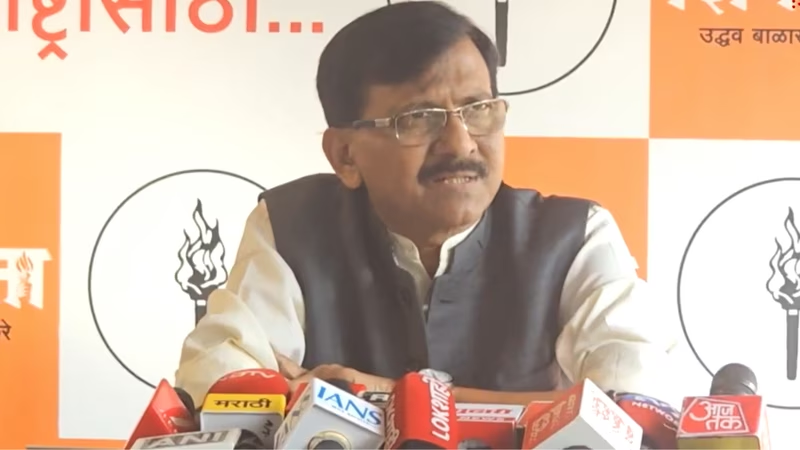
In a sharp escalation of political hostilities ahead of the crucial Brihanmumbai Municipal Corporation (BMC) elections, Shiv Sena (UBT) MP Sanjay Raut has fired a rhetorical missile at Maharashtra Chief Minister Eknath Fadnavis: “Is your CM not capable?”
Raut’s jibe—delivered with trademark sarcasm—comes in response to the BJP’s reported strategy to deploy Prime Minister Narendra Modi and Uttar Pradesh CM Yogi Adityanath for campaigning in Mumbai’s civic polls. For Raut, this reliance on national heavyweights for a *local* election is not just overkill—it’s a damning admission of weakness at the state level. And it’s sparking a fierce debate about leadership, regional pride, and political desperation in India’s financial capital.
Table of Contents
- Sanjay Raut Fadnavis BMC Face-Off: Explained
- Why Is BJP Calling PM Modi and Yogi for BMC Polls?
- Raut’s Attack on Shinde: BJP Seat-Sharing as “Betrayal of Marathi Pride”
- The Stakes: BMC Elections and Maharashtra’s Political Future
- Historical Context: BJP-Shiv Sena Alliances and Fallouts
- Broader Implications: National Leaders in Local Polls
- Conclusion: A Battle for Mumbai’s Soul
- Sources
Sanjay Raut Fadnavis BMC Face-Off: Explained
At the heart of this controversy is a simple but loaded question from Raut: if Maharashtra’s own Chief Minister, Eknath Fadnavis, is so competent, why does the BJP need to parachute in PM Modi and UP CM Yogi Adityanath to win a municipal election in Mumbai?
For Raut—and the Shiv Sena (UBT)—this move signals that the BJP lacks confidence in its state leadership. “Sanjay Raut Fadnavis BMC” has now become more than a headline—it’s a symbol of the deepening rift between regional identity and centralized campaign strategies.
“Does the BJP not trust its own CM?” Raut reportedly asked, highlighting what he sees as an insult to Maharashtra’s political autonomy. This line of attack aims to frame the BJP as an outsider force propping up a failing local administration.
Why Is BJP Calling PM Modi and Yogi for BMC Polls?
The BMC, often called the “mini-Maharashtra” due to its massive budget (₹50,000+ crore annually) and administrative complexity, is India’s richest civic body. Control over it means influence over urban development, housing, infrastructure, and public services for over 12 million Mumbaikars.
After losing ground in recent state elections and facing stiff competition from both factions of Shiv Sena—UBT and Shinde—the BJP appears to be pulling out all stops. Bringing in Modi and Yogi serves multiple purposes:
- Brand Modi Effect: Leverages the PM’s nationwide popularity to energize the base.
- Hindutva Consolidation: Yogi’s presence reinforces the BJP’s core ideological messaging.
- Countering UBT’s Narrative: Aims to drown out Raut’s “Mumbai for Mumbaikars” rhetoric.
However, as political analysts from the Center for South Asian Studies note, over-reliance on national figures in local elections can backfire—alienating voters who prioritize hyperlocal issues like water supply, waste management, and road repairs over grand national narratives.
Raut’s Attack on Shinde: BJP Seat-Sharing as “Betrayal of Marathi Pride”
Raut didn’t stop at Fadnavis. He also launched a scathing critique of CM Eknath Shinde’s faction of Shiv Sena, accusing it of “compromising” on fair seat-sharing with the BJP in the BMC polls.
“They have surrendered our Marathi pride at the altar of power,” Raut declared, calling the alliance with BJP a “misfortune for the people of Maharashtra.” This rhetoric taps into Shiv Sena’s original 1960s ideology of “sons of the soil,” which prioritized Marathi identity and local empowerment.
By painting Shinde as a BJP puppet, UBT hopes to reclaim its legacy as the true guardian of Marathi interests—a narrative it’s pushing hard in [INTERNAL_LINK:shiv-sena-ideology-evolution].
The Stakes: BMC Elections and Maharashtra’s Political Future
The BMC polls are widely seen as a bellwether for the 2029 Maharashtra Assembly elections. A strong BJP-Shinde win could cement their hold, while a UBT resurgence might signal a comeback for the original Sena ideology.
Moreover, Mumbai’s civic health is deteriorating—flooding during monsoons, crumbling infrastructure, and rising cost of living have made voters deeply dissatisfied. The party that addresses these issues with concrete plans, not just star campaigners, may have the edge.
Historical Context: BJP-Shiv Sena Alliances and Fallouts
This isn’t the first time BJP and Shiv Sena have clashed over strategy. Their 25-year alliance collapsed dramatically in 2019, leading to years of political instability. The 2022 split—when Shinde broke away with rebel MLAs—further fractured the Sena brand.
Raut’s current attack is both a tactical move and an ideological reassertion: to remind voters that Shiv Sena (UBT), not the Shinde faction, remains the authentic voice of Marathi aspirations.
Broader Implications: National Leaders in Local Polls
Raut’s criticism raises a valid democratic concern: should national leaders routinely intervene in municipal elections?
While it’s common in India’s high-stakes political theater, experts argue it undermines grassroots leadership. When a CM can’t win a city poll without the PM, it suggests a crisis of local credibility—a dangerous trend for federalism.
Conclusion: A Battle for Mumbai’s Soul
Sanjay Raut’s barb—“Is your CM not capable?”—is more than a political jab. It’s a challenge to the BJP’s entire strategy in Maharashtra. As the Sanjay Raut Fadnavis BMC war intensifies, Mumbaikars are left to decide: do they want their civic future shaped by local leaders who understand their streets, or by national icons parachuted in for photo ops?
One thing is clear: in a city that never sleeps, the fight for its soul is just heating up.