Table of Contents
- The Controversial Claim That Shook Indian Cricket Fans
- What Exactly Is the World Cup Theory?
- Manjrekar’s Full-Throated Defense of Coach Gautam Gambhir
- Do Bilateral ODIs Really Not Matter? The Data Says…
- Historical Precedents: Teams That Lost Series But Won World Cups
- Fan Reaction and the Social Media Backlash
- Why This Mindset Might Be Right for the 2027 ODI World Cup
- Conclusion
- Sources
The Controversial Claim That Shook Indian Cricket Fans
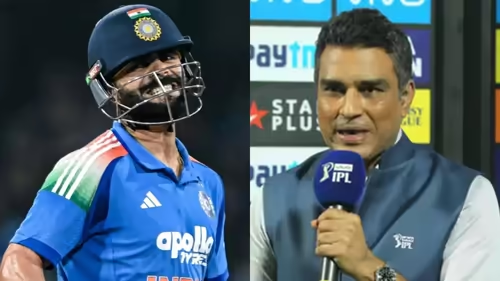
Indian cricket fans are still reeling from the national team’s 2-1 ODI series loss to New Zealand at home—a result that felt jarring given India’s recent dominance. But before the outrage could fully settle, veteran commentator and former cricketer Sanjay Manjrekar dropped a bombshell take that divided the nation: “You’ll struggle to remember this series in a few months.”
In a bold post-match analysis, Manjrekar didn’t just downplay the defeat—he dismissed the entire significance of bilateral ODI series in the modern era. His comments, made while defending new head coach Gautam Gambhir, have ignited a fierce debate about what truly matters in international cricket today .
What Exactly Is the World Cup Theory?
At the heart of Manjrekar’s argument is what he calls the “World Cup theory.” Simply put, he believes that in contemporary 50-over cricket, only ICC World Cups carry lasting weight. Everything else—bilateral tours, tri-series, even high-profile rivalries—are essentially “practice matches” with minimal long-term consequence.
“The real judgment of a team, its coach, and its captain happens only at World Cups,” Manjrekar stated. “Everything else is noise. You can lose ten bilateral series, but if you win the World Cup, you’re heroes. Lose the World Cup, and no one cares how many series you won before it.”
Why Now?
This philosophy isn’t just philosophical—it’s strategic. With the next ODI World Cup scheduled for 2027 in South Africa, Zimbabwe, and Namibia, Manjrekar argues that the current Indian setup under Gambhir is wisely using these “low-stakes” series to experiment, assess fringe players, and build resilience without the pressure of a trophy on the line.
Manjrekar’s Full-Throated Defense of Coach Gautam Gambhir
Manjrekar’s comments were also a direct shield for Gautam Gambhir, who faced immediate criticism following the series loss. As a rookie coach with a reputation for intensity and discipline, Gambhir’s methods are under scrutiny. But Manjrekar insists that judging him on a three-match ODI series is premature and misguided.
“Gambhir is building something for 2027, not for January 2026,” he explained. “He’s giving chances to young batters, testing combinations, and seeing how players handle pressure in unfamiliar roles. That’s far more valuable than winning a dead-rubber series against a strong New Zealand side.”
Do Bilateral ODIs Really Not Matter? The Data Says…
While Manjrekar’s view may seem extreme, there’s data to support his stance. Since the 2015 World Cup, the ICC has drastically reduced the number of bilateral ODI series, prioritizing T20 leagues and Test cricket. Many top teams now play fewer than 10 ODIs a year outside of World Cup cycles .
Moreover, the ICC ODI rankings—once a major benchmark—are now largely ignored by fans and media alike. What captures global attention? Only the World Cup. For example, England lost multiple ODI series in 2018 and early 2019 but went on to win the 2019 World Cup on home soil. Today, few remember those losses—but everyone remembers their triumph.
Historical Precedents: Teams That Lost Series But Won World Cups
History is full of examples that validate the World Cup theory:
- Australia (2015): Lost an ODI series to Pakistan in the UAE just months before winning the World Cup.
- India (2011): Suffered a 3-2 defeat in South Africa in early 2011, then lifted the World Cup in Mumbai two months later.
- England (2019): As mentioned, their pre-tournament form was inconsistent, yet they peaked at the right time.
These cases show that peaking during the World Cup—not maintaining year-round dominance—is the ultimate goal in ODI cricket.
Fan Reaction and the Social Media Backlash
Not everyone is buying Manjrekar’s argument. On social media, fans have slammed the “elitist” and “dismissive” tone of his comments. “Tell that to the players who gave their all,” one user tweeted. Others argue that consistent performance builds confidence and should never be trivialized.
Still, a significant portion of the audience agrees with his long-view approach. Many point out that overreacting to every loss creates a toxic environment that stifles player development—a problem India has struggled with for years. This nuanced debate reflects the evolving mindset of a new generation of cricket followers.
Why This Mindset Might Be Right for the 2027 ODI World Cup
Looking ahead, Manjrekar’s perspective could prove prescient. The 2027 World Cup will be played on African pitches—conditions vastly different from India’s. Using current bilateral series to test spin-heavy attacks, promote aggressive openers, or blood uncapped talents like Raj Bawa or Siddharth Yadav makes perfect sense .
Rather than chasing short-term wins, the focus should be on building a squad that can adapt, survive, and dominate in unfamiliar territory. As Manjrekar puts it: “You don’t win World Cups by being perfect in January. You win them by being ready in October.” For more on India’s 2027 roadmap, see our deep dive on [INTERNAL_LINK:india-2027-world-cup-strategy].
Conclusion
Sanjay Manjrekar’s “World Cup theory” may ruffle feathers, but it’s rooted in a pragmatic understanding of modern cricket’s priorities. While fans naturally crave victory in every match, the reality is that legacy is written in World Cups—not bilateral series. By defending Gautam Gambhir and urging patience, Manjrekar is advocating for a strategic, long-term vision that could pay massive dividends in 2027. Whether you agree or not, one thing is clear: in the high-stakes world of international cricket, context is everything.
Sources
[1] Times of India. “‘You’ll struggle to remember’: Manjrekar explains ‘WC’ theory; backs Gambhir”.
[2] International Cricket Council (ICC). “Future Tours Programme & ODI Status Guidelines”. https://www.icc-cricket.com/
[3] ESPNcricinfo. “India’s Next Generation: Young Talents to Watch for 2027”.