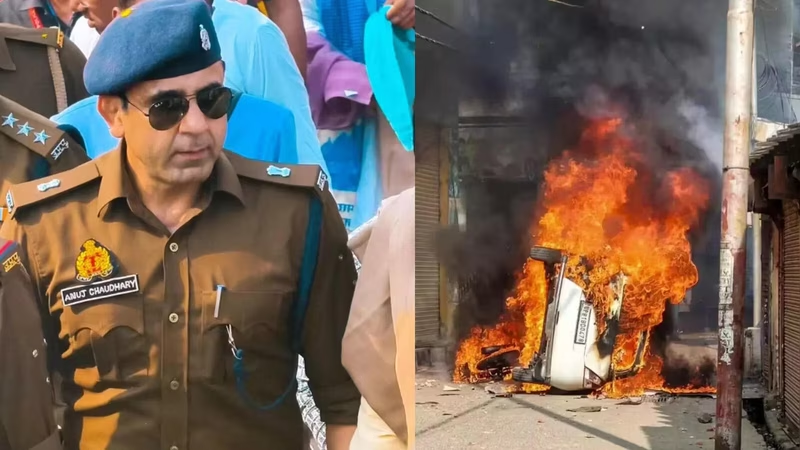
In a dramatic escalation of the long-simmering Sambhal controversy, a local court has ordered the registration of an FIR against 12 police personnel—including a former Circle Officer (CO) and Station House Officer (SHO)—for their alleged involvement in the fatal shooting during the November 2024 survey of the Shahi Jama Masjid. But instead of swift action, the order has been met with outright defiance from the Uttar Pradesh police brass, who have labeled it “illegal” and announced plans to challenge it in a higher court . This unprecedented standoff between the judiciary and law enforcement has reignited fierce debate over police accountability and the rule of law in India.
Table of Contents
- The November 2024 Sambhal Clash: A Recap
- Sambhal Case FIR Against Cops: The Court’s Directive
- Police Pushback: Why They Call It ‘Illegal’
- The Legal Tug-of-War: Judicial Inquiry vs. Magistrate Order
- Broader Implications for Police Accountability in India
- Conclusion: A Test for India’s Legal System
- Sources
The November 2024 Sambhal Clash: A Recap
The roots of this current crisis lie in a tense and tragic event on November 25, 2024. Officials from the Archaeological Survey of India (ASI) arrived at the historic Shahi Jama Masjid in Sambhal, Uttar Pradesh, to conduct a survey—a move that was met with immediate protest from local residents who feared it could be a precursor to a legal challenge over the mosque’s ownership . What began as a peaceful gathering quickly escalated into a violent clash. In the ensuing chaos, police opened fire, resulting in the deaths of six civilians and injuries to dozens more. The incident sent shockwaves across the nation and triggered multiple investigations.
Sambhal Case FIR Against Cops: The Court’s Directive
Following a petition by victims’ families, a Sambhal court, after reviewing evidence and witness statements, concluded there was sufficient ground to proceed against the police officers involved. The court’s order specifically directs the filing of an FIR under serious charges, including murder and attempted murder, against the 12 named officials . This is a rare and significant judicial intervention, as courts typically defer to police discretion in such matters. The order underscores the magistrate’s view that the use of lethal force may have been disproportionate and unjustified.
Police Pushback: Why They Call It ‘Illegal’
The Uttar Pradesh police’s response has been swift and defiant. Senior police officials, including the Superintendent of Police (SP), have publicly stated they will not comply with the court’s directive. Their primary argument rests on a prior investigation: a one-man judicial inquiry commission, headed by a retired judge, had already examined the incident and exonerated the police, concluding their actions were in self-defense and necessary to control a riotous mob .
The police contend that the magistrate’s order is “illegal” because it contradicts the findings of this higher-level judicial body and infringes upon the executive’s domain of conducting probes. They argue that the matter is already sub judice and that a parallel FIR would create legal chaos.
The Legal Tug-of-War: Judicial Inquiry vs. Magistrate Order
This situation presents a complex legal conundrum. On one side is the finding of a dedicated judicial inquiry commission, which carries significant weight. On the other is the statutory power of a local magistrate under Section 156(3) of the Code of Criminal Procedure (CrPC), which allows them to direct the police to register an FIR if they are satisfied that a cognizable offense has been committed .
Legal experts are divided. Some argue that the magistrate’s power is independent and cannot be overridden by an administrative inquiry, no matter how high-level. Others suggest that the police have a valid point about conflicting judicial findings and that the High Court is the appropriate forum to resolve this contradiction. The police have announced their intention to file a writ petition in the Allahabad High Court to quash the magistrate’s order .
Broader Implications for Police Accountability in India
Beyond the legal technicalities, the Sambhal case FIR against cops standoff touches on a much deeper and more systemic issue: the chronic lack of accountability within India’s police forces. Instances of alleged excessive force often result in internal inquiries that clear the officers involved, leaving victims and their families without justice .
This case has become a flashpoint. If the court’s order is ultimately enforced, it could set a powerful precedent for holding law enforcement accountable through the judicial system. Conversely, if the police successfully defy the order, it could reinforce a perception of impunity and weaken public trust in the judiciary’s ability to check executive power.
Conclusion: A Test for India’s Legal System
The battle over the Sambhal case FIR against cops is far more than a local dispute; it’s a critical test of India’s democratic institutions. It pits the independence of the lower judiciary against the authority of the executive and a higher-level inquiry. The outcome will send a clear message about whether the law applies equally to everyone, including those entrusted with enforcing it. As the case moves to the High Court, the entire nation will be watching to see which principle prevails: the rule of law or institutional resistance.
Sources
- Supreme Court of India – Landmark Judgments on Police Accountability: https://main.sci.gov.in/
- The Times of India – City News (Bareilly/Sambhal): https://timesofindia.indiatimes.com/city/bareilly
- [INTERNAL_LINK:uttar-pradesh-crime-news]
- [INTERNAL_LINK:indian-judiciary-explained]