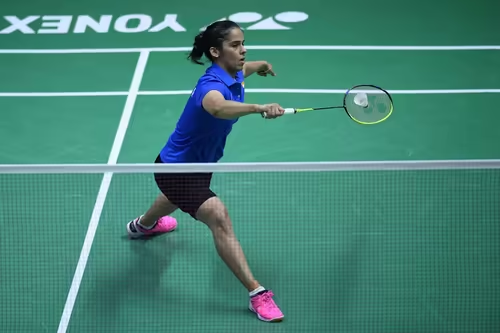
“I can’t do it anymore.”
With those five quiet words, Saina Nehwal closed the final chapter of one of Indian sport’s most storied careers. At 35, the nation’s first Olympic badminton medallist has officially announced her Saina Nehwal retirement, not with fanfare or a farewell match, but with raw honesty about a body that simply couldn’t keep up with the demands of elite competition.
The culprit? A chronic knee condition—worsened by a devastating injury during the 2016 Rio Olympics—that evolved into degenerative arthritis. Despite surgeries, rehabilitation, and sheer willpower, the pain became unbearable. The court, once her kingdom, became a place of limitation.
But while her playing days are over, her impact is far from finished. Let’s honor her journey—not just as an athlete, but as a trailblazer who changed the game for millions of Indian girls who dared to dream.
Table of Contents
- Who Is Saina Nehwal?
- The Rise of India’s Badminton Pioneer
- Saina Nehwal Retirement: The Knee Injury That Ended a Career
- Career Highlights: A Legacy in Points and Pride
- Why Her Retirement Matters for Indian Sports
- What Next for Saina Nehwal?
- Conclusion: More Than a Medal
- Sources
Who Is Saina Nehwal?
Born in Hisar, Haryana, in 1990, Saina Nehwal was introduced to badminton by her father, a former national-level player. Trained under legendary coach Pullela Gopichand at the Gopichand Badminton Academy in Hyderabad, she quickly rose through the ranks with a fierce backhand, relentless footwork, and unmatched mental toughness.
She wasn’t just talented—she was transformative. Before Saina, women’s badminton in India was largely overlooked. She made it mainstream.
The Rise of India’s Badminton Pioneer
Saina’s breakthrough came in 2008 when, at just 18, she won the World Junior Championships. But her true arrival on the global stage was the 2012 London Olympics, where she clinched the bronze—the first-ever Olympic medal in badminton for India .
That moment did more than win a medal; it ignited a generation. Suddenly, badminton academies across small towns saw enrollment surge. Parents began seeing shuttlecocks as pathways to glory.
Saina Nehwal Retirement: The Knee Injury That Ended a Career
The turning point came during the 2016 Rio Olympics. In her quarterfinal match against Carolina Marín, Saina collapsed mid-rally, clutching her right knee. She had torn a ligament but played on—finishing the match in tears. Though she lost, her courage became iconic.
What followed was a slow, painful decline. Multiple surgeries, stem cell therapy, and months of rehab offered temporary relief, but the damage was cumulative. By 2023, she hadn’t competed professionally. In her own words: “My knee has arthritis… I can’t train like I used to. The body says no” .
Unlike many athletes who retire after a final tournament, Saina chose silence. No press conference. No farewell tour. Just peace. And that, in itself, speaks volumes about her character.
Career Highlights: A Legacy in Points and Pride
Saina’s trophy cabinet tells a story of dominance:
- Olympic Bronze Medal (2012) – First Indian in badminton to win Olympic hardware.
- World No. 1 Ranking (2015) – Became the first Indian woman to achieve the top spot in BWF rankings.
- 5 International Superseries Titles – Including wins in Indonesia, China, and India.
- Commonwealth Games Gold (2010) – Led India to team gold in Delhi.
- Padma Bhushan (2016) – India’s third-highest civilian award.
But beyond stats, she redefined what was possible for female athletes in a country still grappling with gender equity in sports.
Why Her Retirement Matters for Indian Sports
Saina’s exit marks the end of an era—but also a critical inflection point. She paved the way for stars like P.V. Sindhu and Lakshya Sen. Yet, her retirement also highlights a systemic issue: the lack of long-term injury management and athlete welfare in Indian sports.
According to a 2022 study by the Sports Authority of India, over 60% of elite athletes suffer career-altering injuries without adequate post-career transition support . Saina’s quiet departure underscores the need for better medical infrastructure, insurance, and mental health resources for retiring athletes.
What Next for Saina Nehwal?
While she hasn’t revealed concrete plans, Saina has expressed interest in mentoring young players and possibly entering sports administration. She’s also active in promoting fitness and women’s empowerment through [INTERNAL_LINK:women-in-sports-india].
Given her influence, a formal role in shaping India’s badminton policy—or even leading a national academy—would be a natural next step.
Conclusion: More Than a Medal
The Saina Nehwal retirement isn’t just the end of a career—it’s the closing of a foundational chapter in Indian sports history. She didn’t just win matches; she won respect, visibility, and opportunity for countless others.
Her legacy won’t be measured in titles alone, but in the millions of girls who now pick up a racket and believe they, too, can stand on an Olympic podium. For that, India owes her more than applause—it owes her gratitude.
Sources
- Times of India: ‘I can’t do it anymore’: Saina Nehwal announces retirement
- Olympics.com: Saina Nehwal – Olympic Profile
- Sports Authority of India (SAI): Annual Report on Athlete Welfare
- BWF World Rankings Archive: Historical Rankings