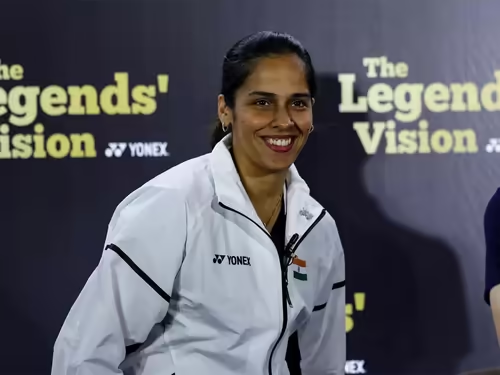
It’s the news every Indian sports fan hoped wouldn’t come—but knew was inevitable. Saina Nehwal retirement is now official. At 35, the woman who redefined Indian badminton, shattered glass ceilings, and gave the nation its first-ever Olympic medal in the sport has hung up her racquet .
In a heartfelt statement, Saina cited a persistent and debilitating knee condition that no longer allows her to compete at the elite level she once dominated. But while her competitive journey ends, her legacy burns brighter than ever—a beacon for every young athlete dreaming of Olympic glory.
Table of Contents
- An Emotional Goodbye: Tears, Gratitude, and Goosebumps
- The 2012 Olympic Moment That Changed Everything
- Career Highlights: A Legacy Written in Gold (and Bronze)
- Why She Retired: The Toll of a Chronic Knee Injury
- What’s Next for Saina? Beyond the Court
- The Future of Indian Badminton: Passing the Torch
- Conclusion: More Than a Player—A Pioneer
- Sources
An Emotional Goodbye: Tears, Gratitude, and Goosebumps
“Those goosebumps will never fade,” Saina said in her exclusive interview with the Times of India, referring to the roar of the crowd during her historic matches . Her voice trembled—not from pain, but from deep emotion—as she thanked fans, coaches, family, and even rivals who pushed her to be better.
This wasn’t just a retirement announcement; it was a love letter to a sport that shaped her life. She spoke of sleepless nights before big matches, the pressure of being India’s hope, and the quiet pride of knowing she paved the way for others. “I gave everything I had,” she said simply. And indeed, she did.
The 2012 Olympic Moment That Changed Everything
When Saina Nehwal stepped onto the court at the London 2012 Olympics, she wasn’t just playing for a medal—she was carrying the hopes of a billion people. On August 4, 2012, she defeated China’s Wang Xin to claim the bronze, etching her name into history as the first Indian to win an Olympic medal in badminton .
That moment did more than win a medal—it ignited a badminton revolution in India. Suddenly, shuttlecocks were flying in small towns and metro academies alike. Parents saw badminton not just as a hobby, but as a viable path to global glory. Saina’s success directly inspired the rise of players like P.V. Sindhu, who would go on to win silver in Rio 2016 and bronze in Tokyo 2020 .
For context, before Saina, India had never won a single Olympic medal in badminton since the sport’s inclusion in 1992. Her achievement was a seismic shift—a proof point that Indians could compete and win on the world’s biggest stage.
Career Highlights: A Legacy Written in Gold (and Bronze)
Beyond the Olympics, Saina’s trophy cabinet reads like a masterclass in consistency and grit:
- World No. 1 Ranking (2015): She became the first Indian woman to achieve the world No. 1 spot in women’s singles .
- Commonwealth Games Gold (2010): Dominated in Delhi, bringing home gold in front of a home crowd.
- Two-time Olympian: Competed in London 2012 (bronze) and Rio 2016.
- Over 24 International Titles: Including the Indonesia Open Super Series (2012), a rare feat for any non-Asian player at the time.
- Arjuna Award, Padma Shri, and Rajiv Gandhi Khel Ratna: India’s highest sporting honors.
Her rivalry with China’s Li Xuerui and Thailand’s Ratchanok Intanon wasn’t just about points—it was about proving that Indian athletes belonged at the top table.
Why She Retired: The Toll of a Chronic Knee Injury
Saina’s decision didn’t come lightly. For years, she battled a chronic knee condition that required multiple surgeries and endless rehabilitation sessions. Despite her determination, the body eventually said enough.
“I can’t train the way I used to. I can’t move like I used to,” she admitted . In modern badminton—where speed, agility, and explosive lunges are non-negotiable—even a slight physical limitation can be the difference between victory and defeat. Rather than compete at half-capacity, Saina chose to walk away with her dignity and legacy intact—a decision many admire.
What’s Next for Saina? Beyond the Court
Don’t expect Saina to disappear from public life. She’s hinted at roles in sports administration, mentoring young talent, and possibly even politics—following in the footsteps of other Indian sports icons. She’s also been vocal about improving sports infrastructure and mental health support for athletes .
[INTERNAL_LINK:future-of-indian-sports] could very well see her as a key architect, using her experience to shape policy and funding for grassroots programs.
The Future of Indian Badminton: Passing the Torch
Saina’s retirement closes one chapter—but the story continues. Today, India boasts a deep bench of talent: Lakshya Sen, Kidambi Srikanth, P.V. Sindhu, and rising stars like Anmol Kharb are all products of the ecosystem Saina helped create.
According to the Badminton World Federation (BWF), India now ranks among the top 5 nations for producing elite-level players—a stark contrast to the early 2000s . This transformation didn’t happen by accident. It started with one girl from Hyderabad who refused to accept limits.
Conclusion: More Than a Player—A Pioneer
The Saina Nehwal retirement is not just the end of a career; it’s the closing of a foundational era in Indian sports. She didn’t just win medals—she changed mindsets. She proved that with discipline, courage, and relentless hard work, an Indian woman could stand tall on the Olympic podium.
As she steps away from the court, her message is clear: “Keep dreaming. Keep fighting.” And for millions of young athletes across the country, those words—and that legacy—will echo far longer than any match score.
Sources
- Times of India: Saina Nehwal exclusive: ‘Those goosebumps will never fade’ — Olympic glory & emotional goodbye
- Badminton World Federation (BWF): Official Rankings and Tournament Archives
- Olympics.com: Saina Nehwal – Athlete Profile