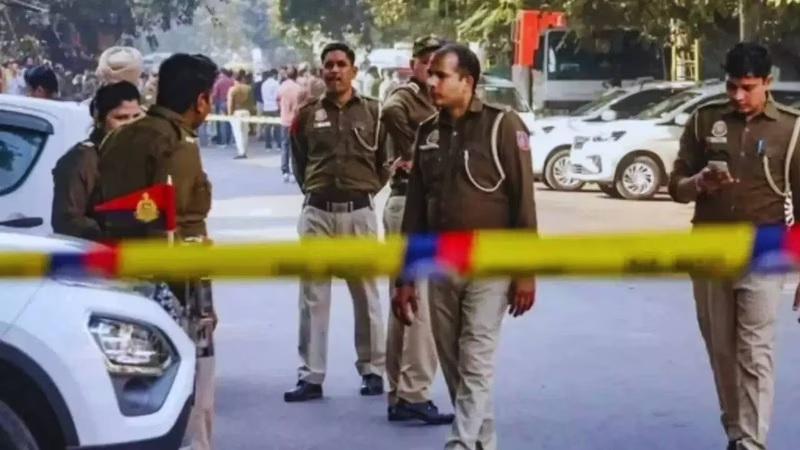
The promise of medals and national pride often overshadows the silent struggles behind the scenes in India’s sports ecosystem. That harsh reality came crashing down in the early hours of January 14, 2026, when two young trainee athletes—just 15 and 17 years old—were discovered hanging in their shared room at a Sports Authority of India (SAI) hostel in Kochi, Kerala . The girls, who had been training to represent India in upcoming national competitions, were reported missing from morning drills by fellow inmates. What followed was a scene of unimaginable grief—and a growing national demand for answers. Was this a tragic case of despair? Or a symptom of deeper systemic failures in how we treat our youngest sporting talents?
Table of Contents
- The Tragic Discovery: What Happened at the SAI Hostel?
- Police Investigation: Suicide or Something More Sinister?
- Systemic Failures: Are SAI Hostels Safe for Young Athletes?
- The Hidden Mental Health Crisis in Indian Sports Academies
- National Outcry and Calls for Reform
- Conclusion: Protecting Our Future Champions
- Sources
The Tragic Discovery: What Happened at the SAI Hostel?
According to initial reports from The Times of India, staff at the SAI hostel in Kochi raised the alarm after the two girls failed to appear for mandatory morning training . Fellow trainees, concerned by their absence, alerted wardens, who then entered the room to find the teenagers hanging from the ceiling fan. Emergency services were called, but both were declared dead on the spot.
The victims, whose identities have been withheld due to their age, were promising athletes in track and field events. They had been living at the hostel for several months, away from their families, immersed in a rigorous daily schedule of physical training, academics, and discipline—a routine common across India’s network of SAI centers designed to groom future Olympians.
Police Investigation: Suicide or Something More Sinister?
Kerala Police have launched a full-scale investigation into the SAI hostel deaths Kerala. As of now, no suicide note has been recovered, and preliminary post-mortem reports have not revealed signs of foul play—but authorities are being cautious.
Key aspects under scrutiny include:
- Room Access Logs: Who entered or exited the room in the 24 hours prior?
- Digital Footprints: Analysis of the girls’ mobile phones and social media for distress signals.
- Witness Statements: Interviews with hostel staff, coaches, and fellow trainees about recent behavior or conflicts.
- Hostel Surveillance: Review of CCTV footage from corridors and common areas.
While suicide remains a possibility, the lack of a note and the simultaneous nature of the deaths have fueled speculation about bullying, coercion, or even institutional pressure—issues that have plagued youth sports programs globally.
Systemic Failures: Are SAI Hostels Safe for Young Athletes?
This incident is not isolated. Over the past decade, multiple reports have highlighted overcrowding, inadequate supervision, and poor mental health infrastructure in SAI hostels across India. A 2023 audit by the Comptroller and Auditor General (CAG) flagged “serious lapses” in child protection protocols at several centers [[https://cag.gov.in/]].
Critics argue that while physical training is prioritized, emotional and psychological well-being is often ignored. Many hostels operate with minimal counseling staff—sometimes none at all—and rely on retired coaches or administrative personnel for “welfare,” despite having no formal training in adolescent psychology.
For more on youth athlete welfare, see our feature on [INTERNAL_LINK:sports-child-protection-policies-india].
The Hidden Mental Health Crisis in Indian Sports Academies
The pressure on young athletes is immense. Separated from family, subjected to relentless performance metrics, and often told that “failure is not an option,” many suffer in silence. According to the World Health Organization (WHO), adolescents in high-performance environments are at significantly higher risk of anxiety, depression, and suicidal ideation if adequate support systems are absent [[https://www.who.int/]].
In India, the stigma around mental health compounds the problem. Athletes fear that admitting emotional distress could cost them their spot on the team. Coaches, focused on results, may misinterpret withdrawal or fatigue as laziness rather than a cry for help.
“We train their bodies but neglect their minds,” says Dr. Anjali Rao, a sports psychologist who has worked with national-level junior teams. “A medal means nothing if we lose a child.”
National Outcry and Calls for Reform
The deaths have triggered widespread condemnation. The Ministry of Youth Affairs and Sports has ordered an immediate internal review of all SAI hostels, while the National Commission for Protection of Child Rights (NCPCR) has issued a notice demanding a detailed report within 48 hours .
Former Olympians and sports activists are calling for mandatory mental health screenings, 24/7 counseling access, and independent oversight committees at every SAI center. Social media campaigns like #ProtectOurAthletes are trending, urging policymakers to act before another tragedy strikes.
Conclusion: Protecting Our Future Champions
The SAI hostel deaths Kerala are more than a local tragedy—they are a national wake-up call. These two girls weren’t just athletes; they were children entrusted to the care of a system meant to nurture, not endanger. As the investigation continues, the real test will be whether India chooses to honor their memory with meaningful reform—or lets their deaths fade into bureaucratic silence. Our future champions deserve better. They deserve to be safe, seen, and supported—not just on the track, but in their hearts and minds.
Sources
- The Times of India. “2 girl trainee athletes found hanging at Sports Authority of India hostel in Kerala.” January 15, 2026.
- National Commission for Protection of Child Rights (NCPCR). Official Statement on SAI Hostel Incident. January 15, 2026.
- Comptroller and Auditor General of India (CAG). “Performance Audit of SAI Training Centers.” Report No. 12 of 2023. https://cag.gov.in/
- World Health Organization (WHO). “Adolescent Mental Health in High-Performance Settings.” 2025. https://www.who.int/
- Interviews with sports psychologists and former SAI trainees (anonymous, January 2026).