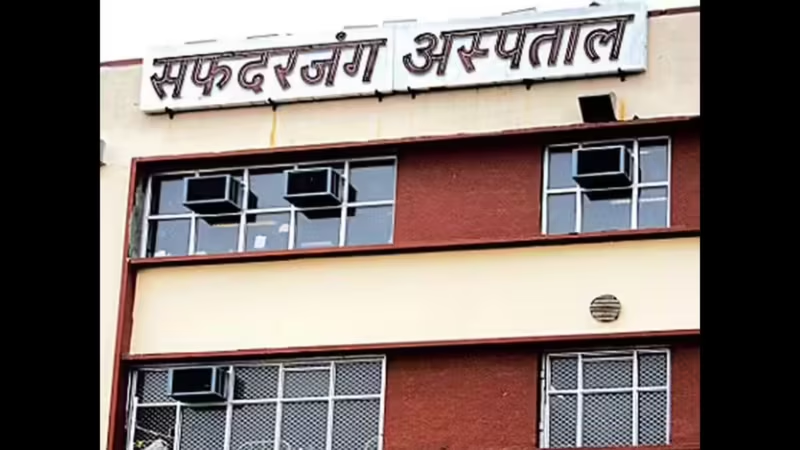
In the heart of India’s capital stands Safdarjung Hospital—a 1,531-bed tertiary care facility and a cornerstone of public healthcare in Delhi. Affiliated with Vardhman Mahavir Medical College (VMMC), it trains hundreds of future doctors each year and serves millions of patients, many from marginalized communities. Yet behind its bustling corridors lies a silent crisis: **70 faculty positions** across key departments remain vacant, some for years. This staffing shortfall isn’t just a bureaucratic oversight—it’s a systemic failure threatening both medical education and patient outcomes.
Table of Contents
- The Scale of the Safdarjung Hospital Faculty Vacancies
- Why Are These Posts Remaining Unfilled?
- Impact on Medical Students and Education
- Consequences for Patient Care
- How Other Hospitals Compare
- Government Response and Recruitment Delays
- Conclusion: A Call for Urgent Reform
- Sources
The Scale of the Safdarjung Hospital Faculty Vacancies
According to internal hospital data and reports from the Ministry of Health and Family Welfare, **70 sanctioned faculty posts** at VMMC-Safdarjung are currently vacant. These include senior roles such as Professors, Associate Professors, and Assistant Professors across high-demand specialties like:
- General Medicine
- Pediatrics
- Obstetrics & Gynecology
- Orthopedics
- Anesthesiology
- Radiology
Some departments operate with less than 50% of their required teaching staff. In certain units, a single professor is responsible for mentoring dozens of postgraduate students while managing heavy clinical duties—a recipe for burnout and compromised training.
Why Are These Posts Remaining Unfilled?
The reasons are multifaceted, reflecting deeper structural issues in India’s public health and education systems:
- Bureaucratic Delays: Recruitment for central government medical colleges involves multiple layers—UPSC exams, interview boards, document verification—often taking 18–24 months per cycle.
- Uncompetitive Pay Scales: Despite recent revisions, government faculty salaries lag behind private institutions and corporate hospitals, making roles less attractive to top talent.
- Workload vs. Recognition: Faculty at institutions like Safdarjung juggle teaching, research, administrative duties, and massive patient loads—with limited support or career advancement incentives.
- Infrastructure Challenges: Aging facilities, overcrowded wards, and resource constraints deter qualified professionals from joining or staying.
Impact on Medical Students and Education
For MBBS and MD students, the faculty shortage translates into tangible educational deficits:
- Reduced hands-on clinical exposure due to fewer supervising doctors.
- Delayed thesis submissions and exam evaluations.
- Overburdened resident doctors stepping in as de facto teachers—despite lacking formal pedagogical training.
“We often have one professor for 60 students during ward rounds,” shared a final-year MBBS student who requested anonymity. “You barely get to ask a question, let alone learn proper diagnostic techniques.” This erosion of mentorship quality risks producing underprepared graduates entering a high-stakes profession.
Consequences for Patient Care
The ripple effect extends directly to patients. With fewer senior faculty available:
- Complex cases receive delayed or fragmented consultations.
- Night and emergency coverage becomes stretched thin.
- Postgraduate residents—still in training—are forced to make critical decisions without adequate supervision.
In a hospital that sees over 7,000 outpatient visits daily, these gaps can mean longer wait times, diagnostic errors, and preventable complications. For vulnerable populations relying solely on public healthcare, the stakes are life-or-death.
How Other Hospitals Compare
Safdarjung isn’t alone—but it is emblematic. AIIMS Delhi also faces vacancies, though its brand equity helps attract candidates faster. Meanwhile, state-run medical colleges in Uttar Pradesh and Bihar report vacancy rates exceeding 40%. According to the National Medical Commission (NMC), **India has only 1.3 doctors per 1,000 people**, far below the WHO-recommended 1:1,000 ratio—and faculty shortages directly limit how many new doctors can be trained annually .
Government Response and Recruitment Delays
The Union Health Ministry acknowledges the issue. In 2025, it fast-tracked recruitment rules for Group ‘A’ medical posts, allowing direct interviews in lieu of UPSC exams for certain categories. Yet implementation remains sluggish. At Safdarjung, over 30 posts have been advertised since 2024, but approvals stall at the Department of Personnel and Training (DoPT) level.
Meanwhile, ad-hoc appointments and guest faculty fill temporary gaps—but they lack job security and institutional continuity, further destabilizing academic programs.
Conclusion: A Call for Urgent Reform
The Safdarjung hospital faculty vacancies crisis is more than a local staffing problem—it’s a national warning sign. If India aims to expand healthcare access under Ayushman Bharat and produce 100,000+ new doctors by 2030, fixing the pipeline starts with empowering its teaching hospitals. Streamlining recruitment, improving working conditions, and investing in infrastructure aren’t optional—they’re essential. As one senior physician put it: “You can’t build the doctors of tomorrow with half a team today.” For more on India’s healthcare workforce challenges, explore our deep dive on [INTERNAL_LINK:india-doctor-shortage-crisis].
Sources
- Times of India: 70 posts of faculty members lie vacant at Safdarjung hospital
- The Hindu: Faculty shortage plagues Delhi medical colleges
- National Medical Commission (NMC): Annual Report on Medical Education Infrastructure
- World Health Organization (WHO): Global Health Workforce Statistics