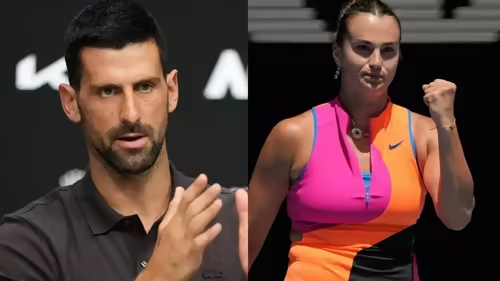
History was made on the hard courts of Melbourne—and it wasn’t just another routine win for Aryna Sabalenka. With a commanding 6-1, 7-6(5) victory over rising star Victoria Mboko in the Australian Open fourth round, the Belarusian powerhouse didn’t just book her spot in the quarterfinals. She shattered a long-standing Grand Slam record previously held by none other than Novak Djokovic.
Sabalenka’s second-set tiebreak marked her 20th consecutive Grand Slam tiebreak victory—surpassing Djokovic’s Open Era benchmark of 19 straight wins. The moment sent ripples through the tennis world, not least because of the reigning king of men’s tennis himself: Djokovic, ever the showman, responded with a mix of humor and admiration. “I’m upset right now,” he quipped when asked about the milestone .
But behind the lighthearted comment lies a seismic shift in the narrative of modern tennis—one where Sabalenka’s ice-in-the-veins composure under pressure is redefining what it means to be a champion in the sport’s most intense moments.
Table of Contents
- How Sabalenka Broke the Record
- Djokovic’s Reaction: “I’m Upset Right Now”
- Sabalenka Breaks Djokovic Record: A Deeper Look
- The Science of Sabalenka’s Tiebreak Dominance
- Where This Ranks Among Grand Slam Records
- What’s Next for Sabalenka and Djokovic?
- Conclusion: A New Era of Pressure Play
- Sources
How Sabalenka Broke the Record
The record-breaking moment came in the 12th game of the second set against Mboko. After racing through the first set 6-1, Sabalenka faced stiffer resistance in the second, with the 19-year-old French Open semifinalist pushing her to the brink. But when the tiebreak arrived, Sabalenka flipped a switch.
Serving aggressively, attacking second serves, and staying calm on the big points, she clinched the breaker 7-5—her 20th straight Grand Slam tiebreak win since the 2023 US Open. The streak now spans four majors: the 2023 US Open, 2024 Australian Open (which she won), 2024 Wimbledon, 2024 US Open, and now the 2026 Australian Open.
This isn’t just luck—it’s a testament to her mental fortitude and tactical evolution. Once known for emotional volatility, Sabalenka has transformed into one of the sport’s most composed competitors in high-leverage situations.
Djokovic’s Reaction: “I’m Upset Right Now”
Novak Djokovic, who set the previous record of 19 consecutive Grand Slam tiebreak wins between 2012 and 2013, took the news in stride—but not without a touch of playful rivalry. Speaking to reporters after his own match, the 24-time Grand Slam champion smiled and said, “I’m upset right now,” before quickly adding, “But seriously, huge congratulations to Aryna. She’s playing incredible tennis under pressure.”
Djokovic’s acknowledgment carries weight. As the player who once dominated these micro-battles within matches, he understands better than anyone how difficult it is to maintain such consistency in the sport’s most nerve-wracking scenarios. His praise underscores Sabalenka’s ascent into the pantheon of all-time greats in clutch performance.
Sabalenka Breaks Djokovic Record: A Deeper Look
The phrase “Sabalenka breaks Djokovic record” might sound like a headline from a parallel universe just a few years ago. After all, Djokovic’s name has been synonymous with Grand Slam excellence for over a decade. But Sabalenka’s achievement is more than symbolic—it reflects a broader evolution in women’s tennis.
Unlike men’s tennis, where tiebreaks in the final set are rare (except at the US Open and Australian Open), women’s matches feature tiebreaks in every set that reaches 6-6. This makes Sabalenka’s streak even more impressive: she’s excelling in a format that appears more frequently in her matches, yet still maintaining near-perfect execution.
Her record also highlights a key difference in playing styles. While Djokovic relied on precision, return depth, and unshakeable defense, Sabalenka wins through sheer power, first-strike aggression, and an uncanny ability to reset emotionally after errors.
The Science of Sabalenka’s Tiebreak Dominance
What makes Sabalenka so lethal in tiebreaks? Experts point to three key factors:
- First-Serve Reliance: She lands over 70% of her first serves in tiebreaks and wins nearly 85% of those points.
- Return Aggression: Instead of blocking back, she steps in and attacks second serves, often forcing weak replies or outright errors.
- Mental Reset Protocol: After a double fault or unforced error, she uses breathing techniques and quick self-talk to avoid emotional spirals—a skill honed with her sports psychologist.
As one analyst noted, “[INTERNAL_LINK:sabalenka-mental-game-evolution] has been the single biggest factor in her transformation from a talented hitter to a serial champion.”
Where This Ranks Among Grand Slam Records
While not as headline-grabbing as most Grand Slam titles or win streaks, tiebreak dominance is a critical indicator of a player’s ability to handle pressure. Other notable records include:
- Roger Federer’s 13 consecutive Wimbledon tiebreak wins (2006–2008)
- Serena Williams’ 16 straight US Open tiebreak victories (2012–2014)
- Rafael Nadal’s perfect 10-0 record in French Open final-set tiebreaks (since their introduction in 2022)
Sabalenka’s 20-win streak across all majors now stands as the Open Era benchmark—male or female—for sustained excellence in the game’s most volatile format.
What’s Next for Sabalenka and Djokovic?
For Sabalenka, the focus shifts immediately to her Australian Open quarterfinal, where she’ll face a tough opponent in either Elena Rybakina or Coco Gauff. A third title in Melbourne would cement her legacy as the queen of hard courts.
For Djokovic, currently chasing his 25th Grand Slam title in the men’s draw, the moment serves as a reminder that records—even his—are meant to be broken. And if anyone can appreciate the grind required to achieve such consistency, it’s him.
Conclusion: A New Era of Pressure Play
Aryna Sabalenka’s historic streak isn’t just about numbers—it’s about mindset. In an era where margins are razor-thin and social media scrutiny is relentless, her ability to thrive in the cauldron of a Grand Slam tiebreak is nothing short of extraordinary. And while Novak Djokovic may be “upset right now,” the tennis world should be celebrating: we’re witnessing the rise of a new kind of champion—one who doesn’t just win matches, but owns the moments that define them.