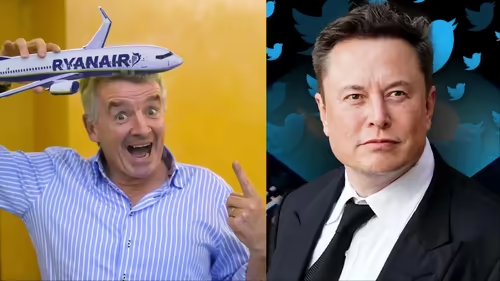
When Airline Titans Clash: The Ryanair vs Musk Feud Explained
The internet loves a good billionaire brawl, but the latest spat between Ryanair’s CEO Michael O’Leary and Tesla/SpaceX chief Elon Musk is more than just playground name-calling. It’s a high-stakes argument about the future of in-flight connectivity, airline economics, and who really knows what they’re talking about. And now, it’s been turned into a brilliant, if cheeky, marketing campaign: the ‘Great Idiots Seat Sale.’
Table of Contents
- The Spark: The Starlink Debate
- The Feud Escalates: Idiot Calls and Takeover Threats
- The Sale: Ryanair’s Marketing Masterstroke
- The Real Issue: Fuel Penalties and Short-Haul Flights
- What Does This Mean for Passengers?
- Conclusion: A Battle of Egos or a Serious Industry Debate?
- Sources
The Spark: The Starlink Debate
It all started with a simple suggestion from Elon Musk: why don’t airlines use his company’s Starlink satellite internet to provide free, high-speed Wi-Fi to passengers? On the surface, it sounds like a win-win. But for Michael O’Leary, the famously frugal boss of Europe’s largest low-cost carrier, the idea was fundamentally flawed.
O’Leary publicly dismissed the proposal, calling Musk an “idiot” for not understanding the harsh realities of the airline business . His primary concern? Physics and fuel costs.
The Feud Escalates: Idiot Calls and Takeover Threats
Musk, never one to back down from a public challenge, fired back on X (formerly Twitter), labeling O’Leary an “utter idiot” and even suggesting he should be fired . The exchange quickly went viral, with Musk doubling down on his claim that Starlink hardware would have a negligible impact on an aircraft’s performance.
O’Leary, however, stood his ground. He quipped that “Musk knows even less about airline ownership rules than he does about aircraft aerodynamics,” further pouring fuel on the fire . The feud became a global spectacle, blending corporate strategy with social media theatrics.
The Sale: Ryanair’s Marketing Masterstroke
Never one to miss a publicity opportunity, Ryanair’s marketing team seized the moment. They launched the audacious “Great Idiots Seat Sale,” offering 100,000 seats for just €16.99 one-way. The official announcement on their X account was clear about its target: “especially for Elon and any other idiots on ‘X’” .
This move is classic O’Leary: combative, cost-conscious, and brilliantly effective at generating headlines. In a single stroke, Ryanair turned a negative online argument into a massive promotional event that drives direct bookings and reinforces its brand identity as the anti-establishment airline.
The Real Issue: Fuel Penalties and Short-Haul Flights
Beyond the name-calling, there’s a genuine technical and economic debate at the heart of this Ryanair vs Musk conflict. O’Leary’s core argument is that installing a Starlink antenna on a plane’s fuselage creates extra weight and aerodynamic drag, leading to a significant increase in fuel burn.
He has stated this “fuel penalty” could be as high as 2% . For an airline like Ryanair, which operates a vast network of short-haul flights (often under an hour), that extra cost is hard to justify. As O’Leary put it, “We don’t think our passengers are willing to pay for Wi-Fi for an average one-hour flight” .
Musk and SpaceX, on the other hand, have contested this figure, claiming the actual impact is closer to 0.3% . This discrepancy highlights a key difference in perspective: a tech innovator focused on the potential of his product versus an airline operator obsessed with every last cent of operating cost.
What Does This Mean for Passengers?
For travelers, this feud raises an interesting question: do you want free, fast Wi-Fi, or the absolute lowest possible fare? Ryanair’s entire business model is built on the latter. Adding any system that increases costs—even slightly—goes against its core promise.
Here’s a quick look at the trade-offs:
- Ryanair’s View: Keep fares rock-bottom by avoiding non-essential costs like premium in-flight entertainment or Wi-Fi.
- Musk’s View: Modern passengers expect connectivity, and Starlink can provide it without a major financial hit.
- The Passenger Dilemma: Choose between a super-cheap flight with no frills or a slightly more expensive one with modern amenities.
For now, if you’re flying Ryanair, you’ll likely be offline. But you might just snag a seat from the ‘Great Idiots Sale’ to get there.
Conclusion: A Battle of Egos or a Serious Industry Debate?
While the “Great Idiots Seat Sale” is undeniably a publicity stunt, the underlying Ryanair vs Musk argument is a serious one for the aviation industry. It forces a conversation about the balance between innovation, passenger expectations, and the razor-thin margins of the low-cost carrier model. O’Leary’s stance may seem stubborn, but it’s a calculated defense of his airline’s foundational principles. Whether you side with the airline tycoon or the tech mogul, one thing is certain: this clash has given us all a fascinating glimpse into the future of flight—and how it will be paid for.
Sources
- Times of India: After Ryanair CEO Michael O’Leary called Elon Musk idiot…
- Reuters: Ryanair boss hits out at ‘Twitshit’ Elon Musk following Starlink row
- Simple Flying: Ryanair CEO Slams Starlink WiFi Over a 2% Fuel Hit
- [INTERNAL_LINK:low-cost-airline-business-models]
- [INTERNAL_LINK:future-of-in-flight-connectivity]