Table of Contents
- Musk’s Airline Ambitions Spark the Feud
- O’Leary’s EU Reality Check: The Legal Wall
- The ‘Big Idiots Seat Sale’ and a Free Flight Offer
- Why Do These EU Ownership Rules Exist?
- Could Musk Ever Work Around It?
- Conclusion: A Clash of Titans—and Regulations
- Sources
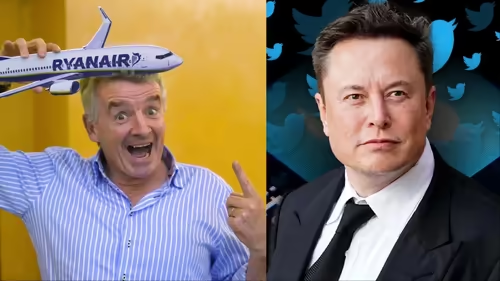
It started with a tweet. Then came a legal lecture wrapped in Irish wit, a limited-time seat sale, and even a free flight voucher. The unlikely feud between Elon Musk and Ryanair CEO Michael O’Leary has become the talk of both Silicon Valley and the aviation world. At its core is a simple but ironclad truth: under current European Union law, Musk—a non-EU citizen—cannot buy or control a European airline. And O’Leary, never one to shy from a public spar, made sure the world knew it. This clash, now famously dubbed the Ryanair CEO to Elon Musk showdown, is more than just banter—it’s a lesson in the complex realities of global business regulation.
Musk’s Airline Ambitions Spark the Feud
The drama began when Elon Musk, fresh off his usual stream of provocative social media posts, hinted at his interest in acquiring an airline. While he didn’t name a specific carrier, the aviation industry buzzed with speculation. Musk, who already runs Tesla, SpaceX, Neuralink, and X (formerly Twitter), seemed to believe his financial firepower could conquer yet another sector.
But in Europe, money alone isn’t enough. Airlines are not just businesses—they’re strategic national assets, tightly regulated for safety, security, and economic sovereignty. When Musk’s comments reached Michael O’Leary, the famously blunt Ryanair chief didn’t just roll his eyes—he fired back with facts, flair, and a healthy dose of sarcasm.
O’Leary’s EU Reality Check: The Legal Wall
“Let me tell you a European reality,” O’Leary quipped in a public statement. “EU rules mean that you cannot buy European airlines” . He was referring to Regulation (EC) No 1008/2008, which mandates that EU-based airlines must be majority-owned and effectively controlled by EU member states or their nationals.
This isn’t a loophole—it’s a foundational pillar of the EU’s common aviation policy. The rule exists to ensure that critical air transport infrastructure remains under European jurisdiction. Even if Musk bought 49% of Ryanair (the legal maximum for non-EU investors), he could never gain operational control or a board majority. In short, his dream of running a European airline is legally impossible without a fundamental change in EU law—which is highly unlikely.
The ‘Big Idiots Seat Sale’ and a Free Flight Offer
True to his maverick style, O’Leary didn’t stop at legal explanations. He turned the moment into a marketing goldmine. Ryanair launched a tongue-in-cheek “Big Idiots Seat Sale”—a clear jab at Musk’s past controversial remarks—offering deeply discounted fares for a limited time.
And in a move that blended mockery with magnanimity, O’Leary personally invited Musk to experience Ryanair firsthand: “I’ve offered him a free flight so he can see what real value looks like,” he said, adding with a grin that investing in Ryanair would be “a better deal than X” . The comment was a direct reference to Musk’s troubled acquisition of the social media platform, which has faced significant financial and reputational challenges.
Why Do These EU Ownership Rules Exist?
To outsiders, the EU’s airline ownership rules might seem protectionist. But they serve several critical purposes:
- National Security: Air traffic control, passenger data, and route planning are tied to national security interests.
- Regulatory Oversight: Ensures airlines comply with EU safety, labor, and environmental standards.
- Economic Stability: Prevents foreign entities from destabilizing a key transportation sector during geopolitical tensions.
These rules aren’t unique to Europe. The U.S. has similar restrictions under the Foreign Ownership Act, capping non-American ownership of U.S. airlines at 25%. It’s a global norm, not a European quirk [INTERNAL_LINK:global-airline-ownership-laws].
Could Musk Ever Work Around It?
Technically, yes—but not in any meaningful way. Musk could:
- Invest a minority stake (up to 49%) in an EU airline, but with no control.
- Launch a new airline outside the EU (e.g., in the UK post-Brexit, though UK rules are similarly strict).
- Lobby for regulatory change—a near-impossible task given the EU’s consensus-driven policymaking.
None of these options give Musk the hands-on control he’s used to. As O’Leary put it: “You can’t run it. You can’t manage it. You can’t even paint the planes red if you wanted to.”
Conclusion: A Clash of Titans—and Regulations
The Ryanair CEO to Elon Musk exchange is more than just corporate sparring. It’s a vivid illustration of how even the world’s richest individuals are bound by the legal frameworks of sovereign regions. Musk may command rockets and social media, but in the skies over Europe, EU law is the ultimate authority. O’Leary’s blend of legal clarity, humor, and promotional savvy not only defended his industry—it reminded everyone that in business, as in aviation, there are rules you simply can’t fly around.