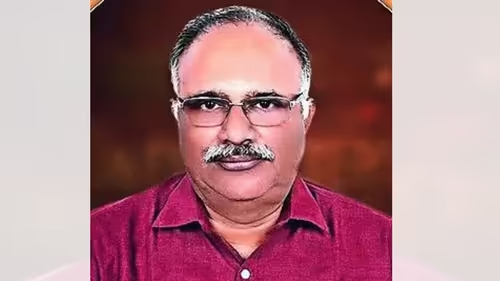
In a move that has reignited a long-standing national controversy, former Ministry of Home Affairs (MHA) officer R.V.S. Mani has been conferred the prestigious Padma Shri award in 2026. His recognition is not just for bureaucratic service, but for his courageous role in exposing a critical contradiction at the heart of the Ishrat Jahan case—a contradiction that pointed directly to political interference from the then-ruling UPA government.
Table of Contents
- Who is RVS Mani and Why is He in the News?
- The Ishrat Jahan Case: The Affidavit Controversy Explained
- Political Interference and Rajnath Singh’s Confirmation
- Why the Padma Shri Matters in This Context
- Conclusion: A Legacy of Integrity in the Face of Pressure
- Sources
Who is RVS Mani and Why is He in the News?
R.V.S. Mani, a former Under Secretary in the MHA, found himself at the epicenter of one of India’s most politically charged legal battles. His name became synonymous with integrity after he went public with claims that he was pressured to alter an official government affidavit related to the 2004 encounter of Ishrat Jahan and three others in Gujarat [[2]].
Mani’s steadfastness in upholding the original version of the affidavit, which cited intelligence reports confirming Jahan’s links to terrorist activities, put him on a collision course with his superiors. Now, a decade later, his actions have been officially recognized by the state, signaling a powerful message about the value of bureaucratic honesty. This award is seen by many as a vindication of his long-held stance [[1]].
The Ishrat Jahan case: The Affidavit Controversy Explained
The core of the controversy lies in two conflicting affidavits filed by the MHA before the Gujarat High Court in 2009. Here’s a breakdown of the key events:
- The First Affidavit (August 2009): Drafted under Mani’s supervision, this document strongly asserted that intelligence inputs from multiple agencies, including the Intelligence Bureau (IB), confirmed that Ishrat Jahan was a member of Lashkar-e-Taiba (LeT) and was on a mission to assassinate then-Chief Minister Narendra Modi [[8]].
- The Second Affidavit (September 2009): Just weeks later, a revised affidavit was submitted, which dramatically watered down the language. It removed specific references to Jahan’s terror links and instead presented a much more ambiguous picture, effectively weakening the government’s initial position [[8]].
Mani has consistently claimed that he was instructed to sign off on the second affidavit against his professional judgment and under immense pressure. He even alleged that he faced threats and was told to sign the document without being allowed to read its final contents [[11]]. This sequence of events created a major scandal, with accusations that the UPA-II government, led by Prime Minister Manmohan Singh, was attempting to appease a particular political constituency by diluting the facts of the case [[10]].
Political Interference and Rajnath Singh’s Confirmation
The allegations of political meddling were not just the claims of a single bureaucrat. They were later substantiated at the highest levels of government. In March 2016, then Union Home Minister Rajnath Singh made a definitive statement in the Lok Sabha, confirming the flip-flop.
“There was an attempt by the erstwhile UPA government to dilute the fact that she [Ishrat Jahan] was a terrorist,” Singh stated, adding that the second affidavit “weakened” the original findings based on intelligence inputs [[14], [19]]. He further accused the previous regime of “policy paralysis” on matters of national security and saw the affidavit change as part of a larger political plot [[15], [16]].
This official confirmation from the head of the MHA lent immense credibility to Mani’s account and turned the Ishrat Jahan case from a local encounter issue into a national debate on the politicization of security and intelligence matters.
Why the Padma Shri Matters in This Context
The decision to award RVS Mani the Padma Shri is deeply symbolic. It transcends a simple civilian honor; it is a public acknowledgment of a civil servant who chose principle over protocol. In an environment where whistleblowers often face career stagnation or worse, Mani’s recognition serves as a beacon.
It sends a clear message that standing up for factual accuracy and resisting political pressure, even when it comes from the highest offices, is a form of service worthy of the nation’s highest praise. For observers, this award is a direct commentary on the events of the UPA era and a reaffirmation of the importance of an apolitical and honest bureaucracy. You can learn more about other recipients in our coverage of the [INTERNAL_LINK:padma_awards_2026].
Conclusion: A Legacy of Integrity in the Face of Pressure
The story of RVS Mani and the Ishrat Jahan case is a stark reminder of the complex interplay between politics, bureaucracy, and national security. His journey from a pressured under-secretary to a Padma Shri awardee underscores a fundamental truth: integrity, even when it is inconvenient, eventually finds its place in the sun. As the nation honors his courage, the lessons from this episode remain crucial for safeguarding the impartiality of our institutions.
Sources
- Indian Masterminds. “Who Is Eminent Bureaucrat R.V.S. Mani?” https://indianmasterminds.com/news/rvs-mani-padma-shri-2026-former-mha-officer-180020/
- The Hindu. “Home Ministry not to give all documents to CBI in Ishrat case.” https://www.thehindu.com/news/national/home-ministry-not-to-give-all-documents-to-cbi-in-ishrat-case/article4924548.ece
- India Today. “Ishrat Jahan case: Was forced to sign second affidavit, says former MHA official.” https://www.indiatoday.in/india/story/ishrat-jahan-case-i-was-forced-to-sign-second-affidavit-says-former-mha-official-311357-2016-03-02
- Deccan Chronicle. “Ishrat Jahan case: Don’t politicise terror, Rajnath Singh tells Cong.” https://www.deccanchronicle.com/nation/current-affairs/100316/rajnath-singh-likely-to-speak-on-ishrat-jahan-case-in-lok-sabha-today.html
- The Times of India. “UPA did flip-flops in Ishrat Jahan case, says Rajnath Singh.” https://timesofindia.indiatimes.com/india/upa-did-flip-flops-in-ishrat-jahan-case-says-rajnath-singh/articleshow/51342482.cms