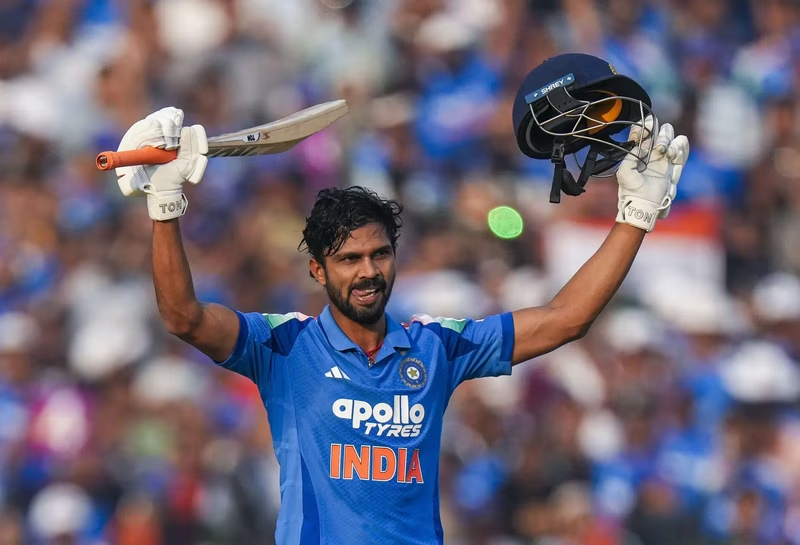
Another international break, another selection controversy. This time, it’s Ruturaj Gaikwad at the center of the storm. Fresh off a sparkling century in domestic cricket, the Maharashtra-born opener was shockingly omitted from India’s ODI squad for the upcoming New Zealand series. The decision didn’t just puzzle fans—it triggered a fiery public response from former India star Robin Uthappa, who bluntly asked: “If you’re not from Mumbai, Delhi, or Punjab, is it harder to make it?”
This isn’t just about one player’s exclusion. It’s about a systemic question that’s haunted Indian cricket for decades: Is there a bias against talent from non-traditional cricketing hubs? And with the Ruturaj Gaikwad ODI snub, the debate has roared back to life with renewed urgency.
Table of Contents
- The Gaikwad Conundrum: Form vs. Favoritism
- Uthappa’s Bold Take: “Survival Mode in Indian Cricket”
- Ruturaj Gaikwad ODI Snub: What the Numbers Say
- The “Metro Monopoly”: A Pattern or a Perception?
- The Mental Toll on Emerging Players
- Conclusion: A System in Need of Reflection
The Gaikwad Conundrum: Form vs. Favoritism
Ruturaj Gaikwad isn’t just any domestic performer. He’s a consistent run-machine who led Chennai Super Kings to an IPL title in 2021 and has since been a top-order mainstay in white-ball cricket. Most recently, he slammed a fluent 107 in the Vijay Hazare Trophy—India’s premier List A tournament .
Yet, despite this form, the national selectors opted for other names, including seasoned campaigners and emerging metro-backed talents. The message? Raw numbers might not be enough if you don’t fit the “right” profile—or come from the “right” region.
Uthappa’s Bold Take: “Survival Mode in Indian Cricket”
Former India all-rounder Robin Uthappa didn’t mince words. In a candid social media post, he expressed his bewilderment at Gaikwad’s omission and highlighted the intense psychological pressure faced by players outside India’s traditional cricket power centers.
“Cricket in India has become a survival game. If you’re not from Mumbai, Delhi, or Punjab, you have to fight twice as hard—not just for runs, but for recognition,” Uthappa wrote .
His comments struck a chord because they reflect a long-standing grievance among players from states like Maharashtra, Karnataka (outside Bengaluru), Odisha, and the Northeast—regions that produce talent but often see their stars overlooked until they’ve proven themselves beyond doubt.
Ruturaj Gaikwad ODI Snub: What the Numbers Say
Let’s put the emotion aside for a moment and look at the stats. In the last 12 months across domestic List A and IPL:
- 3 centuries and 5 half-centuries in 18 innings .
- Strike rate of over 130 in T20s and a healthy 85+ in 50-over cricket.
- Consistently among the top 5 run-scorers for CSK in the IPL .
Compare that to some of the selected openers, and the omission becomes harder to justify on pure performance grounds. This raises a critical question: are selectors valuing “potential visibility” over actual output?
The “Metro Monopoly”: A Pattern or a Perception?
Uthappa’s comment about Mumbai, Delhi, and Punjab isn’t baseless. Historically, these regions have dominated Indian cricket:
- Mumbai alone has produced legends like Tendulkar, Gavaskar, and Rohit Sharma, and benefits from elite infrastructure and powerful selectors.
- Delhi has Kohli, Pant, and a well-connected cricketing ecosystem.
- Punjab has produced stars like Yuvraj Singh and KL Rahul, often with strong representation in national panels.
Meanwhile, players from smaller centers—like Gaikwad (Pune), Sanju Samson (Kerala), or even Hanuma Vihari (Andhra)—often have to wait longer, score bigger, and endure more scrutiny before getting a fair shot .
This isn’t to say metro players aren’t talented—they absolutely are. But the system may unintentionally favor those with better access, louder advocates, and more exposure from a young age.
The Mental Toll on Emerging Players
Uthappa’s reference to “survival mode” is perhaps the most damning insight. The constant uncertainty, the feeling of being perpetually on trial, and the knowledge that one bad game could end your national dreams—it’s a recipe for burnout.
As Dr. Rupali Repale, a sports psychologist who works with domestic cricketers, notes: “Players from non-metro backgrounds often carry an extra burden of proving their worth not just with the bat, but by overcoming systemic invisibility. That mental fatigue can sap confidence faster than any bowling attack.”
This psychological weight is rarely discussed in selection meetings—but it’s very real for the players living it.
Conclusion: A System in Need of Reflection
The Ruturaj Gaikwad ODI snub may seem like a minor squad announcement, but it’s a mirror reflecting deeper issues in Indian cricket. Talent is everywhere—but opportunity isn’t. Robin Uthappa’s intervention is a timely reminder that fairness, transparency, and regional inclusivity aren’t just ideals; they’re essential for building a truly representative and resilient national team.
Until selectors actively scout beyond the usual circuits and reward consistency over convenience, players like Gaikwad will keep facing an uphill battle—not against bowlers, but against the system itself.
Sources
[INTERNAL_LINK:India ODI squad selection criteria]
[INTERNAL_LINK:Robin Uthappa career highlights]
Times of India – Gaikwad Snub Sparks Debate
ESPNcricinfo – Ruturaj Gaikwad Domestic Stats
BCCI – Official ODI Squad Announcement