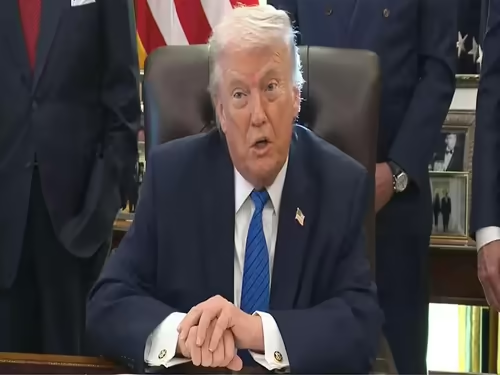
In a move that’s reignited debate over America’s role in the ongoing Ukraine conflict, former President Donald Trump has thrown a diplomatic grenade into the geopolitical arena. Speaking at a recent rally, Trump declared that a Russia-Ukraine peace agreement is “very close,” but pinned the entire stalemate on what he described as the deep-seated personal animosity between Russian President Vladimir Putin and Ukrainian President Volodymyr Zelensky. “They hate each other,” Trump bluntly stated, suggesting that this mutual hostility is the primary barrier to a negotiated end to the war [[1]].
This assertion, coming from the presumptive Republican frontrunner for the 2026 US presidential election, is more than just a casual observation. It’s a direct challenge to the current Biden administration’s strategy of providing unwavering military and financial support to Kyiv. Trump’s comments imply that the solution isn’t more weapons, but rather a high-stakes diplomatic intervention—one that he alone, with his self-proclaimed “deal-making” prowess, could broker.
Table of Contents
- Trump’s Bold Claim on Russia-Ukraine Peace
- The Putin-Zelensky Feud: A Real Hurdle or a Distraction?
- Trump’s Transactional Approach to Foreign Policy
- The Biden Administration’s Counter-Strategy
- Implications for the 2026 US Election
- Conclusion: Can Personal Diplomacy End a War?
- Sources
Trump’s Bold Claim on Russia-Ukraine Peace
Trump’s central argument is deceptively simple: the war is a complex problem with a simple solution—getting the two leaders in a room together. He has repeatedly claimed that he could end the conflict “in 24 hours,” a boast that has become a staple of his campaign rhetoric [[2]]. His latest comments refine that narrative, suggesting that the framework for peace exists, but the personal chemistry (or lack thereof) between Putin and Zelensky is the final, stubborn lock that needs picking.
By framing the issue as a personality clash rather than a fundamental disagreement over sovereignty, territorial integrity, and security guarantees, Trump dramatically simplifies a deeply entrenched geopolitical crisis. This narrative serves his political brand as the ultimate negotiator who can cut through red tape and personal egos to get a deal done.
The Putin-Zelensky Feud: A Real Hurdle or a Distraction?
While it’s undeniable that the relationship between the two leaders is frosty at best, most foreign policy experts argue that their personal feelings are a symptom of the conflict, not its cause. The core issues are structural and non-negotiable for Ukraine: the return of all occupied territories, including Crimea, and ironclad security assurances against future Russian aggression [[3]].
For Putin, the war is about reasserting Russian influence over its “near abroad” and preventing Ukraine from becoming a fully integrated Western state. These are strategic national interests that go far beyond any personal dislike for Zelensky. To suggest that a handshake or a change in tone could resolve these foundational disagreements is, to many analysts, a profound misunderstanding of the conflict’s roots.
Trump’s Transactional Approach to Foreign Policy
Trump’s view of international relations is famously transactional. He sees diplomacy as a series of deals between powerful individuals, where leverage and personal rapport are the key currencies. This approach worked in some business contexts, but its application to matters of war and peace is highly controversial.
Critics point to his previous interactions with authoritarian leaders like Kim Jong-un and, notably, Vladimir Putin himself. His often-cordial public demeanor towards Putin, even in the face of Russian aggression and election interference, has fueled concerns that his desire for a “deal” might come at the expense of Ukraine’s sovereignty and long-term security [[4]].
The Biden Administration’s Counter-Strategy
In stark contrast, the current US administration, along with its NATO allies, has pursued a strategy of “strategic patience.” This involves arming Ukraine to a point where it can defend its territory and negotiate from a position of strength, rather than being forced into a settlement that cedes land to Russia [[5]].
The White House believes that any lasting peace must be one that is acceptable to the Ukrainian people and government, not just a top-down agreement between two leaders. This approach prioritizes principles like national sovereignty and the rules-based international order over the expediency of a quick deal.
Implications for the 2026 US Election
Trump’s comments are not just foreign policy musings; they are a core part of his 2026 campaign platform. He is appealing to a segment of the American electorate that is weary of foreign entanglements and questions the open-ended commitment of US resources to the war. By promising a swift end to the conflict, he positions himself as the candidate of peace and pragmatism.
This stance, however, creates a clear dividing line between him and the current administration, setting up foreign policy as a major battleground in the upcoming election. Voters will have to decide whether they trust Trump’s promise of a quick, personality-driven resolution or the Biden team’s more cautious, principle-based approach.
Conclusion: Can Personal Diplomacy End a War?
While Donald Trump’s assertion that Russia-Ukraine peace is “close” makes for a compelling soundbite, the reality on the ground is far more complex. Reducing a brutal war over national identity and security to a mere personality clash between two men is a vast oversimplification. True peace will require more than just getting Putin and Zelensky to overcome their mutual dislike; it will demand difficult compromises on core issues of territory, security, and justice. Whether a future US president can facilitate that process remains to be seen, but it will likely require far more than just a 24-hour negotiation.
Sources
[INTERNAL_LINK:ukraine-war-timeline-and-key-events]
[INTERNAL_LINK:us-foreign-policy-under-trump-vs-biden]
Times of India: ‘They hate each other’: Trump on Russia-Ukraine peace [[1]]
The White House: U.S. Support for Ukraine [[5]]
Council on Foreign Relations: Ukraine Crisis Timeline [[3]]