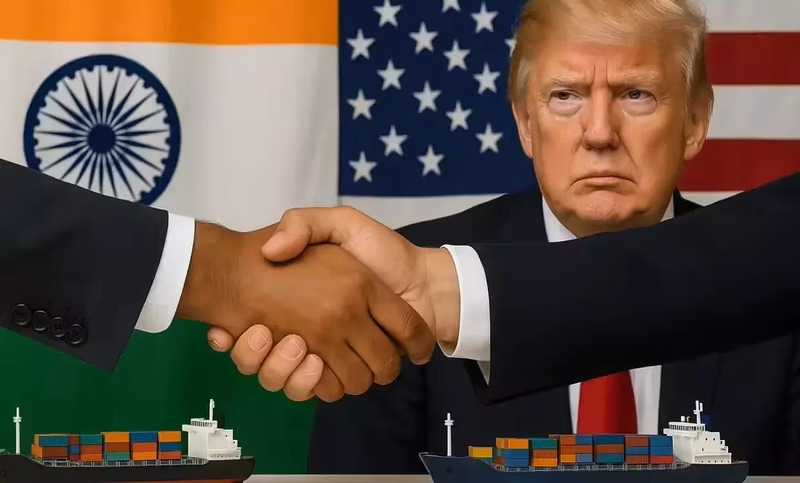
In a move that could send shockwaves through global energy markets, former President Donald Trump has cleared a hard-hitting Russia sanctions bill that threatens to impose tariffs as high as 500% on countries—including India and China—that continue to buy discounted Russian crude oil. Passed with rare bipartisan support in Congress, the bill aims to choke off a critical revenue stream for Vladimir Putin’s war machine in Ukraine. But the unintended consequences for key U.S. partners like India could be severe, raising urgent questions about energy security, trade relations, and geopolitical alignment .
Table of Contents
- What the Russia Sanctions Bill Actually Says
- Why India and China Are in the Crosshairs
- The 500% Tariff Threat—Explained
- Economic Impact on India: A $200 Billion Energy Dilemma
- Geopolitical Ramifications for US-India Relations
- Can India Avoid the Sanctions?
- Conclusion: A High-Stakes Global Energy Chess Game
- Sources
What the Russia Sanctions Bill Actually Says
The newly enacted Russia sanctions bill targets any country that imports Russian oil above the G7-imposed price cap of $60 per barrel. However, its most controversial provision authorizes the U.S. President to levy “secondary sanctions” on nations that significantly purchase Russian energy—even if paid below the cap—on the grounds that such transactions still bolster Moscow’s war economy .
Critically, the bill grants the executive branch sweeping authority to impose tariffs of up to 500% on all exports from non-compliant countries. This isn’t a blanket policy yet—it’s a threat designed to force compliance. But the mere existence of this legislative sword of Damocles has already spooked markets and policymakers in New Delhi and Beijing.
Why India and China Are in the Crosshairs
Since Russia’s invasion of Ukraine in 2022, both India and China have dramatically increased their purchases of discounted Russian crude. India, once importing less than 2% of its oil from Russia, now sources over 40% of its crude from Moscow—making it one of the largest buyers globally .
The U.S. argues that while these purchases might appear as smart economic decisions for energy-hungry economies, they effectively provide Moscow with tens of billions in annual revenue to fund its military operations. The new bill is Washington’s way of saying: you’re either with us or financing the enemy.
The 500% Tariff Threat—Explained
Let’s be clear: a 500% tariff doesn’t mean every Indian T-shirt or Chinese smartphone suddenly costs six times more. Instead, the law empowers the U.S. Trade Representative to selectively impose these punitive duties on strategic sectors—think pharmaceuticals, textiles, electronics, and machinery.
For India, which exported $128 billion worth of goods to the U.S. in 2025, even targeted tariffs could devastate key industries. A 500% duty on Indian generic drugs or auto parts would make them commercially unviable overnight.
Economic Impact on India: A $200 Billion Energy Dilemma
India’s dilemma is complex. On one hand, Russian oil has saved the country an estimated $15–20 billion annually in import costs—critical for managing its current account deficit and fuel inflation . On the other, risking U.S. trade access could cost far more.
Key sectors at risk include:
- Pharmaceuticals: India supplies 40% of U.S. generic drugs.
- IT & Business Services: U.S. firms rely heavily on Indian tech talent.
- Textiles & Apparel: A major source of employment and export revenue.
- Automotive Components: Integrated into U.S. supply chains.
If the Russia sanctions bill is fully enforced, India could face a painful trade-off: energy savings versus economic partnership with its largest export market.
Geopolitical Ramifications for US-India Relations
This isn’t just about trade—it’s about strategic alignment. The U.S. has long viewed India as a crucial counterweight to China in the Indo-Pacific. But New Delhi’s refusal to condemn Russia’s invasion or join Western sanctions has created friction. The new bill tests that partnership.
While the Biden administration has so far avoided penalizing India—citing “national interest”—Trump’s clearance of this bill signals that future U.S. administrations may take a harder line. It’s a reminder that India’s “strategic autonomy” has real economic limits in a polarized world order .
Can India Avoid the Sanctions?
Possibly—if it acts fast. Experts suggest several pathways:
- Gradual Diversification: Slowly reduce Russian oil dependence by boosting purchases from the U.S., UAE, or Iraq.
- Price Cap Compliance: Ensure all Russian oil purchases are verifiably below the $60 cap and paid in non-dollar currencies through compliant channels.
- Diplomatic Engagement: Negotiate a national waiver by demonstrating that Indian purchases don’t enrich Russian state coffers (e.g., via barter or rupee-ruble mechanisms).
However, none of these are easy. Russia has become India’s most reliable and affordable supplier. Walking away isn’t just costly—it’s logistically challenging.
Conclusion: A High-Stakes Global Energy Chess Game
The Russia sanctions bill is more than a piece of legislation—it’s a geopolitical ultimatum. For India and China, the choice is stark: continue benefiting from cheap Russian energy at the risk of U.S. economic retaliation, or realign with Western energy policies at significant domestic cost. As global supply chains reconfigure and great-power competition intensifies, neutral ground is vanishing. The next 12 months will be decisive in determining whether this sanctions threat becomes reality—or remains a powerful negotiating tool in America’s foreign policy arsenal.
Sources
- Details of the Russia Sanctions Bill: U.S. Congress
- G7 Oil Price Cap Mechanism: U.S. Department of the Treasury
- India’s Russian Oil Imports Data: International Energy Agency (IEA)
- Economic Impact Analysis: International Monetary Fund
- US-India Strategic Relations: U.S. Department of State
- [INTERNAL_LINK:impact-of-us-sanctions-on-indian-economy]
- [INTERNAL_LINK:russia-ukraine-war-and-global-oil-prices]