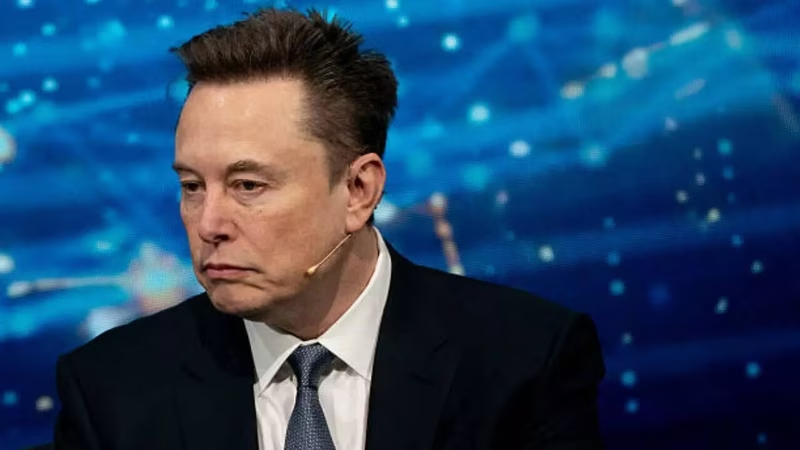
For years, Ross Gerber has been one of Tesla’s most vocal and credible supporters on Wall Street. As the CEO of Gerber Kawasaki, a firm with significant holdings in the electric vehicle maker, his bullish stance carried weight. But now, in a dramatic turn of events, Gerber has publicly turned on Elon Musk, delivering a blistering critique of Tesla’s core narrative around autonomy.
In a recent interview, Gerber didn’t mince words, labeling Musk’s repeated promises about Full Self-Driving (FSD) and the long-awaited Robotaxi as nothing more than “hallucinations” that have consistently failed to materialize . This stark assessment from a former ally is a major blow to Tesla’s credibility at a time when its car sales are softening and its sky-high valuation is under intense scrutiny .
Table of Contents
- From Bull to Critic: The Gerber-Musk Relationship Shifts
- The ‘Hallucination’ Claim: Deconstructing Musk’s Broken Promises
- Missed Milestones: The Robotaxi Debacle and FSD’s Persistent Flaws
- Financial Fallout: Is Tesla’s Valuation Sustainable?
- What This Means for Tesla Investors
- Conclusion: A Wake-Up Call for Tesla
- Sources
From Bull to Critic: The Gerber-Musk Relationship Shifts
Ross Gerber’s journey from staunch Tesla advocate to a critical insider is a story that mirrors the growing skepticism in the investment community. For over a decade, Gerber defended Tesla against short-sellers and naysayers, often appearing on financial news networks to champion the company’s mission and technology .
His firm, Gerber Kawasaki, held Tesla as a cornerstone of its portfolio, betting big on Musk’s vision of an autonomous future. However, Gerber’s patience appears to have run out. His latest comments signal a fundamental loss of faith not just in the timeline, but in the very feasibility of the autonomy roadmap as presented by Musk . This shift is significant because it comes from someone who deeply understands the company and has a vested financial interest in its success.
The ‘Hallucination’ Claim: Deconstructing Musk’s Broken Promises
Gerber’s use of the word “hallucination” is a direct and powerful jab. It implies that Musk’s claims about Tesla’s technological capabilities are not just optimistic forecasts, but complete fabrications detached from reality. This criticism is rooted in a long history of missed deadlines and overblown announcements.
Musk has a well-documented pattern of making bold predictions about FSD:
- In 2016, he claimed a fully autonomous cross-country drive would happen by the end of 2017.
- In 2019, he promised a million Robotaxis on the road by the end of 2020.
- Most recently, the much-hyped August 8, 2024, Robotaxi unveiling was delayed without a clear new date .
Each of these promises has evaporated, leaving investors and customers waiting. Gerber argues that this constant cycle of hype and disappointment is eroding trust and creating a dangerous gap between Tesla’s market valuation and its actual, deliverable products .
Missed Milestones: The Robotaxi Debacle and FSD’s Persistent Flaws
The most glaring recent failure is the delay of the dedicated Robotaxi reveal. This event was meant to be a pivotal moment for Tesla, showcasing its vision for a future of driverless ride-hailing. Its postponement is a tacit admission that the technology or the business model isn’t ready .
Beyond the missed launch, the current state of the FSD Beta software remains problematic. While it has improved, numerous real-world tests and user reports highlight its unreliability in complex urban environments. It still requires constant driver supervision and can make unpredictable, sometimes dangerous, decisions—a far cry from the “full self-driving” name it bears .
This disconnect between marketing and reality is at the heart of Gerber’s frustration. He sees a company that is selling a future that may never arrive, while its core business of selling cars is showing signs of strain.
Ross Gerber Tesla: Financial Fallout and Valuation Concerns
Gerber’s critique extends beyond technology into the financial realm. He has pointed out that Tesla’s vehicle deliveries have been declining, with Q3 2025 marking a significant year-over-year drop—the first in nearly four years . At the same time, competition in the EV market is intensifying from legacy automakers and new Chinese entrants like BYD.
Tesla’s stock price has historically been justified by its future potential in autonomy and AI, not just its current car sales. If that future looks increasingly uncertain, as Gerber suggests, then the company’s massive market capitalization becomes difficult to defend. He warns that the market is beginning to wake up to this reality, which could lead to a painful correction .
For a deeper dive into Tesla’s financial health, check out our analysis on [INTERNAL_LINK:tesla-q3-2025-delivery-numbers-analysis].
What This Means for Tesla Investors
Gerber’s public reversal is a crucial signal for the investment community. It represents a growing faction of sophisticated investors who are no longer willing to bet on Musk’s promises alone. They are demanding tangible results and a clear, credible path to profitability from the autonomy segment.
Investors should now be asking tough questions: What is the realistic timeline for a truly driverless system? What is the actual revenue model for the Robotaxi network? And most importantly, what is Tesla worth if its autonomy dreams remain just that—dreams?
Conclusion: A Wake-Up Call for Tesla
Ross Gerber’s sharp criticism is more than just a personal opinion; it’s a symptom of a larger crisis of confidence surrounding Tesla’s core narrative. The era of blind faith in Elon Musk’s vision may be coming to an end. For Tesla to maintain its position as a market leader, it must move beyond “hallucinations” and deliver concrete, working technology that lives up to its bold promises. The clock is ticking, and the world—including its former biggest fans—is watching closely.
Sources
- Times of India: Tesla bull Ross Gerber calls Tesla Full Self-Driving (FSD) system problematic
- Bloomberg: Tesla’s Robotaxi Unveiling Reportedly Delayed Amid Struggles
- Reuters: Tesla Q3 deliveries fall for first time since 2021
- National Highway Traffic Safety Administration (NHTSA): Automated Vehicles Safety Information