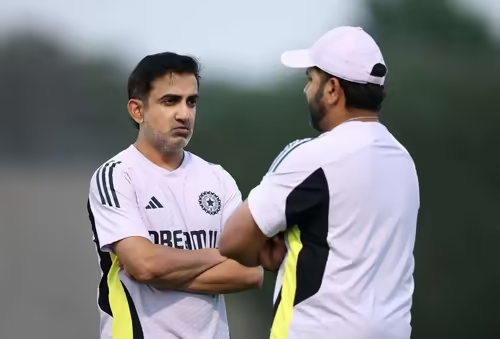
The axe fell quietly—but the backlash is anything but silent. The recent decision to strip **Rohit Sharma** of his ODI captaincy has ignited a firestorm in Indian cricket circles, with former international player **Manoj Tiwary** delivering one of the most pointed critiques yet. In a striking metaphor, Tiwary alleged that new head coach **Gautam Gambhir** was the real force behind the move, saying he “fired the gun from Ajit Agarkar’s shoulder” .
Coming just months after Rohit led India to victory in the **2025 ICC Champions Trophy**, the decision has left fans and experts alike questioning the BCCI’s rationale. Was this a strategic reset—or a stunning act of disrespect toward one of India’s most successful white-ball captains? Let’s unpack the controversy surrounding the Rohit Sharma ODI captaincy removal.
Table of Contents
- The Controversial Decision: What Happened?
- Rohit Sharma ODI Captaincy Removal: Tiwary’s Scathing Take
- Gambhir and Agarkar’s Roles: Who Pulled the Trigger?
- Rohit’s Record as ODI Captain: By the Numbers
- Broader Implications for Indian Cricket
- Conclusion: Respect or Reboot?
- Sources
The Controversial Decision: What Happened?
In late 2025, the BCCI announced that Rohit Sharma would no longer lead India in ODIs, with the captaincy handed to a younger leader as part of a “transition plan.” The official statement cited the need to build a team for the 2027 ODI World Cup—a logical long-term goal.
But the timing raised eyebrows. Just weeks earlier, Rohit had masterminded India’s triumph in the ICC Champions Trophy, defeating arch-rivals Pakistan in a tense final. His leadership was widely praised for its calmness, tactical acumen, and ability to manage a multi-generational squad.
Rohit Sharma ODI Captaincy Removal: Tiwary’s Scathing Take
Manoj Tiwary, who played 3 ODIs for India and has since become a respected voice in Bengali cricket commentary, didn’t mince words. In a recent interview, he called the decision “deeply disrespectful” and questioned its cricketing merit.
“Rohit was performing, leading, and winning,” Tiwary said. “To remove him right after a major ICC trophy sends the wrong message to every senior player who gives their all for the country.”
His most explosive claim? That while chief selector Ajit Agarkar formally announced the change, the real architect was head coach Gautam Gambhir. “Gambhir fired the gun… but from Agarkar’s shoulder,” Tiwary asserted, implying a power dynamic where the coach overruled the selection committee .
Gambhir and Agarkar’s Roles: Who Pulled the Trigger?
This allegation touches on a sensitive nerve in Indian cricket administration. Since taking over as head coach, Gambhir—a former captain himself known for his aggressive philosophy—has pushed for a cultural reset. He’s advocated for “high-intensity training,” “zero tolerance for complacency,” and a faster transition to youth.
Ajit Agarkar, on the other hand, has publicly emphasized continuity and respect for legacy. The tension between these two visions may be playing out behind closed doors. While the BCCI maintains that decisions are collective, Tiwary’s comment suggests internal friction—and possibly a coach wielding outsized influence.
Rohit’s Record as ODI Captain: By the Numbers
To judge the decision fairly, let’s look at the facts. Under Rohit Sharma’s ODI leadership (2017–2025), India achieved remarkable success:
- Matches: 89
- Wins: 62 (win rate of ~69.7%)
- Major Titles: 2025 ICC Champions Trophy, 2023 Asia Cup
- World Cup Performance: Reached final in 2023 ODI World Cup
These numbers place him among India’s most successful ODI captains—on par with MS Dhoni. Critics of the removal argue that discarding such a proven leader mid-cycle undermines stability and rewards impatience over results.
Broader Implications for Indian Cricket
This isn’t just about one captain. It reflects a deeper philosophical shift in Indian cricket:
- Legacy vs. Youth: How long should proven performers be retained during transitions?
- Coach vs. Committee: Should the head coach have decisive say in leadership appointments?
- Emotional Intelligence vs. Tactical Rigor: Is Rohit’s calm demeanor being undervalued in favor of Gambhir’s intensity?
Tiwary even admitted the controversy has diminished his personal interest in ODI cricket—a sentiment shared by many fans who see Rohit as the embodiment of India’s golden white-ball era.
Conclusion: Respect or Reboot?
The Rohit Sharma ODI captaincy removal may be framed as a necessary step toward 2027, but the manner of its execution—and the perception of backroom maneuvering—has damaged trust. As Tiwary’s comments show, when you sideline a champion without clear justification, you don’t just lose a captain; you risk alienating an entire generation of supporters who valued loyalty as much as victory.
Only time will tell if this gamble pays off. But for now, the echo of that “gunshot” continues to reverberate through Indian cricket.