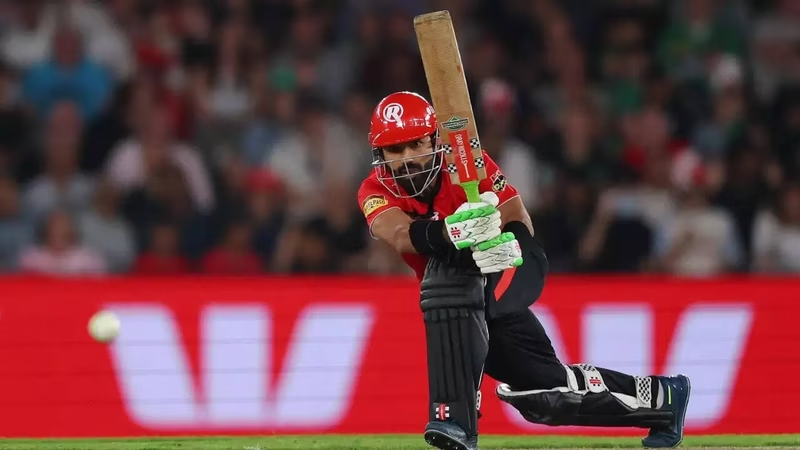
It was meant to be a strategic reset. Instead, it became a career misstep. When Pakistan’s star wicketkeeper-batter Mohammad Rizwan voluntarily walked off the field during a Big Bash League (BBL) match under the rarely invoked ‘retired out’ rule, he likely thought he was doing his team a favor. But the backlash was swift—and severe.
Reports soon emerged that Rizwan had been asked by his franchise to cut his BBL stint short and return home. The reason? His decision sparked outrage back in Pakistan, where critics branded it “disrespectful,” “unprofessional,” and even “a betrayal of the national ethos.” But is this reaction fair—or is it rooted in outdated notions of cricketing honor?
Table of Contents
- What Does ‘Retired Out’ Mean in Cricket?
- The Match That Sparked the Rizwan Retired Out Firestorm
- Why Pakistan Reacted So Strongly
- Kamran Akmal Defends Modern T20 Realities
- How Other Leagues View Slow Batting
- The Bigger Issue: Franchise Cricket vs. National Identity
- Conclusion: Was Rizwan Unfairly Penalized?
- Sources
What Does ‘Retired Out’ Mean in Cricket?
Under Law 25.4.2 of the MCC Laws of Cricket, a batter may “retire” at any time during their innings. There are two types:
- Retired hurt: Temporary; the player can return later if fit.
- Retired out: Permanent; the player is considered dismissed and cannot return.
While “retired hurt” is common, “retired out” is extremely rare in professional cricket—especially in high-stakes T20 matches. It’s typically used in exhibition games or when a batter feels they’re not contributing effectively to the team’s required run rate.
In Rizwan’s case, sources suggest he was batting at a strike rate well below the BBL average (reportedly under 110), and with wickets in hand, the coaching staff may have encouraged him to make way for a more explosive hitter—a move permitted by the rules but culturally jarring.
The Match That Sparked the Rizwan Retired Out Firestorm
Playing for the Melbourne Renegades, Rizwan came in during the middle overs on a slow pitch. As the required run rate climbed, his conservative approach—anchoring rather than accelerating—clashed with the BBL’s all-out attacking ethos.
Rather than risk getting out trying to force shots, he opted to retire out, allowing a finisher like Marcus Stoinis or Nic Maddinson to take his place. On paper, it was a selfless, team-first decision. But optics matter—and in cricket-crazed Pakistan, walking off without being dismissed felt like surrender.
Why Pakistan Reacted So Strongly
The outcry wasn’t just about tactics—it was about identity. In South Asian cricket culture, batters are expected to “fight till the last ball,” regardless of format. Giving up your wicket voluntarily is seen as lacking grit, especially for a player of Rizwan’s stature—a former T20 World Cup standout and national vice-captain.
Social media exploded with comments like “He disrespected the jersey” and “This is why Pakistan loses close games.” Even some former players questioned his commitment. The narrative quickly shifted from “smart cricket” to “cowardice”—a harsh judgment for a legal move.
Kamran Akmal Defends Modern T20 Realities
Not everyone joined the pile-on. Former Pakistan wicketkeeper Kamran Akmal offered a measured perspective. While acknowledging the sensitivity, he stressed that modern T20 leagues demand adaptability.
“Players have to understand the format,” Akmal said in a recent interview. “If you’re not scoring at the required rate, sometimes the best thing for the team is to make way for someone who can. It’s not about ego—it’s about winning.”
His comments reflect a growing divide between traditionalists and pragmatists in the game. As T20 leagues become more data-driven, roles are increasingly specialized. An anchor batter might thrive in international cricket but be a liability in a franchise setting that demands 150+ strike rates.
How Other Leagues View Slow Batting
Compare this to the Indian Premier League (IPL), where stars like Shreyas Iyer or KL Rahul have been benched mid-season for poor strike rates. In the SA20 or CPL, overseas players are routinely released if they don’t meet performance benchmarks.
The BBL, while smaller, operates under similar commercial pressures. Teams invest heavily in marquee players, and underperformance—even if technically legal—can lead to early exits. Rizwan’s case is unique only because of his profile and the dramatic nature of the “retired out” tactic.
The Bigger Issue: Franchise Cricket vs. National Identity
This incident highlights a deeper tension: Can players serve two masters?
When representing Pakistan, Rizwan is expected to embody resilience and fighting spirit. But in the BBL, he’s an employee of a private franchise whose sole goal is entertainment and victory. These identities often clash.
Western players rarely face this dilemma—they’re judged purely on output. But South Asian stars carry the weight of national expectation wherever they play. That double standard needs addressing as global T20 cricket evolves.
Conclusion: Was Rizwan Unfairly Penalized?
The Rizwan retired out saga isn’t really about one man’s decision—it’s about how we define professionalism in modern cricket. Was he wrong to prioritize team strategy over personal pride? Or was the system too rigid to accept a legal, albeit unconventional, choice?
One thing is clear: as T20 leagues grow, players, fans, and boards must reconcile tradition with innovation. Otherwise, more stars will find themselves “asked to return home”—not for failing, but for thinking differently.