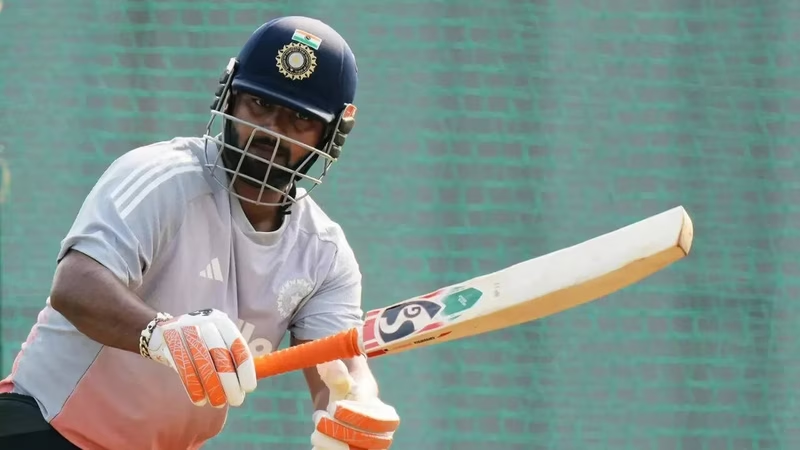
In a major blow to India’s ODI preparations, explosive wicketkeeper-batter Rishabh Pant has been officially ruled out of the upcoming three-match series against New Zealand due to a significant side strain injury. The setback comes just days before the first ODI in Mumbai, throwing the selection committee into a scramble for a suitable replacement and raising fresh concerns about Pant’s recurring fitness issues.
According to a reliable source cited by the Times of India, “He has been diagnosed with a right-sided strain with internal oblique muscle tear, and has thus been ruled out of the forthcoming ODI series against New Zealand” . This latest injury adds another chapter to Pant’s turbulent journey back to top-level cricket following his near-fatal car accident in December 2022.
Table of Contents
- The Diagnosis Behind the Rishabh Pant Injury
- How Did the Injury Occur?
- Who Will Replace Pant in the ODI Squad?
- KL Rahul Steps Up as Primary Wicketkeeper
- Why Oblique Injuries Are a Nightmare for Cricketers
- Impact on India’s ODI Strategy Against New Zealand
- Pant’s Road to Recovery and Future Tournaments
- Conclusion: A Test of Depth and Resilience
- Sources
The Diagnosis Behind the Rishabh Pant Injury
The official medical report confirms that Pant suffered a tear in his right internal oblique muscle—a core stabilizer crucial for rotational power during batting, bowling, and even sprinting between wickets. Such injuries are graded on severity, and while the BCCI hasn’t disclosed the exact grade, the fact that he’s been ruled out entirely suggests at least a Grade 2 strain, which typically requires 3–5 weeks of rest and rehabilitation .
This isn’t the first time Pant has dealt with soft-tissue issues. His return from the 2022 car crash was already complicated by ligament damage and spinal bruising. Now, this new Rishabh Pant injury threatens to disrupt his rhythm just as he was regaining form in domestic and international cricket.
How Did the Injury Occur?
While the exact moment remains unclear, reports suggest the injury occurred during a high-intensity net session in Mumbai. Pant, known for his aggressive shot-making—especially pulls, hooks, and cover drives—likely over-rotated or was struck by a short ball, causing sudden strain on his core muscles. Unlike fractures or ligament tears, oblique strains often happen without dramatic contact, making them harder to prevent but equally debilitating.
Who Will Replace Pant in the ODI Squad?
With Pant out, the BCCI selection committee is expected to announce a replacement imminently. Top contenders include:
- Dhruv Jurel: The 22-year-old UP wicketkeeper has impressed in domestic cricket and made his T20I debut earlier this year. His solid technique and calm demeanor make him a strong candidate.
- Ishan Kishan: Though recently inconsistent, Kishan has ODI experience and can bat aggressively in the top order.
- KS Bharat: A reliable gloveman, though less explosive with the bat compared to Pant.
[INTERNAL_LINK:india-wicketkeeper-prospects] Given the team’s current balance, Dhruv Jurel appears the most likely choice to provide long-term development value.
KL Rahul Steps Up as Primary Wicketkeeper
While a replacement will be named, it’s almost certain that KL Rahul—India’s regular ODI wicketkeeper in Pant’s absence—will don the gloves for the series. Rahul, who kept wickets during India’s 2023 World Cup campaign, brings stability behind the stumps and is a proven top-order batter.
However, keeping wickets adds physical and mental load, which could affect his batting—a concern given his recent struggles to convert starts into big scores. The coaching staff will need to manage his workload carefully across all three matches.
Why Oblique Injuries Are a Nightmare for Cricketers
Oblique strains are among the most common—and frustrating—injuries in cricket. According to the British Journal of Sports Medicine, these injuries account for nearly 15% of all missed playing days in professional cricket due to their high recurrence rate and slow healing process .
For batters like Pant, whose game relies on explosive torso rotation, returning too early can lead to chronic weakness or re-tear. Teams now use advanced biomechanical analysis to monitor stress on core muscles—but prevention remains challenging in high-pressure environments.
Impact on India’s ODI Strategy Against New Zealand
Pant’s absence significantly alters India’s middle-order dynamics. Known for his ability to score 50 runs in 20 balls, Pant provided a unique counterbalance to the more orthodox batters. Without him, India may lack the firepower needed to chase or accelerate in the final 10 overs.
Coach Rahul Dravid might now lean on Hardik Pandya or Suryakumar Yadav to fill that role—but neither offers the same combination of wicketkeeping and finishing prowess. This could force India into a more conservative approach, especially on slower Indian pitches.
Pant’s Road to Recovery and Future Tournaments
All eyes now turn to the ICC Champions Trophy in February 2026. If Pant adheres to a strict rehab protocol—including core strengthening, controlled batting drills, and gradual return-to-play protocols—he could be fit in time. However, the BCCI may opt to rest him from the IPL 2026 auction or limit his franchise commitments to avoid re-injury.
For a player of Pant’s caliber, managing his body is now as critical as managing his talent.
Conclusion: A Test of Depth and Resilience
The Rishabh Pant injury is more than a personnel change—it’s a stress test for India’s bench strength and strategic flexibility. While KL Rahul and a young replacement will step up, Pant’s irreplaceable X-factor leaves a noticeable gap. As fans, we hope this latest setback becomes a brief pause in his comeback story, not another detour. For now, Team India must adapt, overcome, and honor his fighting spirit on the field.