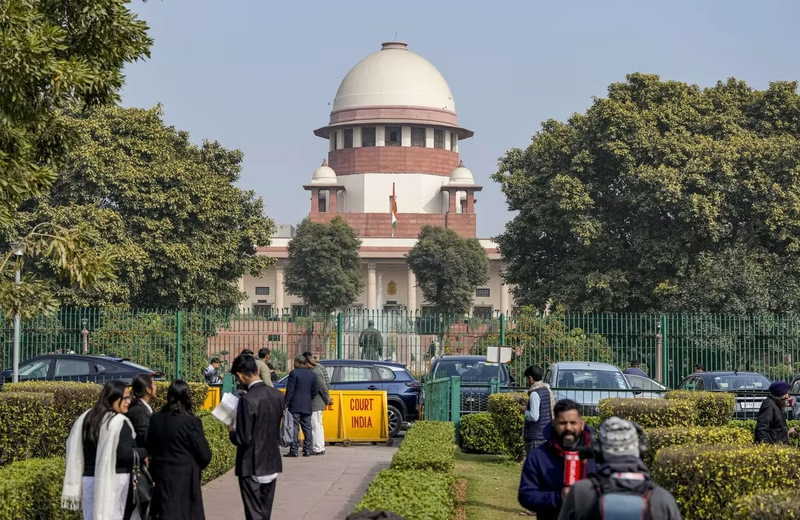
Speedy Justice Isn’t a Privilege—It’s a Right, Says Supreme Court
In a powerful reaffirmation of constitutional values, the Supreme Court of India has declared that the right to speedy trial is not conditional on the severity of a crime. Whether it’s a financial offense or a grave criminal act, no accused should languish in jail indefinitely without trial. This principle was put into action recently when the Court granted bail to the former chairman of auto-components giant Amtek after he spent 16 months behind bars—despite the serious nature of the charges against him.
But the ruling isn’t without complexity. Just weeks earlier, the same Court denied bail to activists jailed for over two years in a high-profile conspiracy case. So what’s the difference? And what does this tell us about the evolving standards of justice in India?
Table of Contents
- What the Supreme Court Said About Right to Speedy Trial
- The Amtek Chairman Case: A Test of Constitutional Justice
- Conflicting Bail Rulings: Activists vs. Corporate Accused?
- Legal Basis of the Right to Speedy Trial in India
- How Delay Harms Justice System and Accused
- What This Means for Future Bail Petitions
- Conclusion: Justice Delayed Is Justice Denied—For Everyone
- Sources
What the Supreme Court Said About Right to Speedy Trial
Delivering its judgment, the bench emphasized a crucial constitutional truth: the right to speedy trial is embedded in Article 21 of the Indian Constitution, which guarantees the right to life and personal liberty.
“The nature of the offense cannot be a reason to deny an accused their fundamental right to a timely trial,” the Court stated. “Prolonged incarceration without conviction is a form of punishment in itself—one the law does not permit.”
Importantly, the Court clarified that while delay alone isn’t automatic grounds for bail, when combined with lack of progress in trial, it becomes a compelling factor—especially if the accused has already spent a significant portion of the likely sentence in custody.
The Amtek Chairman Case: A Test of Constitutional Justice
The petitioner, former Amtek Auto chairman, was arrested in 2024 in connection with alleged bank loan fraud involving over ₹2,000 crore. He remained in judicial custody for 16 months while the trial barely advanced.
The Supreme Court noted:
- No chargesheet had been framed even after a year
- Key witnesses hadn’t been examined
- The accused had no prior criminal record and posed no flight risk
“Sixteen months is not a short period,” the bench observed. “If the state cannot conclude its investigation or trial in a reasonable time, it cannot indefinitely deprive a citizen of liberty” .
Conflicting Bail Rulings: Activists vs. Corporate Accused?
The ruling sparked debate because it contrasts sharply with a recent decision where the Court denied bail to activists in the Bhima Koregaon-Elgar Parishad case—some of whom have been jailed since 2018.
Legal experts explain the distinction lies in the **stage of proceedings** and **evidence cited**:
- In the Amtek case, the trial hadn’t even begun; there was no concrete progress.
- In the activist cases, charges have been framed, and the prosecution claims voluminous digital evidence requires time to process.
Still, critics argue this creates a two-tier system: the wealthy get bail on delay, while others don’t. “The principle must be applied uniformly,” says senior advocate Vrinda Grover .
Legal Basis of the Right to Speedy Trial in India
While the phrase “speedy trial” doesn’t appear in the Constitution, the Supreme Court has consistently read it into Article 21 since the 1980s.
Key precedents include:
- Hussainara Khatoon v. Home Secretary, Bihar (1979): First case to link delay to violation of Article 21
- Abdul Rehman Antulay v. R.S. Nayak (1988): Laid down guidelines for assessing unreasonable delay
- Arnab Manoranjan Goswami v. State of Maharashtra (2020): Reinforced that bail is rule, jail is exception
For deeper context on judicial delays, explore our analysis on [INTERNAL_LINK:why-indian-courts-are-overburdened-and-what-can-be-done].
How Delay Harms Justice System and Accused
Prolonged pre-trial detention has severe consequences:
- Psychological trauma: Accused lose years of life, careers, and family stability
- Erosion of evidence: Witnesses forget details or become unavailable
- Prison overcrowding: Over 70% of India’s 480,000+ jail inmates are undertrials
- Presumption of innocence undermined: Society treats the accused as guilty long before trial
As the Law Commission of India noted in its 271st Report, “Delay is the enemy of justice.”
What This Means for Future Bail Petitions
This judgment sets a clear precedent: courts must now actively assess trial progress when hearing bail applications. Defense lawyers can cite this ruling to argue that:
- Time already served should count toward sentence
- Lack of trial momentum justifies conditional bail
- Liberty cannot be held hostage to administrative inefficiency
However, the Court also warned against using this as a blanket rule—serious crimes with strong evidence may still warrant custody.
Conclusion: Justice Delayed Is Justice Denied—For Everyone
The Supreme Court’s reaffirmation of the right to speedy trial is a timely reminder that justice isn’t just about punishment—it’s about fairness, dignity, and the presumption of innocence. Whether you’re a billionaire industrialist or a grassroots activist, the law must move at a pace that respects human liberty. As India grapples with a backlog of over 50 million cases, this ruling isn’t just legal doctrine—it’s a moral imperative.
Sources
- Times of India. “Right to speedy trial irrespective of nature of offence: Supreme Court grants bail to Amtek chairman in jail for 16 months.” https://timesofindia.indiatimes.com/…
- Supreme Court of India. Official Judgments Database. https://main.sci.gov.in
- National Crime Records Bureau (NCRB). Prison Statistics India 2024. https://ncrb.gov.in
- Law Commission of India. Report No. 271: “Promoting Speedy Trials.” https://lawcommissionofindia.nic.in