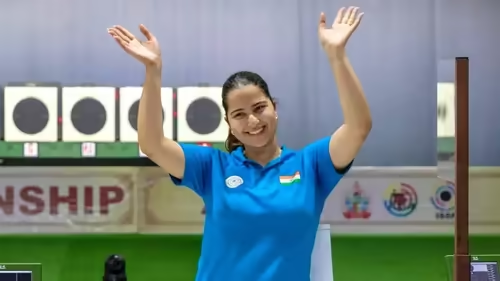
Rhythm Sangwan’s Quest for Gold at the Asian Shooting Championships: Can She Conquer Home Pressure?
For most athletes, competing at home is a dream—a chance to perform in front of roaring crowds and supportive fans. But for 22-year-old Indian shooter Rhythm Sangwan, the upcoming Asian Shooting Championships in New Delhi comes with a unique set of pressures. “Playing in Delhi has its challenges,” she recently admitted, acknowledging the weight of expectation that accompanies a home tournament [[1]].
Despite a stellar 2024—where she clinched three international medals—Sangwan is still chasing that one missing piece: an Asian Shooting Championships gold. Now, with the continent’s top marksmen descending on the capital, she’s determined to turn her focus inward, block out the noise, and let her process do the talking.
Table of Contents
- Who Is Rhythm Sangwan?
- What’s at Stake in the 2026 Asian Shooting Championships?
- The Unique Challenges of Shooting in Delhi
- How Sangwan Is Mastering the Mental Game
- India’s Broader Hopes at the Championship
- Conclusion: The Making of a Champion
- Sources
Who Is Rhythm Sangwan?
Rhythm Sangwan isn’t new to the spotlight. Hailing from Haryana, she emerged as one of India’s most promising young shooters in the women’s 25m pistol discipline. In 2024 alone, she secured a bronze at the ISSF World Cup in Cairo and followed it up with consistent top-five finishes across multiple global events [[2]].
Her rise has been steady, marked by technical precision and a calm demeanor under pressure—traits essential in a sport where milliseconds and millimeters decide victory. Yet, despite her global success, the Asian Shooting Championships gold has remained just out of reach, making this year’s home edition all the more significant.
What’s at Stake in the 2026 Asian Shooting Championships?
Held in New Delhi from late January to early February 2026, the Asian Rifle and Pistol Shooting Championship is more than just a continental title—it’s a critical Olympic qualifier. With Paris 2028 on the horizon, every medal here could translate into vital ranking points and quota places for national teams [[3]].
For India, which has consistently ranked among Asia’s top shooting nations alongside China, South Korea, and Kazakhstan, a strong showing is non-negotiable. The competition will feature over 400 athletes from 30+ countries, turning the Dr. Karni Singh Shooting Range into a high-stakes arena where nerves are tested as much as skill.
The Unique Challenges of Shooting in Delhi
“Playing in Delhi has its challenges,” Sangwan told reporters—a candid admission that speaks volumes. While home support can be energizing, it also brings added scrutiny. Friends, family, local media, and even well-wishers become part of an invisible audience that can amplify self-doubt.
Beyond psychology, Delhi’s environment poses tangible hurdles:
- Air Quality: Despite efforts to improve conditions, winter air pollution in Delhi can affect visibility and respiratory comfort—critical factors in precision sports like shooting [[4]].
- Range Familiarity vs. Complacency: While Sangwan trains regularly at the Dr. Karni Singh range, over-familiarity can sometimes dull competitive edge. Top shooters from abroad often arrive with fresh eyes and meticulously planned strategies.
- Logistical Noise: Home tournaments mean managing distractions—interviews, guest lists, and administrative duties—that visiting athletes don’t face.
Yet, as Sangwan notes, these aren’t excuses—they’re variables to be managed.
How Sangwan Is Mastering the Mental Game
Instead of fixating on the “missing” gold, Sangwan has adopted a process-oriented mindset. “I’m not thinking about medals or past results,” she emphasized. “My focus is on executing my shot plan, one trigger pull at a time.”
This approach aligns with modern sports psychology, which prioritizes controllable actions over outcomes. Elite shooters often work with mental coaches to develop routines that anchor them in the present moment—breathing techniques, visual cues, and pre-shot rituals that create a bubble of calm amid chaos [[5]].
Sangwan’s coach, [INTERNAL_LINK:indian-shooting-coaches], has reportedly intensified her mental resilience training in the weeks leading up to the event, simulating crowd noise and high-pressure scenarios during practice sessions.
India’s Broader Hopes at the Championship
Sangwan isn’t alone in her quest. The Indian shooting contingent includes Tokyo 2020 medallists and rising stars like Manu Bhaker and Saurabh Chaudhary, all aiming to dominate the medal tally. Historically, India has performed strongly in pistol events, and the 2026 edition offers a golden opportunity to assert regional supremacy ahead of the next Olympic cycle.
A successful campaign could also boost funding and grassroots interest in the sport—especially in women’s shooting, where India has become a global powerhouse thanks to athletes like Sangwan.
Conclusion: The Making of a Champion
Rhythm Sangwan’s journey at the Asian Shooting Championships is more than a personal pursuit—it’s a microcosm of modern Indian sport: talented, resilient, and navigating the fine line between expectation and excellence. Whether she secures that elusive gold or not, her ability to stay grounded under home pressure is already a victory in itself. As the shots ring out in Delhi, all eyes will be on her—not just to win, but to prove that true champions are forged in the fire of adversity.
Sources
- Times of India: ‘Playing in Delhi has its challenges’: Sangwan chases ‘missing’ gold
- ISSF Official Website: International Shooting Sport Federation (ISSF)
- Olympics.com: Shooting at the Olympic Games
- The Hindu: India announces strong squad for Asian Shooting Championships
- Journal of Sports Sciences: Mental skills training in elite shooting athletes