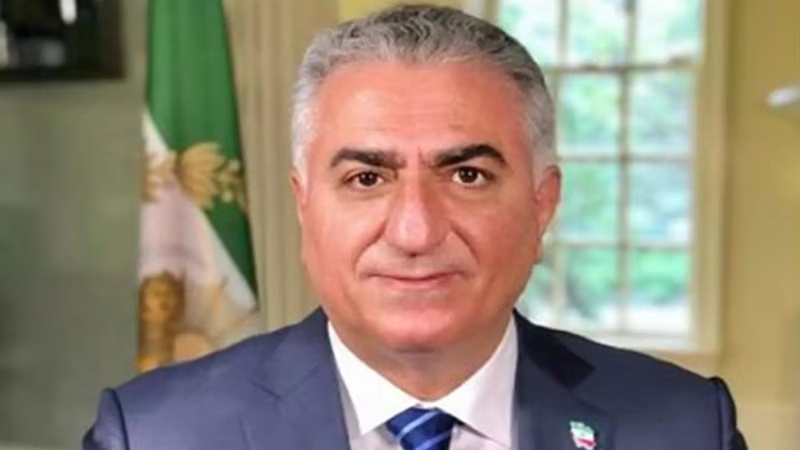
Introduction: A Ghost from Iran’s Past Steps into the Spotlight
For over 50 years, he’s lived in quiet exile—first in Egypt, then the U.S.—watching from afar as the country he was born to rule transformed beyond recognition. Now, Reza Pahlavi, the former crown prince of Iran, is back in global headlines. Not with armies or declarations, but with words that carry the weight of history. In a series of recent interviews, Pahlavi has hinted at a potential return to Iran, not as a monarch demanding a throne, but as a unifying figure in a nation desperate for change .
With Iran gripped by recurring waves of protest and deepening economic despair, Pahlavi’s message resonates with a segment of the population—especially the youth—who never lived under the monarchy but see the Pahlavi name as a symbol of secularism, modernity, and national pride. But is this just nostalgia? Or could Iran actually witness a political revival of its royal past?
Table of Contents
- Who Is Reza Pahlavi?
- What Did Reza Pahlavi Say About Returning?
- Why Iranians Are Looking Back to the Pahlavi Era
- The Challenges to a Royal Restoration
- What a Pahlavi-Led Transition Would Look Like
- Conclusion: Symbol or Statesman?
- Sources
Who Is Reza Pahlavi?
Born in 1960, Reza Pahlavi is the eldest son of Mohammad Reza Pahlavi, the last Shah of Iran, and Empress Farah Diba. He was just 19 when the 1979 Islamic Revolution forced his family into exile, ending 2,500 years of Persian monarchy. Educated in the U.S., he became a vocal critic of the Islamic Republic while advocating for democratic reform—not royal restoration—at least publicly.
Over the decades, he’s built a network of supporters through the National Council of Iran, a coalition of opposition groups. Though he holds no official power, his symbolic status as the last heir of the Pahlavi dynasty gives him unique moral authority among certain diaspora communities and domestic dissidents.
What Did Reza Pahlavi Say About Returning?
In a recent interview with international media, Reza Pahlavi stated, “If the Iranian people call for my return as part of a collective transition toward democracy, I will not hesitate to answer that call” . He emphasized that any return would be conditional on a national consensus and a clear roadmap for a secular, democratic Iran—not a reinstatement of monarchy.
He clarified that he sees himself not as a king-in-waiting, but as a “facilitator of unity” during a transitional period. His vision includes a referendum on Iran’s future governance model, free elections, and the protection of human rights—particularly for women and minorities.
Why Iranians Are Looking Back to the Pahlavi Era
Nostalgia for the Pahlavi era is complex. While the Shah’s regime was authoritarian and backed by the U.S., it also oversaw rapid modernization, women’s rights advancements, and a strong sense of Iranian nationalism. For many young Iranians today—facing unemployment, censorship, and mandatory hijab—the pre-1979 era represents a lost path of progress.
Social media is flooded with #Pahlavi hashtags and images of Empress Farah, signaling a cultural reclamation. According to a 2025 survey by the Center for Human Rights in Iran, nearly 38% of urban youth expressed openness to a non-monarchical role for Reza Pahlavi in a post-regime scenario . This isn’t about restoring kingship—it’s about reclaiming a national identity untethered from clerical rule.
The Challenges to a Royal Restoration
Despite the sentiment, formidable obstacles stand in the way:
- Lack of Institutional Support: No major opposition group officially endorses monarchy. Most advocate for a republic or federal system.
- Generational Divide: Older Iranians remember SAVAK (the Shah’s secret police) and fear authoritarianism returning in a new guise.
- Geopolitical Realities: The U.S. and EU support democratic transitions, not dynastic comebacks. Russia and China back the current regime for strategic reasons.
- Internal Security Apparatus: Iran’s Revolutionary Guard remains powerful and would fiercely resist any royalist movement.
What a Pahlavi-Led Transition Would Look Like
Pahlavi himself has outlined a three-phase plan should conditions allow:
- National Unity Government: A provisional coalition of reformists, secularists, and moderate Islamists to oversee the transition.
- Constitutional Referendum: A free and fair vote to decide Iran’s future system—monarchy, republic, or something new.
- Democratic Elections: Universal suffrage to elect a new parliament and president under a secular framework.
He insists he would not run for office and would step aside once democratic institutions are established. His role, he says, is purely transitional—a bridge from dictatorship to democracy.
Conclusion: Symbol or Statesman?
Reza Pahlavi may never sit on a throne, but his relevance lies in his ability to unify disparate opposition voices under a shared vision of a free Iran. Whether he returns physically or remains a symbolic figurehead, his legacy is being rewritten—not by history books, but by a new generation demanding change. In a region where the past often dictates the future, Pahlavi’s story reminds us that sometimes, the most powerful revolutions begin with a single question: “What if?”
Sources
- Times of India: Is Reza Pahlavi planning to return after 50 yrs in exile?
- Center for Human Rights in Iran: Public Opinion Surveys on Political Alternatives
- U.S. Department of State – Iran Country Report on Human Rights Practices
- BBC Persian: Interviews with Reza Pahlavi (2025)
- [INTERNAL_LINK:iran-protest-movements-history]