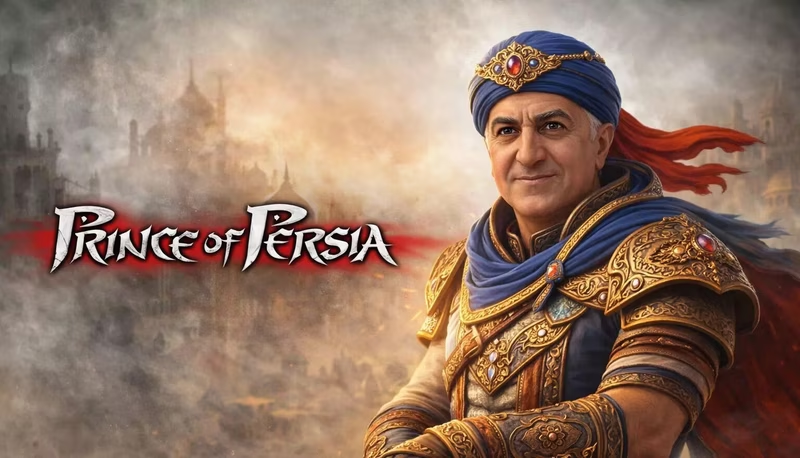
In the heart of Tehran, amidst chants for freedom and justice, a surprising figure has re-emerged as a beacon of hope for many: Reza Pahlavi. Born in 1960 as the heir to the Peacock Throne, his life was upended by the 1979 Islamic Revolution that sent his family into exile and transformed Iran forever . Now, nearly five decades later, his name is on the lips of protesters demanding an end to the current theocratic rule .
This isn’t just nostalgia for a bygone era. It’s a complex political movement driven by a deep yearning for a secular, democratic Iran. The question on everyone’s mind is whether Reza Pahlavi is a viable alternative or merely a symbolic figurehead for a generation that never knew his father’s reign.
Table of Contents
- From Peacock Throne to Washington Exile
- Why Reza Pahlavi Now? The Protest Connection
- The Pahlavi Platform: A Constitutional Future
- Challenges and Criticisms of a Royal Return
- What Does the Future Hold for Iran?
- Sources
From Peacock Throne to Washington Exile
The Pahlavi dynasty, founded by Reza Shah Pahlavi in 1925, ruled Iran with an iron fist but also pursued aggressive modernization . His son, Mohammad Reza Shah, continued this path, positioning Iran as a key US ally in the region. However, widespread discontent over political repression, economic inequality, and the Shah’s close ties to the West culminated in the Iranian Revolution of 1978-79 .
On January 16, 1979, the Shah fled into exile, marking the official end of the monarchy . His 18-year-old son, Reza, who had been educated in the United States, found himself the titular head of a dynasty that no longer existed in its homeland. Since then, he has lived primarily in the Washington, D.C. area, becoming a prominent voice for Iranian dissidents .
Why Reza Pahlavi Now? The Protest Connection
The recent wave of protests in Iran, stretching from 2025 into 2026, has been marked by unprecedented calls for systemic change . Unlike previous movements that focused on reforming the existing system, many demonstrators are now openly advocating for its complete overthrow. In this vacuum of leadership, Reza Pahlavi has emerged as a unifying symbol.
A 2022 poll indicated that he was the most popular political figure among respondents, with around 39% expressing support for him, often in the context of a constitutional monarchy . His consistent messaging from exile, urging peaceful resistance and a national referendum to decide Iran’s future, has resonated with a populace desperate for a clear, non-violent path forward . He has spent his adult life advocating for a secular government for Iran, positioning himself as an alternative to the current regime .
The Pahlavi Platform: A Constitutional Future
It’s crucial to understand that Reza Pahlavi is not campaigning for an absolute monarchy. In numerous interviews over the years, he has clarified his vision: a constitutional monarchy where the monarch serves as a ceremonial head of state, with real power resting in the hands of a democratically elected parliament .
His platform emphasizes core democratic principles:
- Secularism: A clear separation of religion and state.
- Human Rights: Full protection of civil liberties and freedoms.
- National Unity: A focus on a unified Iranian identity that transcends ethnic and religious divisions.
- Peaceful Transition: A firm commitment to achieving change through non-violent means and a national referendum .
This modern, democratic framework is what distinguishes his movement from a simple desire to return to the past.
Challenges and Criticisms of a Royal Return
Despite the growing support, the path to a Pahlavi restoration is fraught with obstacles. Critics argue that his popularity is largely confined to the diaspora and may not reflect the views of ordinary Iranians inside the country who have lived under the Islamic Republic their entire lives.
Others point to the legacy of his father’s regime, which, despite its modernization efforts, was known for its authoritarianism and the brutal activities of its secret police, SAVAK. There’s a legitimate fear that a return to monarchy, even a constitutional one, could be seen as a step backward by those who fought for a republic, however flawed it may be.
Furthermore, the current regime in Tehran will not relinquish power without a fierce fight. The idea of a royal return is viewed as a direct threat, and any organized movement around Pahlavi would face severe crackdowns.
What Does the Future Hold for Iran?
The resurgence of interest in Reza Pahlavi is less about restoring a king and more about rejecting the status quo. He has become a powerful symbol of a different Iran—one that is open, free, and connected to the world. Whether this symbolic support can translate into a concrete political reality remains to be seen. His call for a national referendum offers a democratic mechanism for the Iranian people to decide their own destiny, a proposition that is both radical and deeply appealing in the current climate .