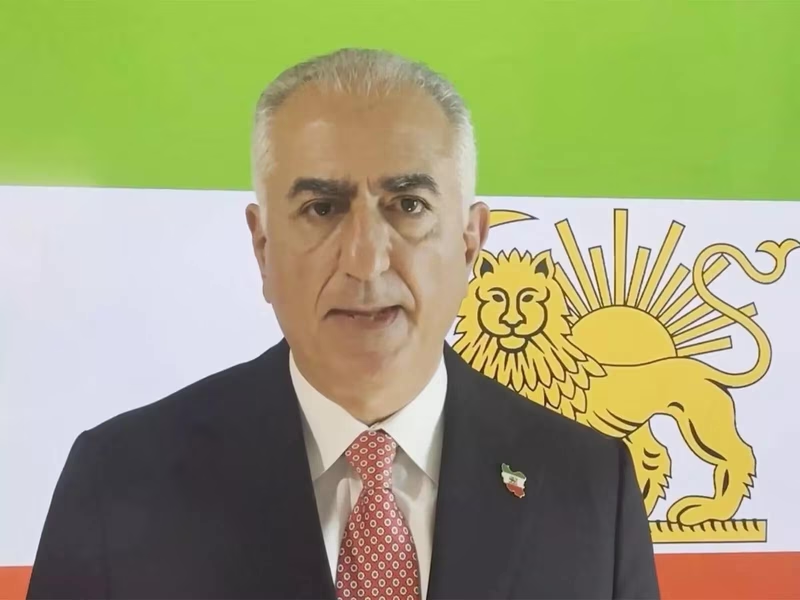
The ground is shifting beneath Tehran. What began as scattered street protests against economic hardship and state repression has now drawn a direct challenge from the exiled heir to Iran’s last monarchy. In a striking public address, Reza Pahlavi didn’t just express solidarity—he declared himself a leader with a mandate. “With the legitimacy and acceptance I have received from you,” he announced, “I declare another phase of the national uprising to overthrow the Islamic Republic and reclaim our beloved Iran.” His directive? “Seize and hold the cities.”
This isn’t rhetoric. It’s a strategic escalation that reframes the entire Reza Pahlavi Iran protests narrative—from grassroots dissent to organized insurrection. And it raises urgent questions: Does he truly speak for the streets? Can urban centers be held against state forces? And what comes after the regime falls?
Table of Contents
- Who Is Reza Pahlavi—and Why His Timing Matters
- The Five Key Takeaways From His Declaration
- Does Pahlavi Have the Legitimacy He Claims?
- What Does ‘Seize and Hold the Cities’ Actually Mean?
- International Reactions and Geopolitical Stakes
- Historical Parallels and Risks of Escalation
- Conclusion
- Sources
Who Is Reza Pahlavi—and Why His Timing Matters
Reza Pahlavi, son of the deposed Shah Mohammad Reza Pahlavi, has lived in exile since 1979. For decades, he positioned himself as a democratic alternative—a constitutional monarch who supports secularism, women’s rights, and free elections. Unlike hardline monarchists or militant groups, he’s long advocated nonviolent resistance.
But his latest statement marks a pivot. With protests intensifying across Iran—fueled by anger over corruption, mandatory hijab laws, and state violence—Pahlavi is no longer waiting on the sidelines. He’s claiming the movement has granted him authority to lead its next stage .
The Five Key Takeaways From His Declaration
Pahlavi’s message, delivered via social media and diaspora networks, contains five critical elements:
- Claim of Popular Mandate: He asserts that mass demonstrations have conferred “legitimacy and acceptance” upon him—a bold move in a leaderless protest landscape.
- Call for Physical Control: The phrase “seize and hold the cities” implies localized takeovers of municipal infrastructure, police stations, and government buildings.
- Rejection of Reform: He explicitly rejects negotiating with the current regime, framing the goal as total overthrow, not incremental change.
- National Unity Appeal: He emphasizes inclusivity—calling on Kurds, Baluchis, women, youth, and religious minorities to unite under a shared vision.
- Post-Regime Blueprint: He hints at a transitional council leading to a national referendum on Iran’s future governance model .
Does Pahlavi Have the Legitimacy He Claims?
This is the million-dollar question. While Pahlavi enjoys significant support among the Iranian diaspora and some urban youth, many inside Iran remain skeptical. The protest movement has been notably decentralized—led by students, labor unions, and women’s collectives—not royalists.
Analysts at the Atlantic Council note that while his message resonates emotionally, translating street energy into coordinated action under a single figure remains unproven . Still, in moments of crisis, symbolic leadership can crystallize fragmented movements.
What Does ‘Seize and Hold the Cities’ Actually Mean?
On the surface, it sounds like an armed insurrection. But Pahlavi’s team clarifies it’s about civil disobedience: occupying public squares, blocking highways, and establishing neighborhood councils to replace state functions—similar to tactics seen in Sudan’s 2019 revolution.
The risk? Iran’s Revolutionary Guard Corps (IRGC) has shown zero tolerance for such challenges. Previous attempts to hold territory—like during the 2022 Zahedan protests—were met with lethal force. Without international backing or internal military defections, sustained urban control may be unsustainable.
International Reactions and Geopolitical Stakes
So far, Western governments have remained cautious. The U.S. State Department reiterated support for “the Iranian people’s right to peaceful protest” but stopped short of endorsing Pahlavi or regime change .
Meanwhile, regional powers are watching closely. Saudi Arabia and Israel may quietly welcome the Islamic Republic’s fall, while Russia and China will likely oppose any U.S.-aligned transition. For deeper context, see our analysis on [INTERNAL_LINK:middle-east-power-plays-iran-uprising].
Historical Parallels and Risks of Escalation
Pahlavi’s call echoes 1979—but in reverse. Then, revolutionaries seized cities to install theocracy. Now, the aim is to dismantle it. Yet history also warns of chaos: post-Gaddafi Libya shows how power vacuums can breed warlordism.
If protests turn into urban warfare, civilians will bear the brunt. And if Pahlavi’s vision fails to unify diverse factions—secularists, Islamists, ethnic minorities—the result could be fragmentation, not freedom.
Conclusion
Reza Pahlavi’s declaration is more than a speech—it’s a high-stakes gamble that could galvanize or fracture the opposition. By framing the Reza Pahlavi Iran protests as a legitimate uprising with him at the helm, he’s betting that the moment demands not just resistance, but leadership. Whether Iran’s streets will follow him into the next phase remains the defining question of this historic uprising.
Sources
- Times of India – “’Seize and hold the cities’: 5 takeaways from Reza Pahlavi’s declaration amid Iran protests” (https://timesofindia.indiatimes.com/world/middle-east/seize-and-hold-the-cities-5-takeaways-from-reza-pahlavis-declaration-amid-iran-protests/articleshow/126485825.cms)
- Atlantic Council – “Iran’s Protest Movement: Between Decentralization and Leadership” (https://www.atlanticcouncil.org)
- U.S. Department of State – Official Statements on Iran (January 2026)