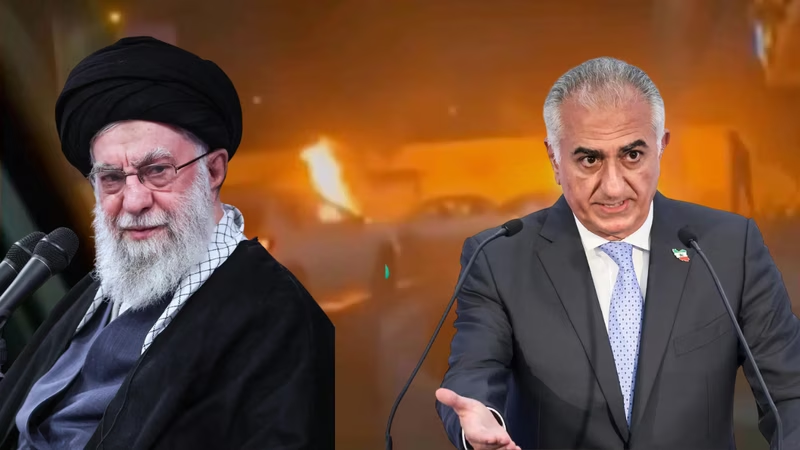
Iran is at a breaking point. Economic collapse, brutal repression, and mass disillusionment have pushed the Islamic Republic to what many analysts call its lowest ebb since 1979. And into this vacuum of legitimacy steps a ghost from the past: Reza Pahlavi, the exiled son of the last Shah of Iran.
Once dismissed as a relic of a bygone era, Pahlavi is now being hailed by protesters—from Tehran’s university campuses to Los Angeles’ Iranian diaspora—as a potential unifying symbol for a post-clerical Iran. He doesn’t command an army or hold office. Yet his name echoes in chants, his image flashes on protest banners, and his interviews draw millions of views. The question on everyone’s lips: Is Reza Pahlavi Ayatollah Khamenei’s greatest challenger?
This isn’t about restoring a monarchy. It’s about reclaiming national identity—and using the memory of 1979 not as a warning, but as a roadmap for change.
Table of Contents
- Who Is Reza Pahlavi? The Exiled Prince
- Reza Pahlavi Iran: A Symbol, Not a Savior
- Why Iran Is at Its Lowest Point in 50 Years
- The 1979 Revolution Connection: Lessons for Today
- Khamenei’s Response and Regime Vulnerabilities
- Global Reactions and U.S. Policy Shifts
- What Comes Next? Three Scenarios for Iran
- Conclusion: History Doesn’t Repeat, But It Rhymes
- Sources
Who Is Reza Pahlavi? The Exiled Prince
Born in 1960, Reza Pahlavi was crown prince when his father, Mohammad Reza Shah Pahlavi, was overthrown in the 1979 Islamic Revolution. He fled to Egypt at 19 and has lived in exile ever since—mostly in the United States.
Unlike many royal heirs, Pahlavi has consistently rejected calls for a monarchical restoration. Instead, he advocates for a secular, democratic Iran shaped by a national referendum. “I am not seeking power,” he stated in a 2023 interview. “I am offering a vision of unity” .
His message resonates particularly with Gen Z Iranians—those born after 1979—who see him not as a king-in-waiting, but as a bridge between pre-revolutionary modernity and post-clerical freedom.
Reza Pahlavi Iran: A Symbol, Not a Savior
The phrase “Reza Pahlavi Iran” trending online isn’t about nostalgia—it’s strategic symbolism. In a fractured opposition landscape (with Marxists, monarchists, feminists, and nationalists often at odds), Pahlavi offers a rare common denominator:
- He’s untainted by regime collaboration. Unlike some opposition figures, he’s never engaged with the Islamic Republic.
- He supports women’s rights and minority protections. His platform aligns with the “Woman, Life, Freedom” ethos of recent protests.
- He has international credibility. He’s addressed think tanks like Chatham House and met with U.S. lawmakers .
Crucially, he doesn’t claim to lead—but to convene. “Let the people decide Iran’s future,” he insists.
Why Iran Is at Its Lowest Point in 50 Years
The Islamic Republic faces a perfect storm:
- Economic freefall: Inflation exceeds 40%, the rial has lost 90% of its value since 2018, and youth unemployment hovers near 30% .
- Brutal repression: Over 500 killed and 20,000 arrested since the 2022 Mahsa Amini protests .
- International isolation: Sanctions, pariah status, and failed nuclear talks have crippled diplomacy.
- Succession uncertainty: Khamenei, 86, is frail; no clear successor exists, risking internal power struggles.
Even hardliners admit morale is collapsing within the Revolutionary Guard ranks—a sign the regime’s coercive power may be nearing its limit.
The 1979 Revolution Connection: Lessons for Today
Ironically, the very revolution that banished the Pahlavis may hold the key to their symbolic return. In 1979, diverse groups—leftists, Islamists, liberals—united to topple the Shah, only to see Ayatollah Khomeini seize control.
Today’s protesters are determined not to repeat that mistake. They chant “No Gaza, no Lebanon, my life for Iran”—rejecting the regime’s foreign adventurism—and demand inclusive democracy, not ideological rule.
Pahlavi, aware of this history, positions himself as a neutral facilitator: “We must avoid the trap of replacing one dictatorship with another,” he warned in a recent speech .
Khamenei’s Response and Regime Vulnerabilities
The regime dismisses Pahlavi as a “CIA puppet”—a tired trope that no longer sways urban youth. More tellingly, state media rarely mentions him, fearing that amplification could boost his profile.
Yet cracks are showing. In December 2025, leaked audio revealed senior clerics debating whether to offer limited reforms to stave off collapse—a sign of panic at the top .
Global Reactions and U.S. Policy Shifts
While the Biden administration officially backs “Iranian-led change,” behind the scenes, U.S. officials have quietly met with Pahlavi-aligned groups. The shift reflects growing consensus that the Islamic Republic is unsustainable.
European nations, meanwhile, are expanding sanctions on IRGC entities while funding independent Persian-language media—tools that amplify voices like Pahlavi’s without direct endorsement.
[INTERNAL_LINK:iran-protests-timeline-2022-2026] | [INTERNAL_LINK:what-is-the-irgc-and-why-it-matters]
What Comes Next? Three Scenarios for Iran
Experts outline possible paths:
- Regime survival through intensified repression (short-term likely, long-term unstable).
- Controlled transition led by reformist factions within the system (unlikely given hardliner dominance).
- Popular uprising leading to transitional council—where figures like Pahlavi could play a ceremonial role (increasingly plausible).
Conclusion: History Doesn’t Repeat, But It Rhymes
The rise of Reza Pahlavi Iran discourse isn’t about turning back time—it’s about learning from it. As Iran stands at its most fragile moment since the fall of the monarchy, the exiled prince offers not a throne, but a torch: one that illuminates a path beyond clerical rule toward a republic defined by liberty, not dogma. Whether he becomes Khamenei’s greatest challenger may depend less on him—and more on the courage of ordinary Iranians demanding change.
Sources
- Times of India: Khamenei’s greatest challenger? Iran at its lowest point in 50 years
- Chatham House: Iran’s Opposition and Future Governance Models
- International Monetary Fund: Iran Economic Outlook 2026
- Human Rights Watch: Iran Crackdown Reports
- Official Website of Reza Pahlavi: Public Statements Archive
- Middle East Institute: Iran’s Leadership Succession Crisis