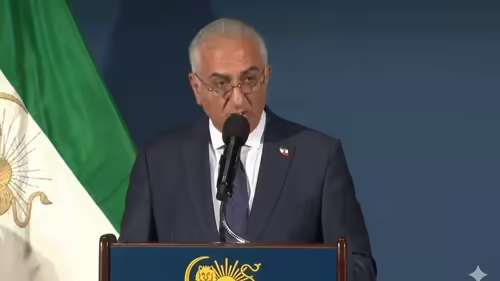
In a striking appeal that bridges history and geopolitics, Iran’s exiled crown prince Reza Pahlavi has positioned India as a cornerstone of his vision for a post-theocratic Iran. Speaking candidly in a recent interview, Pahlavi emphasized the “deep civilizational bonds” between Tehran and New Delhi and expressed strong optimism that a future democratic Iran would forge close strategic partnerships with nations like India that uphold sovereignty, pluralism, and technological progress .
His remarks come at a pivotal moment—amid growing unrest inside Iran and shifting alliances across Asia. While currently living in exile in the United States, Pahlavi has emerged as a unifying figure for Iran’s fragmented opposition movement. And now, by spotlighting Reza Pahlavi India ties, he’s signaling that a new Iran wouldn’t just realign with the West—but actively deepen ties with rising democracies in the Global South.
Table of Contents
- Who Is Reza Pahlavi—and Why His Words Matter
- The Historical Roots of Iran-India Relations
- Reza Pahlavi’s Vision for a Democratic Iran
- Key Areas for Future India-Iran Cooperation
- Geopolitical Implications for the Middle East and Beyond
- Challenges and Realities of a Post-Islamic Republic Iran
- Conclusion: A New Chapter Between Two Ancient Civilizations?
- Sources
Who Is Reza Pahlavi—and Why His Words Matter
Reza Pahlavi is the son of Mohammad Reza Pahlavi, the last Shah of Iran, who was overthrown during the 1979 Islamic Revolution. Though he holds no official political power, Pahlavi has spent decades advocating for a secular, democratic Iran. He leads the National Council of Iran, a coalition of opposition groups, and enjoys significant support among Iran’s youth and diaspora .
Unlike hardline factions or monarchist nostalgists, Pahlavi frames his mission not as a restoration of monarchy but as a transition to a constitutional democracy—where the people, not clerics or kings, hold ultimate authority. His outreach to India reflects this modern, inclusive approach.
The Historical Roots of Iran-India Relations
The connection between Persia (modern-day Iran) and India stretches back millennia. From the ancient trade routes of the Silk Road to shared linguistic roots in Sanskrit and Avestan, the two civilizations have long influenced each other:
- Cultural exchange: Zoroastrian refugees (Parsis) found sanctuary in India over 1,000 years ago and became integral to Indian commerce and society.
- Strategic geography: Both nations border the Indian Ocean and share interests in regional stability, counter-terrorism, and energy security.
- Economic potential: Pre-sanctions, Iran was a key oil supplier to India and a partner in the Chabahar Port project—a critical alternative to China’s Gwadar .
Pahlavi’s invocation of this shared heritage isn’t mere nostalgia—it’s a strategic reminder that Iran and India are natural allies beyond the constraints of current regimes.
Reza Pahlavi’s Vision for a Democratic Iran
In his interview, Pahlavi was clear: “Once Iran is free, we can start a new chapter.” He envisions a nation that rejects both theocratic rule and authoritarianism, embracing instead a system grounded in human rights, gender equality, and the rule of law.
Critically, he stressed that such an Iran would prioritize relationships with countries that “respect sovereignty and democratic values”—a clear nod to India’s non-aligned yet principled foreign policy. Unlike the current regime’s alignment with Russia and China, a democratic Iran under Pahlavi’s influence would likely pivot toward partnerships with the U.S., EU, and Indo-Pacific democracies.
Key Areas for Future India-Iran Cooperation
Pahlavi specifically highlighted three domains where Reza Pahlavi India ties could flourish:
- Renewable Energy: Iran has vast solar and wind potential. India’s expertise in green tech could help modernize Iran’s energy grid post-sanctions.
- Technology & Startups: With a young, educated population, Iran could become a tech hub—with Indian firms providing mentorship, investment, and market access.
- Cultural & Academic Exchange: Reviving university partnerships, film collaborations, and tourism to rebuild people-to-people bonds.
Notably, he avoided framing India as a counterweight to Pakistan or China—instead focusing on mutual growth and civilizational respect.
Geopolitical Implications for the Middle East and Beyond
A democratic Iran aligned with India would reshape regional dynamics:
- It could weaken the “Axis of Resistance” (Iran-Syria-Hezbollah-Houthis).
- Strengthen the Indo-Pacific strategy by adding a friendly partner on the western flank.
- Provide India with secure energy corridors and enhanced influence in Central Asia.
However, experts caution that such a shift would face resistance from entrenched powers in Tehran, Moscow, and Beijing. As Dr. Anjali Mody of the Observer Research Foundation notes, “India will tread carefully—supporting democracy in principle but avoiding overt backing of any single opposition figure” .
Challenges and Realities of a Post-Islamic Republic Iran
While Pahlavi’s vision is compelling, the path to democracy remains fraught. The Islamic Revolutionary Guard Corps (IRGC) controls vast economic and military resources. Internal divisions among opposition groups persist. And global powers remain divided on intervention.
Moreover, India maintains diplomatic relations with the current Iranian government—especially regarding Chabahar Port, crucial for Afghanistan access. Any public embrace of Pahlavi could complicate these delicate ties.
Still, quiet engagement may already be underway. For deeper insights, explore our analysis on [INTERNAL_LINK:india-middle-east-strategy].
Conclusion: A New Chapter Between Two Ancient Civilizations?
Reza Pahlavi’s call for stronger Reza Pahlavi India ties is more than diplomatic rhetoric—it’s a blueprint for a transformed Middle East. By anchoring his democratic vision in historical friendship and future-oriented collaboration, he offers India a rare opportunity: to help shape a stable, prosperous Iran that aligns with shared democratic values.
Whether this vision becomes reality depends on forces far beyond one man’s words. But in a world hungry for hopeful alternatives, Pahlavi’s message resonates as both a promise and a challenge—to Iranians, Indians, and all who believe that ancient civilizations can build a freer future together.
Sources
- Times of India: ‘Can start a new chapter’: Iran’s exiled crown prince Reza Pahlavi hails ties with India
- Encyclopædia Britannica: Reza Pahlavi – Biography
- Ministry of External Affairs, India: India-Iran Bilateral Relations
- Observer Research Foundation: India’s Strategic Options in a Post-Khamenei Iran (2025)