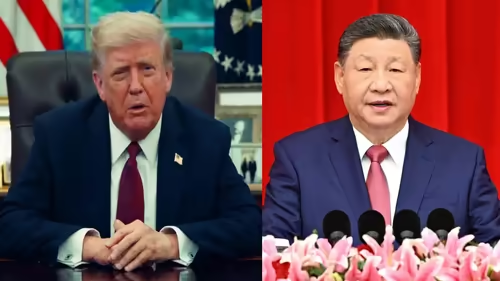
On January 26, 2026, as India marked its 77th Republic Day with a grand parade in New Delhi and celebrations across the nation, a quieter but equally significant diplomatic ritual unfolded: Republic Day messages from global leaders. These weren’t just polite greetings—they were calibrated statements packed with symbolism, strategy, and subtle signals about where the world’s most powerful nations stand in relation to India.
From Donald Trump’s praise of “the world’s oldest and largest democracies” to Xi Jinping’s poetic reference to a “dragon-elephant tango,” and King Charles III’s nod to “enduring partnership,” each message offered a window into the complex web of international alliances at a time of rising global uncertainty. But what do these words truly mean beneath the diplomatic veneer?
Table of Contents
- Trump’s Message: Democracy and Strategic Alliance
- Xi Jinping’s ‘Dragon-Elephant Tango’—Explained
- King Charles III and the India-UK Partnership
- Why Republic Day Messages Matter in Global Diplomacy
- The Geopolitical Context of 2026
- Conclusion: Words as Weapons and Bridges
- Sources
Trump’s Message: Democracy and Strategic Alliance
In his Republic Day message, former U.S. President Donald Trump—still a dominant figure in American politics—highlighted the “historic bond” between the United States and India, calling them “the world’s oldest and largest democracies.”
This phrasing is no accident. By framing the relationship through the lens of shared democratic values, Trump reinforced a narrative that has become central to U.S.-India ties under both Democratic and Republican administrations. It’s also a not-so-subtle contrast to China’s authoritarian model—a point increasingly emphasized in Washington’s Indo-Pacific strategy [[1]].
Notably, Trump avoided mentioning trade disputes or defense procurement delays, focusing instead on unity and mutual respect. For observers, this suggests a desire to keep the strategic partnership on track, especially as India plays a pivotal role in countering Chinese influence in Asia.
Xi Jinping’s ‘Dragon-Elephant Tango’—Explained
Chinese President Xi Jinping took a more metaphorical route. In his greeting, he described India and China as “good neighbours, friends and partners,” and invoked the now-famous phrase: the “dragon-elephant tango.”
The “dragon” (China) and “elephant” (India) imagery has been used before—but always cautiously. The tango implies coordination, rhythm, and mutual awareness. Yet, given the ongoing border tensions in Ladakh and deep mistrust on trade and security issues, many analysts see this as aspirational diplomacy rather than a reflection of reality [[1], [3]].
Xi’s message notably omitted any reference to the 2020 Galwan clash or the current military standoff. Instead, he emphasized “peaceful coexistence” and “common development”—standard Beijing talking points aimed at softening China’s image while maintaining strategic ambiguity.
King Charles III and the India-UK Partnership
From London, King Charles III sent a warm and statesmanlike message, praising the “enduring India-UK partnership” and highlighting “shared values and deepening cooperation.”
His remarks come at a critical juncture. The UK has been pushing hard to finalize a long-delayed Free Trade Agreement (FTA) with India, while also seeking to strengthen defense and tech collaboration post-Brexit. By invoking “shared values,” the King subtly aligned the UK with the democratic bloc led by the U.S.—a positioning that distances Britain from closer ties with authoritarian regimes [[2]].
Moreover, as Head of State, Charles’s message carries symbolic weight, reinforcing continuity in bilateral relations despite political shifts in Westminster.
Why Republic Day Messages Matter in Global Diplomacy
To the casual observer, these annual greetings might seem like routine protocol. But in international relations, every word is weighed. Republic Day messages serve several key functions:
- Signal intent: They show whether a country wants to deepen or distance ties.
- Manage public perception: Leaders use them to shape narratives at home and abroad.
- Maintain protocol without commitment: A friendly message costs nothing but keeps communication channels open.
- Counter rival narratives: In a multipolar world, aligning with India is a strategic move against competitors.
For India, receiving such messages—especially from geopolitical rivals like the U.S. and China—is a sign of its growing centrality in global affairs.
The Geopolitical Context of 2026
These messages arrive amid heightened global volatility. The Indo-Pacific is a flashpoint, with naval buildups, semiconductor wars, and supply chain realignments underway. India, as a non-aligned but strategically autonomous power, is courted by all sides.
The U.S. sees India as a linchpin in the Quad alliance. China wants to prevent India from fully aligning with Washington. The UK, meanwhile, seeks relevance beyond Europe. In this chess game, Republic Day messages are small but telling moves.
According to the Council on Foreign Relations, India’s ability to balance relationships with both Washington and Beijing is one of the most delicate—and consequential—acts in modern diplomacy [[4]].
For deeper insights, explore our analysis on [INTERNAL_LINK:india-foreign-policy-in-a-multipolar-world].
Conclusion: Words as Weapons and Bridges
The Republic Day messages from Trump, Xi, and King Charles III may be brief, but they are far from trivial. They reflect a world where diplomacy is conducted not just in backroom deals, but in public pronouncements loaded with subtext. As India continues to assert itself on the global stage, these annual greetings will remain a barometer of its standing—and the shifting sands of international power.
Sources
- Times of India: In Republic Day messages, Trump hails historic bond, Xi talks of dragon-elephant tango
- UK Government – Royal Communications: His Majesty The King’s Message to India on Republic Day 2026
- Ministry of External Affairs, India: Statements and Messages Received on Republic Day
- Council on Foreign Relations (CFR): India’s Foreign Policy in an Era of Strategic Competition
- Brookings Institution: The Dragon and the Elephant: Managing Rivalry