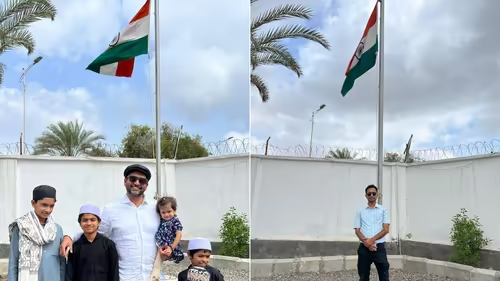
On January 26, 2026, a quiet but powerful ceremony unfolded in one of the world’s most volatile regions: Yemen. For the first time in over ten years, the Indian Embassy there unfurled the tricolor to mark Republic Day in Yemen. This wasn’t just a nostalgic nod to national pride—it was a deliberate signal of India’s re-engagement with a fractured nation and its commitment to its citizens abroad.
While grand parades dazzled on Kartavya Path in New Delhi, smaller yet equally meaningful celebrations took place across the globe—from Tokyo to Colombo, Singapore to Washington, D.C.—uniting the Indian diaspora under a shared identity. But it was the return of Republic Day observances in Yemen that caught the attention of foreign policy watchers.
Table of Contents
- Why Republic Day in Yemen Matters After a Decade
- The 2026 Ceremony: What Happened?
- India’s Diplomatic Presence in Yemen: A Timeline
- Global Republic Day Celebrations 2026: Highlights
- Marco Rubio’s Unusual Greeting—and What It Signals
- The Strategic Importance of Yemen for India
- Conclusion: A Symbolic Flag with Real-World Implications
- Sources
Why Republic Day in Yemen Matters After a Decade
The last official Republic Day event at the Indian Embassy in Sana’a was held before 2015—a year that marked the escalation of Yemen’s civil war and the collapse of central governance. With security conditions deteriorating, India, like many nations, scaled back its diplomatic operations. The embassy remained functional but operated with minimal staff, often from safer locations.
Resuming a formal Republic Day in Yemen celebration suggests a cautious but clear recalibration. It signals that India is not only monitoring the situation closely but is also willing to reassert its presence—even symbolically—in a region critical to its energy security and maritime interests.
The 2026 Ceremony: What Happened?
According to reports from the Ministry of External Affairs (MEA), the flag-hoisting ceremony in Yemen was attended by Indian embassy staff and members of the local Indian community. Though small in scale, the event carried deep emotional and diplomatic weight. Photos released by the embassy showed the tricolor fluttering against a backdrop of modest surroundings—a stark contrast to the grandeur in New Delhi, yet no less significant.
Such ceremonies are more than protocol; they reassure Indian nationals—many of whom work in essential sectors like healthcare and construction—that their government has not forgotten them, even in conflict zones.
India’s Diplomatic Presence in Yemen: A Timeline
India’s relationship with Yemen dates back decades, but recent history has been turbulent:
- Pre-2015: Full-fledged embassy operations in Sana’a; active trade and labor migration.
- 2015: Operation Raahat evacuates over 4,600 Indians and foreign nationals as war intensifies [[1]].
- 2015–2025: Embassy remains technically open but operates with skeletal staff; most services shifted to Riyadh or virtual platforms.
- January 2026: Formal Republic Day celebration resumes—first in over 10 years [[2]].
Global Republic Day Celebrations 2026: Highlights
Beyond Yemen, Indian missions worldwide marked the 77th Republic Day with enthusiasm:
- United States: The Indian Embassy in Washington, D.C., hosted a large gathering of diaspora members. Notably, U.S. Secretary of State Marco Rubio extended official greetings—a rare and high-level acknowledgment [[3]].
- Singapore: Cultural performances and a youth-led flag ceremony highlighted community participation.
- Japan: The embassy in Tokyo emphasized Indo-Japanese technological collaboration in its Republic Day address.
- Sri Lanka: A joint cultural event with local artists underscored centuries-old civilizational ties.
Marco Rubio’s Unusual Greeting—and What It Signals
U.S. Secretary of State Marco Rubio’s public Republic Day message to India was more than ceremonial. In his statement, he praised the “enduring partnership between our democracies” and highlighted cooperation in defense, technology, and climate resilience [[3]].
Coming from a key figure in the new U.S. administration, this gesture underscores the strategic depth of Indo-U.S. ties. It also reflects a broader trend: Republic Day is no longer just an internal celebration—it’s a global diplomatic platform.
The Strategic Importance of Yemen for India
Yemen sits at the southern tip of the Red Sea, adjacent to the Bab-el-Mandeb Strait—one of the world’s busiest maritime chokepoints. Over 80% of India’s oil imports pass through this corridor [[4]]. Stability in Yemen is therefore not just a humanitarian concern but a core national security interest.
Moreover, an estimated 30,000–50,000 Indians still reside in Yemen, many working in challenging conditions. Re-establishing consistent diplomatic visibility helps protect their welfare and reinforces India’s role as a responsible stakeholder in West Asia.
For more on India’s West Asia strategy, see our analysis on [INTERNAL_LINK:india-middle-east-policy].
Conclusion: A Symbolic Flag with Real-World Implications
The simple act of hoisting the Indian flag in Yemen after a decade-long pause is rich with meaning. It speaks to India’s quiet but persistent diplomacy, its commitment to its overseas citizens, and its strategic patience in a complex region. While the parade in New Delhi showcases might, the ceremony in Sana’a embodies resilience.
In an era where soft power and diaspora engagement define global influence, Republic Day in Yemen may be small—but it’s mighty in its message.
Sources
- [1] Ministry of External Affairs, Government of India. “Operation Raahat – 2015.” https://www.mea.gov.in
- [2] The Times of India. “After a gap of over 10 years, India marks Republic Day in Yemen.” https://timesofindia.indiatimes.com/india/after-a-gap-of-over-10-years-india-marks-republic-day-in-yemen/articleshow/127552145.cms
- [3] U.S. Department of State. “Secretary Rubio’s Statement on India’s Republic Day 2026.” https://www.state.gov
- [4] Observer Research Foundation. “India’s Maritime Interests in the Red Sea Region.” https://www.orfonline.org