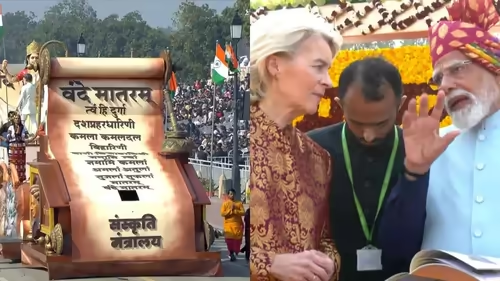
On January 26, 2026, India didn’t just mark its 77th Republic Day—it reasserted its civilizational identity. At the center of the grand spectacle on Kartavya Path was a poignant cultural tableau by the Ministry of Culture, celebrating the enduring legacy of Vande Mataram, the song that once stirred a nation to freedom and now echoes through its democratic soul.
This wasn’t just another ceremonial march. With President Droupadi Murmu and Prime Minister Narendra Modi presiding over the event—and European Union leaders Antonio Costa and Ursula von der Leyen as chief guests—the day carried both domestic resonance and global significance. But what truly set Republic Day 2026 apart was its deliberate return to cultural roots, using heritage as a lens to frame India’s modern ambitions.
Table of Contents
- The Vande Mataram Tableau: A Cultural Anchor
- Republic Day 2026: Dignitaries and Global Presence
- Kartavya Path Transformed: A Narrative of Progress
- Beyond the Parade: What Vande Mataram Represents Today
- Military Might Meets Cultural Soft Power
- Conclusion: Republic Day as a Living Heritage
- Sources
The Vande Mataram Tableau: A Cultural Anchor
The Ministry of Culture’s tableau was the emotional centerpiece of the civilian segment of the parade. Designed to reflect the historical and spiritual journey of Vande Mataram—from its origins in Bankim Chandra Chattopadhyay’s 1882 novel Anandamath to its role in the Indian independence movement—the display featured traditional artisans, classical dancers, and visual motifs drawn from India’s diverse regional traditions.
Unlike tableaux focused solely on infrastructure or technology, this one emphasized cultural continuity. It reminded viewers that India’s constitutional democracy is built not just on laws, but on centuries of shared ethos. The phrase “Vande Mataram” (I bow to thee, Mother) was rendered in multiple scripts—Devanagari, Bengali, Tamil, Gurmukhi—symbolizing linguistic unity in diversity.
Republic Day 2026: Dignitaries and Global Presence
For the first time, India hosted two top European leaders as joint chief guests: Antonio Costa, President of the European Council, and Ursula von der Leyen, President of the European Commission. Their presence underscored the deepening strategic partnership between India and the EU, especially in areas like green tech, digital governance, and defense cooperation.
President Droupadi Murmu, the first tribal woman to hold the office, took the salute at Kartavya Path—a powerful symbol of inclusion. Prime Minister Narendra Modi, standing alongside her, watched as contingents from the armed forces, paramilitary, and NCC marched with precision. The dual leadership on the dais reflected India’s evolving political landscape: rooted in tradition, yet forward-looking.
Kartavya Path Transformed: A Narrative of Progress
Once known as Rajpath, the renamed Kartavya Path—stretching from Rashtrapati Bhavan to the National War Memorial—was meticulously decorated to tell India’s story. Floral installations depicted milestones from the last decade: the launch of Chandrayaan-3, the construction of the Ram Mandir in Ayodhya, and the expansion of the Ujjwala and PM Awas Yojana schemes.
But the decorations weren’t just celebratory—they were thematic. The path was divided into zones representing “Azadi Ka Amrit Mahotsav,” “Make in India,” and “Green India,” creating a visual timeline that connected past sacrifices with present achievements. LED screens along the route displayed archival footage of freedom fighters juxtaposed with modern innovators, reinforcing the idea that duty (kartavya) is the thread linking generations.
Beyond the Parade: What Vande Mataram Represents Today
While the national anthem is Jana Gana Mana, Vande Mataram holds a unique place in India’s emotional architecture. In 2026, its revival in the Republic Day 2026 tableau sparked conversations about cultural memory in a globalized age.
Experts note that the choice reflects a broader governmental emphasis on ‘cultural nationalism’—not as exclusion, but as a source of soft power. As Dr. Meera Sampath, a historian at Jawaharlal Nehru University, explained in a recent interview, “Vande Mataram isn’t just a song; it’s a mnemonic device for collective resilience.”
Military Might Meets Cultural Soft Power
The parade seamlessly blended hard power and soft power. On one hand, India showcased its latest defense capabilities: the indigenously developed Tejas Mk-1A fighter jets, the BrahMos supersonic cruise missile, and women-led contingents from the Armed Forces Medical Services.
On the other, folk troupes from Sikkim, Odisha, and Gujarat performed on moving floats, their vibrant costumes and rhythms telling stories of harvest, devotion, and community. This duality—strength and grace, steel and silk—is increasingly central to India’s global image.
For authoritative context on national symbols and ceremonies, the Ministry of External Affairs provides official documentation on India’s diplomatic and cultural protocols.
Conclusion: Republic Day as a Living Heritage
Republic Day 2026 was more than a commemoration—it was a reaffirmation. By placing Vande Mataram at the heart of its cultural narrative, India signaled that its future is inseparable from its past. With global leaders witnessing this fusion of heritage and ambition, the message was clear: India’s democracy isn’t just surviving; it’s thriving on its own terms.
As citizens across the country hoisted the tricolor, the day served as a reminder that national pride isn’t static—it’s renewed every year through collective memory, civic duty, and the unwavering belief in the idea of India. For more on national events and policy, explore our coverage on [INTERNAL_LINK:indian-national-holidays-and-ceremonies].