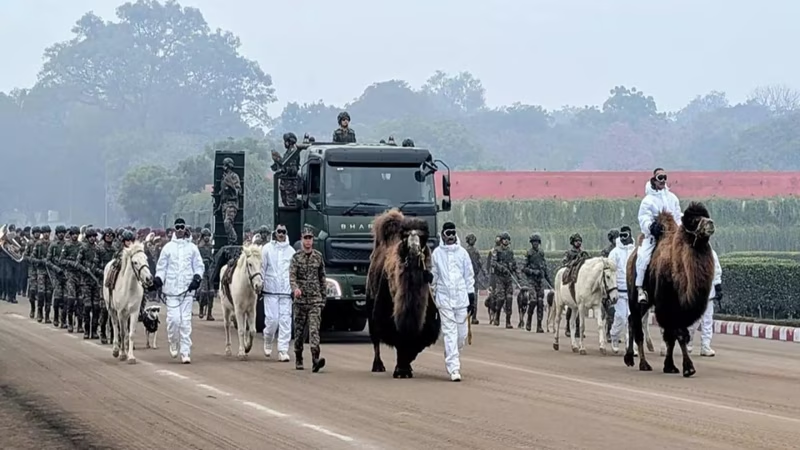
Imagine this: amidst the thunder of tanks and the sharp precision of our marching soldiers on Kartavya Path, a different kind of hero steps into the spotlight. Not a human, but a creature whose loyalty, strength, and endurance have been a silent yet crucial pillar of our national security. For the first time ever, Republic Day 2026 will officially showcase the Indian Army’s remarkable animal contingent—Bactrian camels, Zanskar ponies, raptors, and a squad of brave Indian-breed dogs . But this historic debut has sparked a fascinating debate: is this a long-overdue tribute, or a carefully crafted narrative of tradition in a modern military age?
Table of Contents
- Why the Animal Contingent is a Game-Changer for Republic Day 2026
- Meet the Four-Legged Warriors of the Indian Army
- Beyond the Parade: The Real Mission of India’s Animal Force
- A Dive into the History and Strategy Behind the Scenes
- The Great Debate: Tradition, Tribute, or Tactical Display?
- Conclusion: Not Just a Parade, But a Promise
- Sources
Why the Animal Contingent is a Game-Changer for Republic Day 2026
The Republic Day 2026 parade has always been a symbol of India’s military might and cultural mosaic. This year, it takes a bold new direction. The official contingent from the Remount Veterinary Corps (RVC) will include two Bactrian camels, four Zanskar ponies, four raptors, ten Indian-breed Army dogs, and six conventional military canines . This isn’t just about adding a unique visual element; it’s a profound statement on the integration of indigenous resources, tradition, and tactical necessity in modern warfare. It’s a powerful narrative of self-reliance—a cornerstone of India’s current defence policy .
Meet the Four-Legged Warriors of the Indian Army
These aren’t just animals; they are highly trained and essential members of our armed forces. Let’s get to know them.
The Resilient Bactrian Camels
Native to the harsh, high-altitude regions of Ladakh, these double-humped camels are a recent but critical formal inductee into the Indian Army . Their incredible ability to withstand freezing temperatures and traverse difficult, snow-laden terrains makes them perfect for last-mile logistics and patrolling in areas where even the most advanced vehicles fail . A Bactrian camel can carry loads of up to 250 kg for long distances, a capability the Army is now strategically leveraging along its sensitive northern borders .
The Mighty Zanskar Ponies
Often called the ‘soldiers of the snow,’ these small but incredibly strong mountain ponies are indigenous to the Zanskar region of Ladakh. For decades, they have been the backbone of military logistics in the Himalayas . These hardy creatures can cover up to 70 kilometres in a single day on mountainous trails, ferrying supplies and supporting mounted patrols in areas inaccessible to motorized transport . The Army is even looking to gradually replace mules with these more resilient Zanskar ponies .
The Loyal K9 Corps and Soaring Raptors
The Indian Army’s K9 units, featuring breeds like German Shepherds, Labradors, and now Indian breeds like the Rampur Hound, are indispensable for roles ranging from detection and tracking to combat support . These dogs serve on the front lines with a courage that is nothing short of heroic . Complementing them are the raptors—majestic birds of prey used for surveillance and scouting in specific, challenging environments. Their inclusion in the parade is a nod to the diverse and innovative ways the Army operates .
Beyond the Parade: The Real Mission of India’s Animal Force
The spectacle on Kartavya Path is just the tip of the iceberg. The real story unfolds in the remote, frozen outposts of Ladakh and the treacherous mountain passes of the Himalayas. Here, these animals are not ceremonial; they are lifelines. Their roles are a perfect blend of ancient wisdom and modern military strategy, proving that sometimes, the best technology is nature itself, refined by generations of adaptation .
A Dive into the History and Strategy Behind the Scenes
The route of the parade itself, now known as Kartavya Path (formerly Rajpath), is a historic ceremonial boulevard designed during the British Raj . Having these indigenous animals march on this iconic path is deeply symbolic. It reclaims a narrative of strength that is uniquely Indian. The decision to include them in 2026 is also a strategic move towards highlighting the Army’s ongoing efforts in conserving and utilizing native species, moving away from complete reliance on imported resources and showcasing a form of defence self-sufficiency .
The Great Debate: Tradition, Tribute, or Tactical Display?
Some critics may view this as a nostalgic spectacle, a feel-good moment with little strategic value. But that would be a shallow interpretation. This parade contingent is a meticulously planned communication from the Indian military to its citizens and the world. It says: “Our strength is not just in our missiles and tanks, but in the deep-rooted, indigenous solutions that have safeguarded this nation for centuries.” It’s a tribute that educates and a display that informs, all while honoring the silent sacrifices of these non-human soldiers who have no voice but whose service speaks volumes .
Conclusion: Not Just a Parade, But a Promise
As we watch the Republic Day 2026 parade unfold, the sight of camels, ponies, and dogs marching with our soldiers should be more than just a photo opportunity. It’s a powerful reminder of a holistic approach to national security—one that respects its past, leverages its natural assets, and innovates for the future. It’s a promise to never forget the silent warriors who stand, walk, and fly in service of our nation, far from the crowds and cameras on Kartavya Path.
Sources
- Times of India: Republic Day 2026 parade: Camels, ponies and dogs to march on Kartavya Path
- The Hindu: Army Animal Contingent to Debut at Republic Day Parade 2026
- India Today: Indian Army’s unique animal contingent to feature in Republic Day 2026 parade
- Ministry of Defence, India: Official Website
- National Geographic: Bactrian Camel Facts