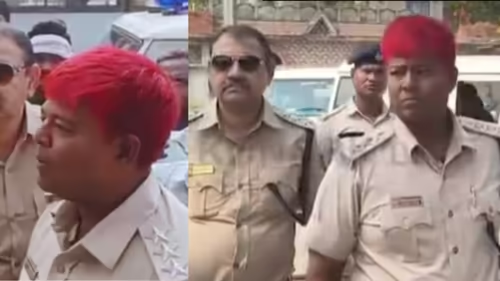
Imagine being mocked online for something completely beyond your control—something as personal as your own hair. That’s exactly what happened to Odisha Deputy Superintendent of Police (DSP) Rashmi Ranjan Das, whose vibrant red hair recently became the subject of viral memes, workplace gossip, and even official scrutiny.
But in a candid and dignified response, DSP Das shut down the speculation: his red hair isn’t a fashion statement, a rebellion, or a cosmetic experiment. It’s the result of a **medical condition** that has been gradually altering his hair pigmentation for years. His story shines a light on a rarely discussed aspect of health—how internal disorders can manifest in visible, misunderstood ways.
Table of Contents
- The Controversy That Sparked a Conversation
- What Is the Red Hair Medical Condition?
- Common Medical Causes of Unexpected Hair Color Changes
- Why Public Perception Matters for Civil Servants
- DSP Das’ Response and the Power of Transparency
- Breaking Stigma Around Visible Health Conditions
- Conclusion: Judgment vs. Empathy in the Digital Age
- Sources
The Controversy That Sparked a Conversation
DSP Das, a respected officer in Odisha’s law enforcement, began noticing changes in his hair color several years ago. What started as subtle reddish streaks eventually turned into a full head of copper-toned locks. In a profession where uniformity and discipline are emphasized, his appearance drew attention—some curious, some critical.
Recently, photos of him circulated widely on social media, with users mocking his “punk look” or accusing him of violating police dress codes. The backlash escalated to the point where he felt compelled to speak out—not in anger, but in education.
“This is not a choice,” he stated firmly. “It is a health issue I have no control over.”
What Is the Red Hair Medical Condition?
While DSP Das did not disclose his specific diagnosis, medical experts say several conditions can cause natural hair to turn red or reddish—even in people with no genetic predisposition to red hair.
The most likely culprits include:
- Premature canities with oxidative stress: When melanin production declines unevenly, residual pheomelanin (the red/yellow pigment) can dominate, giving hair a ginger or auburn tint [[1]].
- Vitiligo or alopecia areata: Autoimmune disorders that attack pigment cells can alter hair color in patches or overall.
- Nutritional deficiencies: Severe lack of copper, iron, or vitamin B12 can affect melanin synthesis, leading to unusual hues.
- Medication side effects: Certain drugs (e.g., chemotherapy, antimalarials) are known to change hair color temporarily.
Importantly, this is **not albinism** or a genetic trait—it’s an acquired condition, often progressive and irreversible.
Common Medical Causes of Unexpected Hair Color Changes
Many people assume hair color is fixed after adolescence. But dermatologists confirm that health, environment, and aging can dramatically shift pigmentation:
| Condition | Typical Hair Change | Reversible? |
|---|---|---|
| Oxidative stress | Brown/black → red/gold | No |
| Copper deficiency | Dark → silvery or pale red | Sometimes |
| Vitiligo | Patches of white or pale hair | Rarely |
| Thyroid disorders | Thinning + color dulling | With treatment |
As Dr. Anjali Sharma, a dermatologist at AIIMS Delhi, explains: “Hair is a mirror of internal health. A sudden or unexplained color shift should prompt a medical evaluation—not judgment” [INTERNAL_LINK:hair-as-a-health-indicator].
Why Public Perception Matters for Civil Servants
In India, police officers are expected to maintain a “standard” appearance—short hair, neutral colors, minimal deviation. This norm stems from colonial-era discipline codes, but it often clashes with modern realities of health and diversity.
Officers like DSP Das face a double bind: uphold institutional image while managing personal health. Yet, as public servants, they also have a unique platform to challenge outdated norms. By speaking openly, Das has turned a moment of shame into one of awareness.
DSP Das’ Response and the Power of Transparency
Rather than file a complaint or retreat, DSP Das chose clarity. In a brief but powerful statement, he said:
“My red hair is not dyed. It is the result of a medical condition that began years ago. I request people not to make assumptions about others based on appearance.”
This simple act of honesty disarmed critics and earned him widespread support—from fellow officers to medical professionals. It also highlighted a broader truth: **visible differences are not always choices**.
Breaking Stigma Around Visible Health Conditions
From vitiligo to alopecia, millions live with conditions that alter their appearance. Yet stigma persists because these issues are rarely discussed in mainstream discourse.
DSP Das’ case is a reminder that empathy matters. Before mocking someone’s looks, consider: Could this be a symptom, not a statement? As social media fuels snap judgments, stories like his are vital antidotes to cruelty.
Conclusion: Judgment vs. Empathy in the Digital Age
The red hair medical condition affecting Odisha’s DSP isn’t just a personal health issue—it’s a societal mirror. It reflects how quick we are to judge, and how slow we are to understand.
Hopefully, Das’ courage will inspire others to speak up—and encourage the public to pause before posting. Because sometimes, the most rebellious thing you can do is simply exist as you are… and demand to be seen with dignity.
Sources
- Times of India: DSP: Red hair a medical condition, not cosmetic choice
- Journal of the American Academy of Dermatology: Acquired Hair Color Changes: A Clinical Review
- World Health Organization (WHO): Micronutrient Deficiencies and Hair Health
- National Vitiligo Foundation: Understanding Pigment Disorders