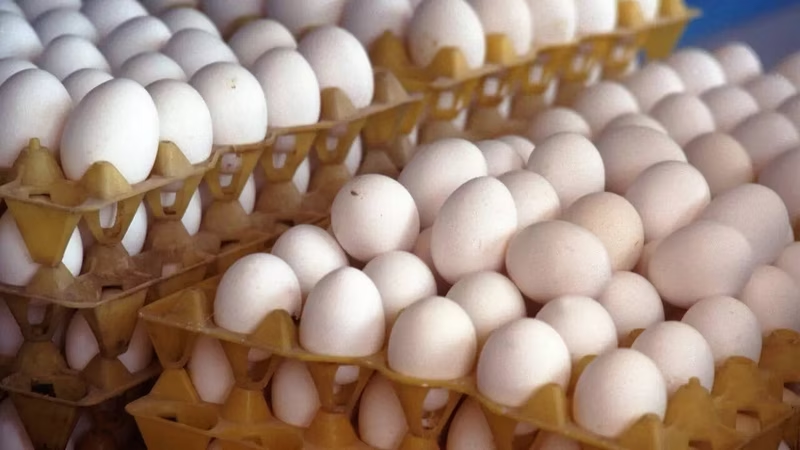
You crack open an egg for your morning omelette—and something feels off. The yolk is too firm. The white doesn’t spread like it should. Could it be… fake?
While it sounds like a plot from a dystopian thriller, the circulation of synthetic or “plastic” eggs has been reported in parts of Asia, including India and China, sparking widespread concern among consumers . These counterfeit eggs—made from a mix of calcium carbonate, starch, resin, and dye—are designed to mimic real eggs but offer zero nutrition and may even pose health risks with long-term consumption .
The good news? You don’t need a lab to protect yourself. With a few simple, non-destructive tests, you can confidently tell real egg vs fake egg before they ever hit your pan.
Table of Contents
- What Are Fake Eggs Made Of?
- Why Fake Eggs Exist: The Shocking Truth
- 5 Non-Destructive Tests to Spot a Fake Egg
- Real Egg vs Fake Egg: A Side-by-Side Comparison
- Health Risks of Consuming Synthetic Eggs
- What to Do If You Find a Fake Egg
- Conclusion
- Sources
What Are Fake Eggs Made Of?
Despite the name “plastic egg,” most counterfeits aren’t made from actual plastic. Instead, fraudsters use a blend of:
- Calcium carbonate (for the shell)
- Potato or corn starch (for the egg white)
- Alginic acid or resin (to bind ingredients)
- Food coloring (to mimic yolk hue)
The result? An egg that looks convincing from the outside—but lacks protein, vitamins, and the natural texture of a real egg .
Why Fake Eggs Exist: The Shocking Truth
Fake eggs aren’t about pranks—they’re about profit. In regions with high egg demand and volatile prices, counterfeiters can produce synthetic eggs at a fraction of the cost. One report from China’s Guangdong province estimated fake eggs could be manufactured for as little as ₹8–10 each, compared to ₹7–9 for real ones—but sold at market rates, yielding huge margins .
While large-scale infiltration into mainstream supply chains is rare, unregulated vendors and roadside stalls remain vulnerable points of entry.
5 Non-Destructive Tests to Spot a Fake Egg
You don’t need to crack it open. Try these easy checks at home or in the store:
- Shake Test: Hold the egg close to your ear and shake gently. A real egg is silent. A fake one may produce a faint sloshing sound due to loose internal binding.
- Shell Texture: Real eggshells are slightly rough and porous. Fake shells are often unnaturally smooth, glossy, or waxy to the touch.
- Weight Check: Fake eggs tend to be lighter than real ones of the same size. Compare with a known genuine egg if possible.
- Smell Test (Pre-Crack): Rub the shell vigorously with your palm for 10 seconds. Real eggs may emit a faint organic odor. Fake eggs might smell chemical-like or of chalk.
- UV Light (Optional): Under UV light, some synthetic resins used in fake eggs fluoresce—a trick used by food inspectors in high-risk zones [INTERNAL_LINK:food-safety-tips].
Real Egg vs Fake Egg: A Side-by-Side Comparison
Still unsure? Here’s a quick-reference guide:
| Feature | Real Egg | Fake Egg |
|---|---|---|
| Shell Texture | Matte, slightly grainy | Smooth, shiny, plastic-like |
| Weight | Heavier for its size | Lighter, hollow feel |
| Sound When Shaken | No sound | Faint liquid slosh |
| Odor (after rubbing) | Mild farm smell | Chemical or chalky |
| Price | Market-standard | Suspiciously cheap |
Health Risks of Consuming Synthetic Eggs
Occasional consumption may not cause immediate harm, but long-term intake of resin-based binders and industrial dyes can lead to digestive issues, liver stress, and potential toxin accumulation .
The Food Safety and Standards Authority of India (FSSAI) has issued multiple alerts about food adulteration, urging consumers to buy eggs only from licensed vendors and report suspicious products .
What to Do If You Find a Fake Egg
Don’t panic—and don’t eat it. Instead:
- Take clear photos of the egg and packaging.
- Report it to your local food safety authority or via the FSSAI’s Food Safety Connect app.
- Avoid confronting the seller directly; let officials handle verification.
Conclusion
The idea of fake eggs might seem far-fetched, but vigilance is your best defense. By mastering these simple, non-invasive checks, you can confidently distinguish real egg vs fake egg and protect your family’s health. Remember: when it comes to food, trust your senses—and always buy from reputable sources.
Sources
- Times of India. (2026, January). Real egg vs Fake egg: How to identify plastic eggs without breaking them. Retrieved from https://timesofindia.indiatimes.com/life-style/food-news/real-egg-vs-fake-egg-how-to-identify-plastic-eggs-without-breaking-them/articleshow/126496627.cms
- World Health Organization (WHO). (2024). Guidelines on Food Adulteration and Public Health Risks. Retrieved from https://www.who.int
- Journal of Food Science and Technology. (2023). Detection Methods for Synthetic Egg Substitutes. Vol. 60, Issue 4
- South China Morning Post. (2022). The Rise and Fall of China’s Fake Egg Scandal. Retrieved from https://www.scmp.com
- National Institute of Nutrition (India). (2025). Health Impacts of Common Food Adulterants. Retrieved from https://nin.res.in
- Food Safety and Standards Authority of India (FSSAI). (2026). Consumer Advisory on Egg Authenticity. Retrieved from https://www.fssai.gov.in