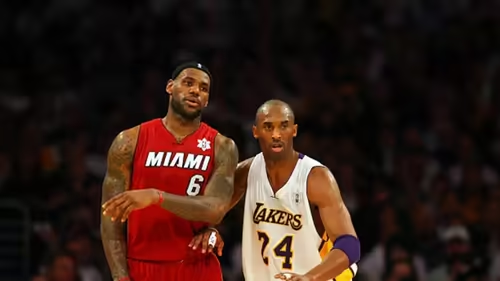
When the debate between LeBron James and Kobe Bryant flares up, it’s usually about championships, work ethic, or clutch gene. But music executive and podcaster Ray Daniels just threw a grenade into the conversation—and it had nothing to do with basketball.
On a recent episode of his show, Daniels made a shockingly personal remark that instantly went viral: “Kobe had a daddy. LeBron didn’t.” The comment, referencing the well-known fact that LeBron was raised by a single mother while Kobe’s father, Joe “Jellybean” Bryant, was a former NBA player and constant presence in his life, ignited a firestorm of criticism .
This wasn’t a hot take on fadeaway jumpers or playoff stats. It was a deeply intimate—and many say inappropriate—dig into childhood trauma. And it’s left fans, analysts, and even fellow celebrities questioning where the line should be drawn in sports discourse. The Ray Daniels LeBron Kobe controversy has shifted the conversation from legacy to basic human decency.
Table of Contents
- What Ray Daniels Actually Said
- Why the LeBron James Father Comment Crossed a Line
- The Real Stories Behind LeBron and Kobe’s Upbringings
- Public and Celebrity Reactions to the Controversy
- When Sports Debate Becomes Personal Attack
- Conclusion
- Sources
What Ray Daniels Actually Said
Daniels, known more for his work in the music industry than sports analysis, made the comment during a segment comparing the mentalities of the two NBA legends. He framed it as an explanation for their differing approaches to the game: Kobe’s relentless, almost obsessive drive versus LeBron’s more holistic, team-oriented style.
“Kobe had structure. He had a dad who played in the league, who knew the game inside and out,” Daniels said. “LeBron grew up without that male guidance. That shapes you. That’s why Kobe was wired differently.” While he may have intended to highlight environmental influences, the phrasing—especially the blunt “LeBron didn’t”—came across as dismissive and cruel to many listeners .
Why the LeBron James Father Comment Crossed a Line
LeBron James has been open about his challenging childhood in Akron, Ohio. Raised by his mother, Gloria James, he often speaks with pride about her sacrifices and strength. His absent father, Anthony McClelland, has been a source of pain he’s rarely discussed publicly—but that doesn’t make it fair game for public commentary.
Critics argue that Daniels’ remark wasn’t insightful analysis—it was a low blow disguised as psychology. Reducing a man’s entire career and character to the presence or absence of a father figure is not only reductive but ignores the resilience and determination LeBron showed in overcoming adversity. As one fan tweeted: “You don’t get to weaponize someone’s trauma to win a GOAT debate.”
The Real Stories Behind LeBron and Kobe’s Upbringings
To understand why this comment hit so hard, it’s important to look at the facts:
- Kobe Bryant: Born in Philadelphia, Kobe spent part of his childhood in Italy while his father played professional basketball overseas. Joe Bryant was a constant mentor, coaching him from a young age and instilling a deep love for the game. Their relationship was complex but undeniably present .
- LeBron James: Grew up in poverty in Akron, frequently moving between homes. His father was largely absent from his life. LeBron has credited his mother, Gloria, and surrogate father figures like Frank Walker and his high school coach Dru Joyce II for guiding him . He’s also created the I PROMISE School to support children in similar situations, turning his past into purpose.
Both men’s upbringings shaped them—but in vastly different, equally valid ways. Using one as a “superior” template is not just inaccurate; it’s disrespectful to the realities of millions of fatherless children who succeed against the odds.
Public and Celebrity Reactions to the Controversy
The backlash was swift and severe. Social media exploded with condemnation, with hashtags like #RespectLeBron trending on X (formerly Twitter). Former NBA players and media personalities weighed in, with many calling the comment “classless” and “unprofessional.”
Even outside the sports world, commentators noted how the remark reflected a broader societal tendency to judge men based on paternal presence—a harmful stereotype that ignores the diverse structures of modern families. [INTERNAL_LINK:nba-player-mental-health] The incident has reignited conversations about empathy in public discourse, especially when discussing athletes who are already under immense scrutiny.
When Sports Debate Becomes Personal Attack
The LeBron vs. Kobe debate is one of the most enduring in NBA history. Fans can argue for hours about scoring titles, defensive intensity, or leadership styles—all fair game. But the moment the discussion shifts from performance to personal trauma, it ceases to be a sports debate and becomes something else entirely.
Experts in sports psychology emphasize that an athlete’s background can inform their approach, but it should never be used as a weapon. As Dr. Justin Anderson, a licensed sport psychologist, notes: “Understanding context is valuable. Mocking someone’s childhood is not analysis—it’s bullying.”
Daniels later doubled down on his comments, claiming he was “just telling the truth,” which only fueled more anger. In an era where mental health and personal boundaries are increasingly respected, his refusal to acknowledge the harm caused feels tone-deaf at best.
Conclusion
The Ray Daniels LeBron Kobe controversy serves as a stark reminder: greatness in sports should be debated on the court, not in the wounds of someone’s past. LeBron James and Kobe Bryant are both icons whose legacies deserve thoughtful, respectful discussion. Dragging childhood trauma into a GOAT argument doesn’t elevate the conversation—it diminishes everyone involved. As fans, we can do better. And as commentators, they must.