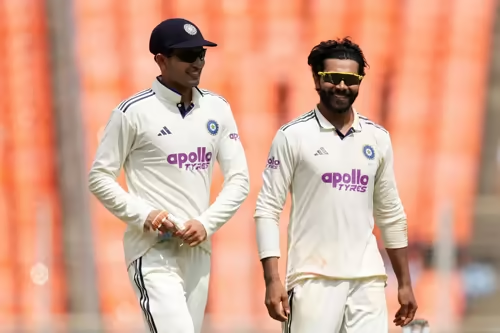
The hallowed grounds of domestic cricket were supposed to be a sanctuary—a place for India’s top stars to find rhythm, silence doubts, and rebuild confidence. But on Day 1 of the Ranji Trophy clash between Punjab and Saurashtra, that sanctuary turned into a pressure cooker. In a stunning twist that sent shockwaves through the cricketing world, both Shubman Gill and Ravindra Jadeja suffered embarrassing batting collapses, raising urgent questions about their current form just months before key international assignments .
Table of Contents
- Gill’s Two-Ball Nightmare
- Jadeja’s Continued Batting Struggles
- Match Context: Saurashtra Collapses, Punjab Stumbles
- Why This Matters for Indian Cricket
- Historical Precedents and Form Slumps in Domestic Cricket
- What Next for Gill and Jadeja?
- Conclusion: A Wake-Up Call in the Ranji Trophy
- Sources
Gill’s Two-Ball Nightmare
Shubman Gill’s much-anticipated return to the Ranji Trophy was supposed to be a statement. After inconsistent outings in recent international series, many expected the elegant right-hander to dominate the domestic circuit and remind selectors—and himself—of his class. Instead, he lasted just two deliveries.
Bowled by a sharp incoming delivery that nipped back off the seam, Gill was clean bowled without troubling the scorers. It was a dismissal that spoke less of technical error and more of a mind not fully in the game—perhaps burdened by expectations or lingering fatigue from a packed international calendar . For a batter of his caliber, such an exit is not just unlucky; it’s alarming.
This isn’t Gill’s first low in domestic cricket, but coming so soon after being retained as India’s No. 3 in Tests and a top-order mainstay in white-ball formats, it adds fuel to growing concerns about his concentration under pressure.
Jadeja’s Continued Batting Struggles
If Gill’s dismissal was shocking, Ravindra Jadeja’s was depressingly familiar. The all-rounder, often hailed as India’s premier match-winner with bat and ball, walked in with intent but departed for just 7 runs. His struggle against quality spin and short-pitched bowling has become a recurring theme over the past year .
Jadeja’s role in the Indian middle order has evolved—he’s no longer just a finisher but a genuine No. 6 or 7 who must stabilize innings. Yet, his recent returns in both international and domestic cricket suggest he’s lost some of the fluency that once made him so dangerous. Against Saurashtra’s disciplined attack, he looked tentative, unsure whether to defend or attack—a rare sight for a player known for his clarity of thought.
Match Context: Saurashtra Collapses, Punjab Stumbles
The day belonged to the bowlers. Saurashtra, batting first, was bundled out for a paltry 172. Their top order crumbled under pressure, offering little resistance to Punjab’s pace attack. However, Punjab’s response was equally unconvincing.
At stumps, they were 87 for 5—deep trouble on a pitch offering variable bounce and seam movement. Beyond the star names, the entire batting lineup appeared fragile. This context makes Gill’s and Jadeja’s failures even more significant: when senior players don’t anchor the innings, the team’s foundation cracks instantly.
Why This Matters for Indian Cricket
Some might argue: “It’s just domestic cricket.” But that’s a dangerous oversimplification. The Ranji Trophy is more than a tournament—it’s the bedrock of India’s cricketing pipeline. When established internationals like Gill and Jadeja fail here, it signals deeper issues:
- Form erosion: International cricket’s relentless schedule leaves little room for recovery. Domestic matches are meant to be reset buttons—but what if they expose further decline?
- Team balance: If Jadeja can’t contribute 30–40 crucial runs regularly, India’s batting depth thins significantly in overseas Tests.
- Psychological impact: Public failures, even in domestic games, can dent confidence. And in elite sport, confidence is everything.
As noted by ESPNcricinfo analysts, consistent domestic performance remains a key indicator for long-term international success . Ignoring these red flags could prove costly during high-stakes series against England or Australia later in 2026.
Historical Precedents and Form Slumps in Domestic Cricket
History is full of comebacks born from domestic struggles. Rahul Dravid once scored a string of low scores in the Ranji Trophy before reinventing himself as “The Wall.” Virat Kohli used a poor 2014-15 domestic season as motivation to overhaul his technique against spin.
But history also warns of ignored slumps. Players like Suresh Raina saw their international careers fade after repeated domestic failures went unaddressed. The difference? Self-awareness and corrective action. The question now is: will Gill and Jadeja use this setback as a catalyst—or let it fester?
What Next for Gill and Jadeja?
Both players have time—but not much. With India’s Test squad for the England tour expected to be announced in March 2026, the next few Ranji matches are critical. Gill needs to spend long hours in the middle, even if it means playing aggressively in low-risk situations. Jadeja, meanwhile, must revisit his trigger movements and shot selection against spin—a weakness that’s been exploited repeatedly.
For selectors, this is a test of patience versus pragmatism. Do they back proven performers through rough patches, or open the door to hungry domestic stars like Yash Dhull or Riyan Parag, who’ve been piling on runs consistently? [INTERNAL_LINK:india-test-squad-selection-2026]
Conclusion: A Wake-Up Call in the Ranji Trophy
The Ranji Trophy isn’t just about trophies or promotions—it’s a mirror. On Day 1 of Punjab vs Saurashtra, that mirror reflected discomfort, uncertainty, and vulnerability in two of India’s most trusted players. While one bad innings doesn’t define a career, a pattern of them does. For Gill and Jadeja, the path forward is clear: use the domestic arena not as an escape, but as a forge—to temper their skills, rebuild their confidence, and return to the international stage not just as names, but as match-winners once again.
Sources
- Times of India: Gill’s Ranji return ends in a two-ball duck; Jadeja’s batting woes continue
- ESPNcricinfo: How domestic form influences India’s national selection
- BCCI Official Match Scorecard: Punjab vs Saurashtra – Ranji Trophy 2025-26, Day 1 Report