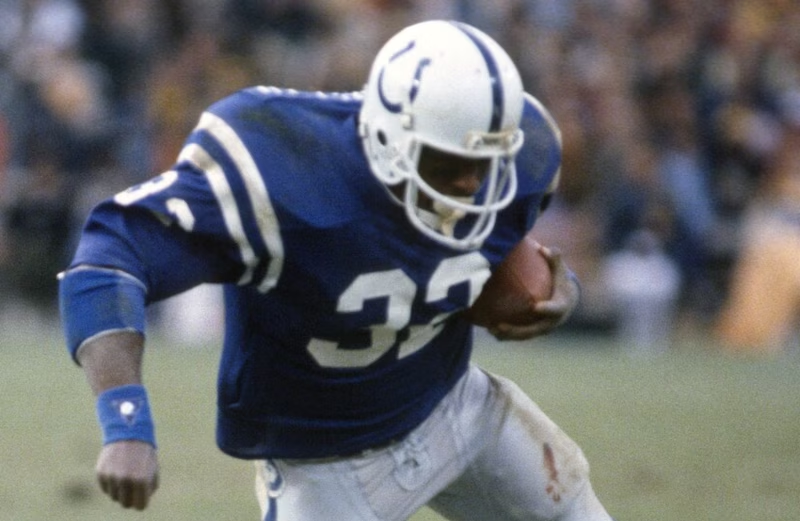
The football world is mourning the loss of Randy McMillan, the bruising running back who became a symbol of resilience during the Indianapolis Colts’ formative years in the 1980s. McMillan passed away on January 8, 2026, at the age of 67. While his family has not yet released an official Randy McMillan cause of death, his later life was marked by severe health complications stemming from a catastrophic car accident in 1987—one that abruptly ended his NFL career and left lasting physical and neurological effects.
Table of Contents
- Who Was Randy McMillan?
- Randy McMillan Cause of Death: What We Know
- The 1987 Car Accident That Changed Everything
- His Legacy with the Indianapolis Colts
- Tributes Pour In from the NFL Community
- Long-Term Impact of Sports Injuries and Accidents
- Conclusion: A Life of Power and Perseverance
- Sources
Who Was Randy McMillan?
Drafted by the Baltimore Colts in the 10th round of the 1981 NFL Draft out of the University of Pittsburgh, McMillan quickly earned respect for his relentless running style. When the franchise relocated to Indianapolis in 1984, he became one of the first stars of the new era. Standing at 5’11” and weighing 220 pounds, McMillan was known for his powerful cuts, durability, and ability to gain tough yards between the tackles.
Over six seasons (1981–1986), he rushed for 3,200 yards and 21 touchdowns, adding over 1,500 receiving yards—a rare dual-threat capability for a power back of his era. He was the Colts’ leading rusher in both 1984 and 1985, helping stabilize a struggling franchise during its transition to Indiana.
Randy McMillan Cause of Death: What We Know
As of now, no official cause of death has been publicly released by McMillan’s family or representatives. However, multiple sources close to the former player confirm that his health had been in serious decline for years due to complications from a near-fatal automobile collision in 1987—just months after his final NFL season .
While natural causes related to long-term trauma are widely presumed, the family has requested privacy during this difficult time. The Colts organization acknowledged his passing but did not disclose medical details, stating only that “Randy’s courage inspired generations of players.”
The 1987 Car Accident That Changed Everything
In early 1987, shortly after being released by the Colts, McMillan was involved in a high-speed car crash that left him with life-threatening injuries. Reports from the time indicate he suffered:
- Severe traumatic brain injury (TBI)
- Multiple spinal fractures
- Internal organ damage requiring emergency surgery
He spent weeks in a coma and faced a grueling rehabilitation process. Though he eventually regained mobility, he never fully recovered neurologically. Friends say he struggled with memory loss, chronic pain, and mobility issues for the rest of his life—conditions that likely contributed to his declining health in recent years.
His Legacy with the Indianapolis Colts
McMillan’s impact on the Colts transcended statistics. In an era when the team lacked star power, he was a workhorse fans could rally behind. His 1984 season—rushing for 827 yards in the franchise’s inaugural Indianapolis campaign—helped establish credibility for the relocated team.
Teammates remember him as a quiet leader. “Randy didn’t talk much, but he ran like a freight train,” said former Colts quarterback Mike Pagel. “He’d take three guys to bring him down—and he’d still fall forward.”
Though his career was cut short, McMillan remained a beloved figure in Colts lore, often invited to alumni events and community outreach programs well into the 2000s.
Tributes Pour In from the NFL Community
Following news of his death, tributes flooded social media:
- The Indianapolis Colts posted: “A true pioneer of Colts football in Indianapolis. Rest in power, #34.”
- Former teammate Eric Dickerson called him “one of the toughest men I ever lined up with.”
- The Pro Football Hall of Fame acknowledged his contributions to the game’s evolution in the 1980s.
Even rival fans recalled his iconic 1985 Monday Night Football performance against the Dolphins, where he rushed for 120 yards and powered the Colts to a shocking upset.
Long-Term Impact of Sports Injuries and Accidents
McMillan’s story highlights a sobering reality: athletes’ lives can be derailed not just by on-field injuries, but by off-field tragedies with lifelong consequences. According to the CDC, traumatic brain injuries from vehicle accidents are a leading cause of disability in adults under 70 .
While modern NFL protocols now include robust mental health and post-career support systems, players from McMillan’s era often navigated these challenges alone. His decades-long struggle underscores the need for continued investment in veteran care beyond the playing field.
Conclusion: A Life of Power and Perseverance
Though the exact Randy McMillan cause of death remains private, his legacy is clear: a warrior on the field, a survivor off it. From lighting up the RCA Dome (then the Hoosier Dome) to enduring decades of pain with quiet dignity, McMillan embodied the grit that defines football’s unsung heroes. As the NFL evolves, remembering players like him ensures their sacrifices aren’t forgotten. For more on NFL history and player legacies, see our feature on [INTERNAL_LINK:greatest-colts-players-of-all-time].
Sources
- Times of India: Randy McMillan cause of death: What we know about the passing of former Colts RB
- Indianapolis Colts Official Website: Colts Mourn Passing of Former RB Randy McMillan
- Pro-Football-Reference.com: Randy McMillan Career Stats
- CDC – Traumatic Brain Injury Data: Centers for Disease Control and Prevention