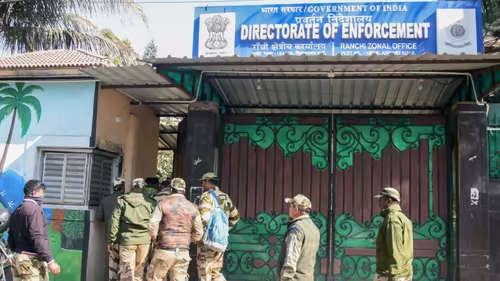
In a dramatic escalation of India’s ongoing tussle between state and central investigative agencies, the Jharkhand High Court has delivered a scathing rebuke to local police following their controversial raid on the Enforcement Directorate (ED) office in Ranchi. The court didn’t mince words—it called the operation “preplanned,” suggesting not just procedural overreach but deliberate provocation. And in an unprecedented move, it has now ordered the immediate deployment of additional security to protect the federal agency’s premises.
This isn’t just another bureaucratic squabble. It’s a flashpoint in a larger battle over jurisdiction, autonomy, and the very balance of power between state governments and central enforcement bodies. For citizens watching from the sidelines, it raises a critical question: When police storm a central agency’s office, who is really under investigation—and who is being intimidated?
Table of Contents
- What Happened During the Ranchi ED Raid?
- Why the High Court Called It ‘Preplanned’
- The ED and Its Role in India’s Legal Framework
- State vs. Center: The Growing Tension Over Investigative Powers
- What the Court’s Security Order Means for Federal Agencies
- Public and Legal Reactions to the Incident
- Conclusion: A Warning Shot Across the Bow
- Sources
What Happened During the Ranchi ED Raid?
According to reports, a large contingent of Jharkhand police personnel entered the ED office in Ranchi without prior coordination or clear legal justification . Witnesses described the scene as chaotic—officers reportedly seized documents, questioned staff, and created an atmosphere of intimidation. The ED, which operates under the Ministry of Finance and investigates financial crimes like money laundering, was caught off guard despite its national mandate.
Notably, the police action came amid heightened political friction between the ruling state government and the central administration. Critics argue the raid was less about law enforcement and more about sending a political message—a theory the High Court seems to endorse.
Why the High Court Called It ‘Preplanned’
The Jharkhand High Court’s use of the word “preplanned” is legally significant. It implies intent, coordination, and possibly malice—far beyond a routine or mistaken police operation. During hearings, the bench expressed deep concern over the lack of warrants, absence of communication with central authorities, and the disproportionate force used.
“This was not spontaneous,” the court observed. “Such actions undermine the rule of law and the constitutional framework that grants the ED its authority.” By labeling it preplanned, the judiciary has effectively shifted the narrative from a procedural error to a potential abuse of power.
The ED and Its Role in India’s Legal Framework
The Enforcement Directorate is a specialized financial intelligence and law enforcement agency tasked with enforcing two key laws: the Prevention of Money Laundering Act (PMLA) and the Foreign Exchange Management Act (FEMA). Unlike local police, the ED operates nationwide and reports directly to the Union Government .
Its independence is crucial for investigating high-stakes financial crimes that often cross state borders. Any attempt by a state police force to interfere with its operations—without due process—sets a dangerous precedent. Legal experts warn this could lead to a fragmented enforcement landscape where political agendas override national legal standards [INTERNAL_LINK:role-of-enforcement-directorate-in-india].
State vs. Center: The Growing Tension Over Investigative Powers
The Ranchi incident is the latest in a series of confrontations between state governments and central agencies like the ED and CBI. In recent years, opposition-ruled states have accused these agencies of being weaponized for political vendettas. In response, some states have attempted to assert control—through legislative hurdles, police interventions, or public denouncements.
However, the Constitution of India clearly demarcates certain subjects—including banking, foreign exchange, and inter-state trade—as part of the Union List, meaning only the central government can legislate and enforce laws on them . The ED’s mandate falls squarely within this domain. Thus, unilateral state action against it may not just be unwise—it could be unconstitutional.
What the Court’s Security Order Means for Federal Agencies
The High Court’s directive to deploy “additional security” at the Ranchi ED office is more than a logistical fix—it’s a judicial shield. This order serves multiple purposes:
- Deters future incursions: Visible security signals that federal offices are under judicial protection.
- Reaffirms institutional sanctity: It upholds the ED’s legal standing against arbitrary state interference.
- Sets a legal precedent: Other High Courts may cite this ruling if similar incidents occur elsewhere.
Importantly, the court also demanded a detailed report from the state government explaining the rationale behind the raid—a move that could lead to administrative or even criminal accountability.
Public and Legal Reactions to the Incident
Legal circles have largely welcomed the High Court’s intervention. Senior advocates called it a “necessary check on executive overreach.” Meanwhile, political reactions remain divided along party lines, with the ruling state party downplaying the event as “routine coordination,” while the opposition labeled it “an assault on federalism.”
Civil society groups, meanwhile, are urging transparency. “If the police had legitimate concerns, they should have followed due process—not stormed a federal office like it was a crime den,” said a spokesperson for a Ranchi-based legal rights collective.
Conclusion: A Warning Shot Across the Bow
The Ranchi ED raid is far more than a local news story. It’s a litmus test for India’s federal structure and the independence of its investigative institutions. The Jharkhand High Court’s firm stance sends a clear message: no agency—state or central—is above the law, but neither can one arm of the state unilaterally undermine another without consequences.
As tensions simmer, one thing is certain: the balance of power in India’s democratic framework is being watched closely—not just by lawyers and politicians, but by every citizen who believes in the rule of law.
Sources
- Times of India. “Ranchi ED office raid: HC flags police action as ‘preplanned’; orders additional security deployment.” https://timesofindia.indiatimes.com/…
- Enforcement Directorate, Government of India. “About ED.” https://enforcementdirectorate.gov.in/
- Constitution of India. “Seventh Schedule: Union List, State List, Concurrent List.” https://www.india.gov.in/my-government/constitution-india/seventh-schedule