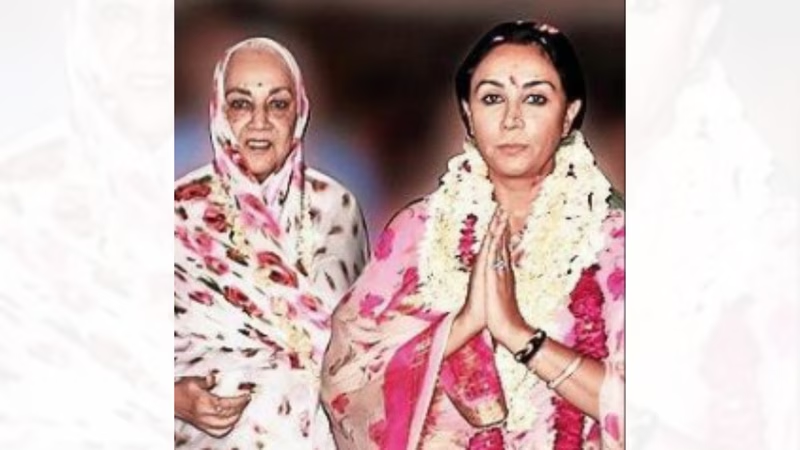
In a dramatic legal reversal that echoes India’s complex transition from princely states to a modern republic, the Supreme Court has reopened a decades-old battle over land worth an estimated ₹400 crore between the Government of Rajasthan and the descendants of its erstwhile royal families. The Court’s decision to set aside a 2011 Rajasthan High Court judgment doesn’t just revive a financial dispute—it reignites a profound constitutional debate about legacy, sovereignty, and who truly owns the land once ruled by kings.
Table of Contents
- What Happened: The SC Ruling Explained
- Background: The Origins of the Rajasthan Royals Land Dispute
- The 2011 High Court Verdict and Why It Was Overturned
- Key Legal Issues at Stake
- Implications for Other Princely States
- Political and Public Reaction
- Conclusion: A Case That Transcends Property
- Sources
What Happened: The SC Ruling Explained
In a significant order, a bench of the Supreme Court of India has annulled a 2011 judgment by the Rajasthan High Court that had largely favored the state government in the Rajasthan royals land dispute. The apex court found “procedural infirmities” and “inadequate consideration of historical context” in the lower court’s reasoning, paving the way for a fresh hearing on the merits of the case .
This means the legal battle over thousands of acres of prime land—once part of royal estates (jagirs) in districts like Jaipur, Udaipur, and Jodhpur—is now back in play. The disputed properties include palaces, hunting lodges, agricultural fields, and urban plots whose current market value is pegged at around ₹400 crore.
Background: The Origins of the Rajasthan Royals Land Dispute
The roots of this conflict go back to India’s independence. When the princely states merged with the Union in 1947–49, the rulers were granted privy purses and allowed to retain certain personal properties under the Indian Constitution (Article 291 and 362). However, in 1971, Prime Minister Indira Gandhi abolished the privy purses and derecognized royal titles through the 26th Constitutional Amendment.
Following this, the Rajasthan government enacted laws to take over “excess” or “non-private” lands belonging to former rulers, arguing these were state assets misclassified as personal property. The royal families countered that much of the seized land was part of their private holdings, not state-administered jagirs, and thus protected under property rights.
The 2011 High Court Verdict and Why It Was Overturned
In 2011, the Rajasthan High Court ruled that the state had the right to acquire the disputed lands, stating that post-1971, former rulers held no special legal status. The judgment effectively validated decades of land seizures by successive state governments.
However, the Supreme Court found critical flaws in this approach. According to the bench, the High Court failed to distinguish between “state property” and “private ancestral property” and did not adequately examine original land records, sanads (deeds), and pre-merger agreements. “Historical entitlement cannot be erased by administrative convenience,” the SC observed .
Key Legal Issues at Stake
This case hinges on several nuanced legal questions:
- Definition of “Private Property”: What constitutes personal property versus state-administered estate under pre-independence treaties?
- Retrospective Application of Laws: Can laws passed after 1971 be used to justify seizures that occurred before clear legal frameworks existed?
- Right to Property: Though no longer a fundamental right (after the 44th Amendment), Article 300A still guarantees protection against arbitrary deprivation of property.
- Doctrine of Legitimate Expectation: Did the state breach assurances given during the integration of princely states?
Legal experts note that the outcome could set a precedent for similar disputes in Madhya Pradesh, Gujarat, and Hyderabad.
Implications for Other Princely States
Rajasthan isn’t alone. Former royal families in Gwalior, Baroda, and Travancore have also challenged state takeovers of their properties. A favorable ruling here could open floodgates for restitution claims across India. Conversely, if the state prevails, it would cement the government’s authority to manage all former royal assets as public property.
The Ministry of Home Affairs maintains that all such matters were settled during state reorganization. But historians argue that many agreements were ambiguous, leaving room for interpretation—a gap the courts are now being asked to fill.
Political and Public Reaction
The ruling has drawn mixed responses. Heritage conservationists welcome a potential return of palaces to royal families, who often maintain them better than cash-strapped state departments. “Many havelis are crumbling under government neglect,” says Dr. Meera Iyer, a cultural historian.
However, opposition parties accuse the current BJP-led Rajasthan government of “sympathizing with feudal elites” while farmers struggle for land rights. The Congress party called the move “a betrayal of the common man.” Meanwhile, royal descendants describe it as “a fight for dignity, not just land.”
Conclusion: A Case That Transcends Property
The Rajasthan royals land dispute is far more than a real estate battle. It’s a living archive of India’s journey from empire to democracy—a test of whether historical promises hold weight in a modern legal system. As the Supreme Court prepares for a full hearing, the nation watches closely. Will the verdict honor the past, or affirm the primacy of the present? Either way, the echoes will be felt far beyond Rajasthan’s desert borders. For more on India’s constitutional history, see our feature on [INTERNAL_LINK:princely-states-integration-post-independence].
Sources
- Times of India: SC sets aside 14-year-old HC order, reopens ₹400cr land dispute between govt & Rajasthan royals
- The Hindu: Supreme Court reopens ₹400 crore land dispute involving Rajasthan royal families
- Supreme Court of India: Official Judgments Database
- Constitution of India: Ministry of Law and Justice – Full Text