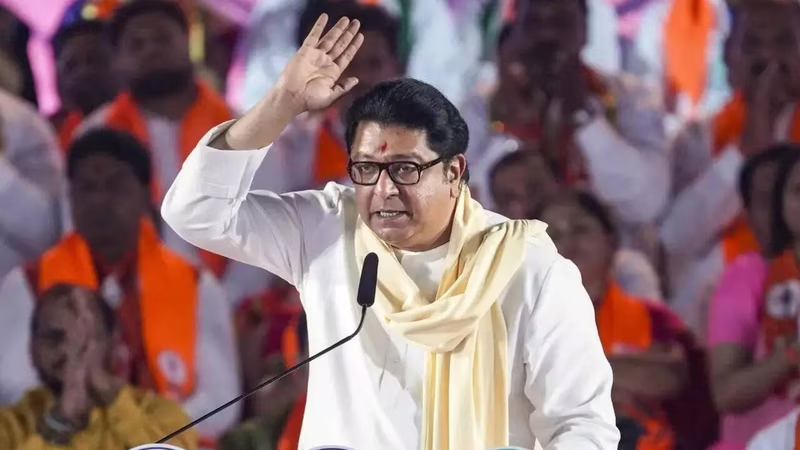
In the bustling heart of Mumbai, a linguistic storm is brewing. At a massive rally held at Shivaji Park on January 11, 2026, Maharashtra Navnirman Sena (MNS) chief Raj Thackeray delivered a message that was as blunt as it was incendiary: “I’ll kick you.” His target? Migrants from Uttar Pradesh and Bihar, whom he accused of attempting to impose Hindi on the local Marathi-speaking population .
This isn’t just another political soundbite. Thackeray framed the upcoming Brihanmumbai Municipal Corporation (BMC) elections as nothing short of an existential battle, declaring it the “last election for the Marathi man.” He urged voters to seize this final opportunity or face being “finished” .
Adding a powerful layer to this drama is the rare sight of the Thackeray cousins—Raj and Uddhav—standing shoulder-to-shoulder on the same stage after years of estrangement. Their joint attack on the BJP, accusing it of peddling “fake Hindutva,” has sent shockwaves through Maharashtra’s political landscape .
Table of Contents
- The ‘Hindi Imposition’ Controversy Explained
- A Legacy of ‘Marathi Manoos’
- The Thackeray Reunion and its Political Impact
- What This Means for the BMC Elections
- Conclusion: A City at a Crossroads
- Sources
The ‘Hindi Imposition’ Controversy Explained
Raj Thackeray’s core argument hinges on the concept of Hindi imposition. He contends that Hindi is not the native language of people from UP and Bihar, but rather a tool of cultural dominance being forced upon Maharashtra. His statement, “Hindi is not for you,” directed at these migrant communities, underscores his belief that their primary duty is to learn and respect Marathi, the state’s official language .
This stance taps into a long-standing, sensitive nerve in Mumbai’s socio-political fabric. The city, India’s financial capital, has always been a melting pot, attracting workers and families from across the country. However, the balance between integration and preservation of local identity has been a constant source of tension.
A Legacy of ‘Marathi Manoos’
The rallying cry of “Marathi Manoos” (Marathi Person) is not new. It was famously championed by Raj’s uncle, the late Bal Thackeray, who founded the Shiv Sena in the 1960s on a platform of protecting the rights and identity of the native Marathi-speaking populace . This ideology propelled the party to immense power in Mumbai for decades.
Raj Thackeray, who split from the Shiv Sena in 2006 to form the MNS, has consistently carried this torch, often using more aggressive rhetoric. His recent warning is a direct continuation of this legacy, designed to galvanize his core voter base by painting a picture of a Marathi identity under siege .
The Thackeray Reunion and its Political Impact
The most significant development in this saga is the unprecedented alliance between Raj Thackeray’s MNS and Uddhav Thackeray’s Shiv Sena (UBT). After a bitter two-decade-long feud, their joint appearance signals a major strategic shift aimed squarely at countering the BJP-Shiv Sena (Eknath Shinde faction) combine .
At the rally, Uddhav Thackeray echoed his cousin’s sentiments, launching a scathing attack on the BJP. He declared, “BJP’s idea of Hindutva is fake,” arguing that their brand of nationalism threatens the very sanctity of Mumbai and the interests of the Marathi community . This united front presents a formidable challenge to the ruling coalition in the crucial civic polls.
What This Means for the BMC Elections
The BMC is not just any municipal body; it’s the richest civic corporation in India, controlling a massive budget and wielding enormous influence over the city’s infrastructure and daily life. The stakes for the January 2026 elections are incredibly high.
Raj Thackeray’s inflammatory remarks and the Thackeray reunion are a clear electoral strategy with several key objectives:
- Consolidate the Marathi Vote: By framing the election as a fight for survival, they aim to unite all Marathi-speaking voters behind their alliance, cutting across previous party loyalties.
- Challenge the BJP’s Narrative: Accusing the BJP of “fake Hindutva” is an attempt to delegitimize their core ideological appeal and position the Thackeray camp as the true protectors of both regional and, in their view, authentic national identity.
- Regain Lost Ground: Both the MNS and the UBT faction have seen their influence wane in recent years. This high-stakes gamble is their bid to reclaim political relevance in their home turf of Mumbai .
For a deeper look at the history of regional politics in India, see our analysis on [INTERNAL_LINK:maharashtra-political-history].
Conclusion: A City at a Crossroads
Raj Thackeray’s “I’ll kick you” warning is far more than a personal threat; it’s a potent political symbol. It encapsulates the deep anxieties about cultural identity, linguistic pride, and economic competition that simmer beneath Mumbai’s cosmopolitan surface. The rare Thackeray alliance has injected a massive dose of uncertainty into the BMC elections, promising a fierce battle for the soul of India’s most important city. As the campaign heats up, all eyes will be on whether the call to save the “Marathi Manoos” can translate into a decisive electoral victory.
Sources
- Times of India: ‘I’ll kick you’: Raj Thackeray warns UP, Bihar migrants against Hindi imposition
- Hindustan Times: BMC election 2026 #LIVE: ‘Marathi manoos’ in focus
- News24: Raj Thackeray’s fiery warning to UP, Bihar migrants
- Daijiworld: Mumbai civic polls: Uddhav, Raj reunite, target BJP over ‘fake Hindutva’
- SocialNews.XYZ: Uddhav, Raj Thackeray’s ‘Marathi Manoos first’ vow
- Council on Foreign Relations (Historical Context): India’s Language Politics