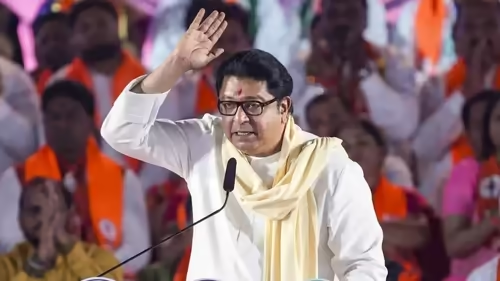
In the ever-shifting sands of Maharashtra politics, a single phrase can send shockwaves through the corridors of power. That phrase, uttered by the ever-volatile MNS chief Raj Thackeray, is flexible politics. Coming on the heels of a major strategic shift in the Kalyan-Dombivli Municipal Corporation (KDMC), Thackeray’s remarks have ignited a firestorm of speculation: Is the long-standing feud between the Thackeray cousins truly over? And what does this mean for the future of the state?
Table of Contents
- The KDMC Debacle: A Surprise Alliance
- Raj Thackeray’s Cryptic Message on Flexible Politics
- The History of the Thackeray Split
- What Does ‘Flexible Politics’ Really Mean for MNS?
- Conclusion: The Future of Maharashtra Politics
- Sources
The KDMC Debacle: A Surprise Alliance
The recent Kalyan-Dombivli Municipal Corporation elections delivered a hung verdict, leaving all major parties scrambling for allies to form a government. In a stunning turn of events, the Eknath Shinde-led Shiv Sena, which won 53 seats, secured the crucial support of five MNS corporators . This unexpected backing effectively gave the Shinde faction a working majority of 58 in the 122-member house .
This move was particularly jarring given the decades-long, bitter rivalry between the Thackeray factions. The MNS, founded by Raj Thackeray in 2006 after he left the Shiv Sena due to differences with his cousin Uddhav Thackeray, has built its identity on being the primary challenger to the original party . For them to now lend support to a rival Shiv Sena faction is a seismic shift in local politics.
Raj Thackeray’s Cryptic Message on Flexible Politics
In the aftermath of this controversial decision, Raj Thackeray took to social media to address the public outcry. His message was clear yet enigmatic: his new stance of flexible politics is not a betrayal of his core Marathi ideology, nor is it driven by personal ambition.
He stated, “If I have to take a flexible stance in changing times, it will never be for my personal gain” . To emphasize his point, he even went so far as to say he would be “willing to back even Trump for a strong Maharashtra,” a hyperbolic statement meant to underscore that his flexibility is purely strategic and aimed at a larger goal for the state .
This carefully crafted narrative attempts to walk a tightrope—justifying a pragmatic political maneuver while reassuring his loyal base that the soul of the MNS remains intact.
The History of the Thackeray Split
To fully grasp the weight of this recent development, one must look back at the acrimonious split that defined a generation of Maharashtrian politics. In 2006, Raj Thackeray, feeling sidelined in the succession plan of his uncle Bal Thackeray’s Shiv Sena, broke away to form his own party, the Maharashtra Navnirman Sena .
For nearly two decades, the two cousins, Uddhav and Raj, led their respective parties in a fierce battle for the same Marathi voter base, often trading barbs and accusations. Their rivalry was so deep-rooted that a truce proposed by Uddhav in 2013 was outright rejected by Raj .
However, recent months have shown signs of a thaw. In a major turning point, the two cousins announced a pre-poll alliance between the Shiv Sena (UBT) and the MNS for the Brihanmumbai Municipal Corporation (BMC) elections . This historic reunion suggested that old wounds were healing, at least for the sake of political survival against a common enemy.
What Does ‘Flexible Politics’ Really Mean for MNS?
Raj Thackeray’s declaration of flexible politics appears to be a direct response to the harsh realities of electoral math. The MNS has seen its influence wane in recent years, struggling to win even local body elections . In this context, his strategy seems to be one of survival and relevance.
By offering conditional support to various factions—including both wings of the Shiv Sena—he can position the MNS as a kingmaker, a force to be reckoned with, rather than a fading entity. This approach allows him to:
- Maintain ideological purity in rhetoric while making pragmatic deals on the ground.
- Extract concessions and influence from larger parties desperate for his handful of corporators’ votes.
- Keep his cadre motivated by demonstrating that the party still holds significant sway in key urban centers like Kalyan-Dombivli.
This new doctrine is a stark departure from the rigid, confrontational politics that defined the MNS’s early years. It’s a sign that Raj Thackeray is evolving from a firebrand agitator into a more calculating political operator.
Conclusion: The Future of Maharashtra Politics
Raj Thackeray’s “flexible politics” is more than just a catchy phrase; it’s a fundamental recalibration of his party’s strategy. The KDMC alliance with the Shinde Sena is a clear signal that in the current political climate, survival often trumps old grudges. While he insists this flexibility is not for personal gain but for a “strong Maharashtra,” the immediate effect is to keep the MNS relevant in a highly competitive arena.
As Maharashtra heads towards larger state elections, all eyes will be on Raj Thackeray. Will his flexible politics lead to a grand, stable alliance, or will it remain a series of tactical, short-term maneuvers? One thing is certain: the Thackeray family drama is far from over, and its next act promises to be just as unpredictable as the last. For more on the complex dynamics of regional parties, see our analysis on [INTERNAL_LINK:maharashtra-regional-politics].
Sources
- Times of India: ‘Willing to back even Trump for strong Maharashtra’: Raj Thackeray’s cryptic take on ‘flexible politics’
- The Economic Times: MNS offers support to Shiv Sena in Kalyan-Dombivli Municipal Corporation
- Republic World: Raj Thackeray celebrated the party’s BMC election victory along with Uddhav Thackeray
- The Indian Express: After years of political estrangement, cousins Uddhav and Raj Thackeray have reunited