Table of Contents
- Why the Railway Budget 2026 Matters More Than Ever
- Railway Budget 2026: Five Pillars for a Viksit Bharat
- 1. Modernize Core Infrastructure with Speed and Safety
- 2. Unlock Freight Potential Through Dedicated Corridors
- 3. Boost Private Investment via Transparent PPPs
- 4. Digitize Operations for Efficiency and Transparency
- 5. Align Skilling and Green Tech with National Goals
- Conclusion: From Budget to Blueprint for Growth
- Sources
Why the Railway Budget 2026 Matters More Than Ever
The Railway Budget 2026 isn’t just another fiscal exercise—it’s a pivotal moment for India’s most iconic public asset. With the government pushing its ambitious Viksit Bharat (Developed India) vision by 2047, Indian Railways must evolve from a legacy transporter into a dynamic, tech-driven growth engine. While budgetary support for infrastructure remains essential, experts warn that without accompanying structural reforms, even massive investments could yield diminishing returns .
As Finance Minister Nirmala Sitharaman prepares to present the Union Budget—and with it, the de facto Railway Budget since its merger in 2017—the pressure is on to deliver not just funds, but a clear roadmap for transformation. The stakes? Economic efficiency, job creation, energy sustainability, and global competitiveness.
Railway Budget 2026: Five Pillars for a Viksit Bharat
To truly serve as a catalyst for national development, the Railway Budget 2026 must prioritize strategic reforms over routine allocations. Here are five actionable pathways that can turn India’s railways into a cornerstone of the Viksit Bharat agenda.
1. Modernize Core Infrastructure with Speed and Safety
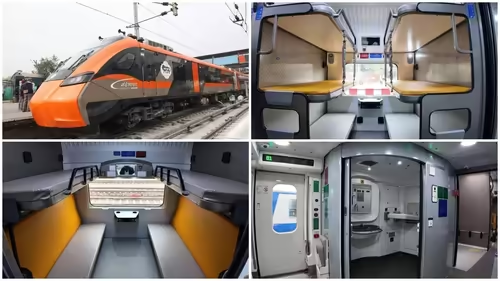
Despite progress on projects like the Vande Bharat trains, much of India’s rail network still operates on century-old tracks with speed restrictions. The 2026 budget must accelerate the Amrit Bharat Station Scheme and complete the long-delayed semi-high-speed corridors (e.g., Delhi–Varanasi, Mumbai–Ahmedabad).
Critical upgrades include:
- Eliminating all unmanned level crossings by 2027.
- Electrifying 100% of broad-gauge routes (currently at ~95%).
- Deploying Kavach, India’s indigenous anti-collision system, across all major routes.
Investing in safety isn’t just ethical—it’s economic. Every accident causes massive operational losses and erodes public trust.
2. Unlock Freight Potential Through Dedicated Corridors
Freight revenue is Indian Railways’ lifeline, yet its modal share has dropped from 89% in 1950 to under 30% today . The Eastern and Western Dedicated Freight Corridors (DFCs)—now nearing completion—must be fully leveraged.
The Railway Budget 2026 should:
- Incentivize industries to shift cargo from road to rail through lower tariffs and faster turnaround.
- Develop multi-modal logistics parks at DFC nodes (e.g., Dadri, Khurja, Nagpur).
- Introduce time-tabled freight services to guarantee delivery windows.
A 10% increase in rail freight share could reduce logistics costs by 2–3% of GDP—a game-changer for Make in India .
3. Boost Private Investment via Transparent PPPs
Public funds alone can’t meet the estimated ₹50 lakh crore needed for full rail modernization by 2047. The 2026 budget must create a predictable, investor-friendly environment for public-private partnerships (PPPs).
Key steps include:
- Fast-tracking private train operations on 100+ routes under the NMP (National Monetisation Pipeline).
- Offering revenue-sharing models instead of fixed track access charges.
- Establishing an independent rail regulator to ensure fair competition.
As the World Bank notes, “Private participation in rail infrastructure can drive efficiency, innovation, and service quality—if governance is strong” .
4. Digitize Operations for Efficiency and Transparency
Digital transformation is no longer optional. The Railway Budget 2026 should fund end-to-end digitization—from predictive maintenance using AI to real-time passenger information systems.
Priorities include:
- Integrating IRCTC with UPI for seamless ticketing.
- Using drones and IoT sensors for track and bridge inspections.
- Launching a unified data dashboard for freight customers.
Digital rails mean fewer delays, lower corruption, and happier passengers—aligning perfectly with Digital India.
5. Align Skilling and Green Tech with National Goals
Indian Railways employs over 1.2 million people—the world’s largest industrial workforce. The 2026 budget must invest in reskilling this force for green and digital roles.
Simultaneously, the push for net-zero by 2030 requires:
- Scaling up solar power on station rooftops and vacant land.
- Testing hydrogen-powered trains on non-electrified routes.
- Recycling 100% of plastic waste from trains by 2027.
This isn’t just sustainability—it’s future-proofing the railways for a low-carbon economy.
Conclusion: From Budget to Blueprint for Growth
The Railway Budget 2026 has a historic opportunity: to move beyond incrementalism and position Indian Railways as the backbone of a self-reliant, sustainable, and inclusive India. By linking every rupee spent to measurable reforms—modernization, freight efficiency, private capital, digitalization, and green transition—the government can ensure that the railways don’t just carry passengers, but carry the nation toward Viksit Bharat. For deeper insights on infrastructure policy, explore our analysis at [INTERNAL_LINK:india-infrastructure-policy-2026].
Sources
- Times of India. “Railway Budget 2026 expectations: 5 ways to drive an important growth engine for the Viksit Bharat vision.” https://timesofindia.indiatimes.com/…
- Ministry of Railways, Government of India. “Annual Report 2024-25.”
- NITI Aayog. “National Logistics Policy: Reducing Logistics Costs in India,” 2023.
- World Bank. “Revitalizing Indian Railways: The Role of Private Investment,” 2025. https://www.worldbank.org/…
- Press Information Bureau (PIB). “Amrit Bharat Station Scheme Launched,” February 2023.