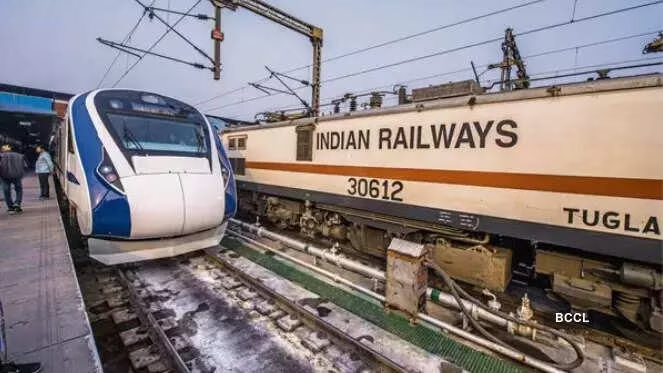
For millions of Indians who rely on the rails every day, the Railway Budget 2026 isn’t just about numbers—it’s about punctuality, safety, and the promise of a faster, smarter network. And while headlines might suggest “no change” in funding, the reality is far more nuanced. The Gross Budgetary Support (GBS) for Indian Railways in FY26–27 is expected to remain stable—but behind that steady figure lies a bold reallocation of resources, signaling a new era of strategic investment.
Table of Contents
- Funding Steady—Not Stagnant
- Railway Budget 2026: The New Priority List
- Amrit Bharat & Vande Bharat: The Flagship Duo
- Bullet Train Gets a Financial Boost
- Track Safety and Decongestion: Silent Game-Changers
- What This Means for Everyday Passengers
- Conclusion: Efficiency Over Expansion
- Sources
Funding Steady—Not Stagnant
According to government sources cited by The Times of India, the GBS for Indian Railways in the upcoming fiscal year—estimated at around ₹2.52 lakh crore—will likely remain unchanged from FY25–26 . At first glance, this might seem like a pause in progress. But experts argue it’s actually a sign of fiscal maturity.
“The Railways have optimized their capital expenditure planning,” says Dr. Arun Kumar, a former advisor to the Ministry of Railways. “Current allocations are sufficient because implementation has improved—less leakage, better project tracking.”
Rather than asking for more money, the Ministry is reshuffling its existing budget to align with Prime Minister Modi’s vision of a modern, high-speed, and accident-free rail network.
Railway Budget 2026: The New Priority List
The real story of the Railway Budget 2026 isn’t about the total pot—it’s about who gets what slice. Key projects are being fast-tracked, while less critical upgrades are being delayed or scaled back. The ministry is prioritizing:
- National high-speed rail corridors (especially the Mumbai–Ahmedabad bullet train)
- Vande Bharat train expansion (target: 500+ sets by 2030)
- Track safety modernization (Kavach rollout, elimination of unmanned level crossings)
- Decongestion of saturated routes (e.g., Delhi–Mumbai, Chennai–Bangalore corridors)
- Amrit Bharat Station Scheme (modernizing 1,300+ stations with multimodal connectivity)
This strategic shift reflects a move from quantity to quality—fewer new lines, but smarter, safer, and faster service on existing ones.
Amrit Bharat & Vande Bharat: The Flagship Duo
The Amrit Bharat Station Scheme and Vande Bharat trains are twin pillars of India’s rail modernization. In 2026, both will absorb a significant chunk of internal reallocations.
Vande Bharat trains—India’s semi-high-speed indigenous service—have already covered over 40 routes and carry millions monthly. The goal for 2026 is to accelerate manufacturing at ICF Chennai and Marathwada, with new variants designed for hilly and coastal terrains. Each new Vande Bharat set costs around ₹120 crore, making efficient budgeting critical .
Meanwhile, the Amrit Bharat scheme aims to transform stations into integrated transit hubs with better lighting, waiting areas, food courts, and last-mile connectivity via buses and e-rickshaws. Over ₹30,000 crore is expected to be redirected toward this initiative alone in FY26.
Bullet Train Gets a Financial Boost
Despite past delays, the Mumbai–Ahmedabad High-Speed Rail Corridor (India’s first bullet train project) is set to receive renewed financial emphasis in the Railway Budget 2026. Japan’s Shinkansen technology underpins the project, which is already 45% complete as of late 2025 .
With land acquisition hurdles mostly cleared in Gujarat and Maharashtra, the focus now shifts to tunneling, elevated viaducts, and rolling stock. A significant portion of the reallocated GBS will support this, ensuring the inaugural run—now targeted for 2028—stays on track. The project’s total cost has ballooned to over ₹1.1 lakh crore, making sustained funding essential.
Track Safety and Decongestion: Silent Game-Changers
While flashy trains grab headlines, the most vital investments may be invisible. Track safety remains a top concern: Indian Railways aims to eliminate all unmanned level crossings by 2027 and fully deploy Kavach, its indigenous anti-collision system, across 2,000+ km of high-density routes.
Simultaneously, decongestion projects—like the third and fourth lines on the Delhi–Howrah and Mumbai–Chennai trunk routes—will receive priority funding. These upgrades don’t just reduce travel time; they prevent bottlenecks that cause cascading delays across the network.
For insights into how rail safety is evolving, check out our deep dive on [INTERNAL_LINK:indian-railways-kavach-system].
What This Means for Everyday Passengers
Passengers can expect:
- Faster and more frequent Vande Bharat services on key intercity routes
- Cleaner, better-equipped stations under Amrit Bharat
- Reduced accidents thanks to Kavach and infrastructure upgrades
- Potential fare hikes on premium services to support self-sustainability
However, long-haul general-class travelers may see fewer new amenities, as resources shift toward high-impact corridors.
Conclusion: Efficiency Over Expansion
The Railway Budget 2026 marks a turning point: Indian Railways is no longer chasing expansion at all costs. Instead, it’s optimizing its existing budget to deliver safer, faster, and smarter mobility. By holding GBS steady while reallocating internally, the ministry shows fiscal discipline—and a clear strategic vision. For a network that moves 23 million people daily, that’s not stagnation. It’s smart stewardship.
Sources
- The Times of India. “Railway Budget 2026: Funding for Indian Railways likely to remain unchanged.” December 27, 2025.
- Ministry of Railways, Government of India. “Vande Bharat Mission: Production and Deployment Plan 2025–2030.”
- National High-Speed Rail Corporation Ltd (NHSRCL). “Mumbai–Ahmedabad Bullet Train Project Progress Report.” November 2025.
- World Bank. “Financing Urban Transport in South Asia: The Case of Indian Railways.” 2024. https://www.worldbank.org/en/topic/transport
- [INTERNAL_LINK:indian-railways-kavach-system]