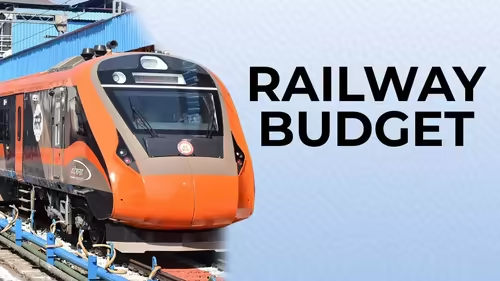
Hold onto your seats, because the Railway Budget 2026 just promised to rewrite the map of Indian travel. In a move that’s equal parts thrilling and eyebrow-raising, Finance Minister Nirmala Sitharaman announced not one, not two, but seven new high-speed rail corridors across the nation [[1]]. This comes hot on the heels of the successful launch of India’s first Vande Bharat sleeper train in January 2026, which is already transforming overnight journeys [[10]].
But let’s be real—grand announcements are easy. The real question is, can Indian Railways, an institution steeped in legacy, actually deliver on this hyper-modern vision? We’re diving deep into the details, the routes, and the gritty reality behind the headlines.
Table of Contents
- What’s in the Railway Budget 2026?
- The 7 New High-Speed Rail Corridors: A Route Map
- Vande Bharat Sleeper Train: Revolutionizing Overnight Travel
- From Dream to Track: The Challenges Ahead
- Conclusion: Is India’s Rail Future on the Right Track?
- Sources
What’s in the Railway Budget 2026?
The Railway Budget 2026 is more than just a financial statement; it’s a bold declaration of intent. The government has proposed a massive capital expenditure to push the envelope on rail infrastructure, with a clear focus on speed, safety, and modernization [[3]]. The centerpiece of this vision is the development of seven high-speed rail corridors designed to connect major economic and population hubs, promising to slash travel times dramatically [[2]].
This isn’t happening in a vacuum. It’s part of a larger strategy that includes the near-complete electrification of the rail network and the aggressive rollout of indigenous safety systems like Kavach [[8]]. The budget also allocates a specific provision of Rs 100 crore to the High Speed Rail Corporation (HSRC) to take concrete steps on these projects [[6]].
The 7 New High-Speed Rail Corridors: A Route Map
While the official detailed route list is still awaited, early reports from the budget speech confirm some key connections. The most prominent name mentioned is the corridor between Mumbai and Pune, a route notorious for its heavy traffic and long commute times [[2]].
It’s crucial to understand that “high-speed” in the Indian context is evolving. While the flagship Mumbai-Ahmedabad bullet train project (under construction) aims for speeds of 320 kmph, these newly announced corridors are likely to be semi-high-speed, targeting 160-200 kmph, similar to the current Vande Bharat fleet [[28]]. This makes them more feasible for rapid implementation on existing or upgraded tracks.
These corridors are expected to follow a hub-and-spoke model, connecting major metros and state capitals to create a seamless national high-speed network over the next decade.
Vande Bharat Sleeper Train: Revolutionizing Overnight Travel
While the corridors are a future promise, the revolution is already here. At the start of 2026, Indian Railways launched its first Vande Bharat sleeper train on the Kamakhya–Howrah route [[13]]. This isn’t just another train; it’s a complete overhaul of the overnight travel experience.
Capable of hitting 160 kmph, the sleeper variant brings the comfort and efficiency of the day-time Vande Bharat to long-distance night journeys [[28]]. Passengers can now expect features like:
- Modern, ergonomic AC 2-tier and AC 3-tier coaches.
- Enhanced onboard amenities, including better lighting and charging points.
- The indigenous KAVACH anti-collision safety system for peace of mind [[12]].
- Regenerative braking technology for improved energy efficiency [[12]].
The success of this initial service is a critical test case. If it performs well, Indian Railways plans to roll out 12 more Vande Bharat Sleeper trains by March 2027 [[10]]. This is a tangible, immediate benefit for millions of travelers, unlike the longer-term corridor projects.
From Dream to Track: The Challenges Ahead
Let’s not get lost in the hype. Turning these grand announcements into operational reality is a monumental task fraught with challenges:
Land Acquisition and Funding
Building dedicated high-speed corridors requires vast amounts of land, a process that is historically slow and contentious in India. Securing the massive, sustained funding needed over many years is another significant hurdle.
Technical and Operational Complexity
Integrating high-speed services with the existing, incredibly dense conventional rail network is a complex engineering and logistical puzzle. Safety and scheduling will be paramount.
Setting Realistic Expectations
It’s important to manage public expectations. These “high-speed” corridors are unlikely to be “bullet trains” in the true sense immediately. They are more likely to be premium, semi-high-speed services that offer a significant upgrade over current options. For a deeper look at the state of high-speed rail in India, you can check out [INTERNAL_LINK:high-speed-rail-in-india-explained].
Conclusion: Is India’s Rail Future on the Right Track?
The Railway Budget 2026 has undeniably set a visionary course. The combination of immediate wins like the Vande Bharat sleeper and the long-term ambition of a national high-speed network shows a multi-pronged strategy. While the path to building seven new corridors is long and winding, the very act of announcing them creates a framework for progress. The real test will be in the execution, the transparency of updates, and the ability to deliver on the promises made. For now, the journey towards a faster, smarter Indian Railways has officially begun.
Sources
- Angel One. “Union Budget 2026 Live”. https://www.angelone.in/news/budget/union-budget-2026-live-check-updates-on-taxation-policies-defence-railway-infrastructure
- Firstpost. “Budget 2026 Live Updates”. https://www.firstpost.com/india/budget-2026-live-updates…
- Economic Times. “Infra-Railways Budget 2026 LIVE Updates”. https://infra.economictimes.indiatimes.com/live-blog/infra-industry-railway-budget-2026-live-updates/127799410
- Wikipedia. “Vande Bharat Sleeper Express”. https://en.wikipedia.org/wiki/Vande_Bharat_Sleeper_Express
- The Hindu. “First commercial run of first Vande Bharat sleeper train…”. https://www.thehindu.com/news/national/vande-bharat-sleeper-express-train-kamakhya-howrah-route-stops-fare-timing/article70524443.ece
- High Speed Rail Corporation. “Railway Budget – HSRC”. https://hsrc.in/news1.html
- Times of India. “Railway Budget 2026 Live Updates…”. https://timesofindia.indiatimes.com/business/india-business/railway-budget-2026-live-updates…