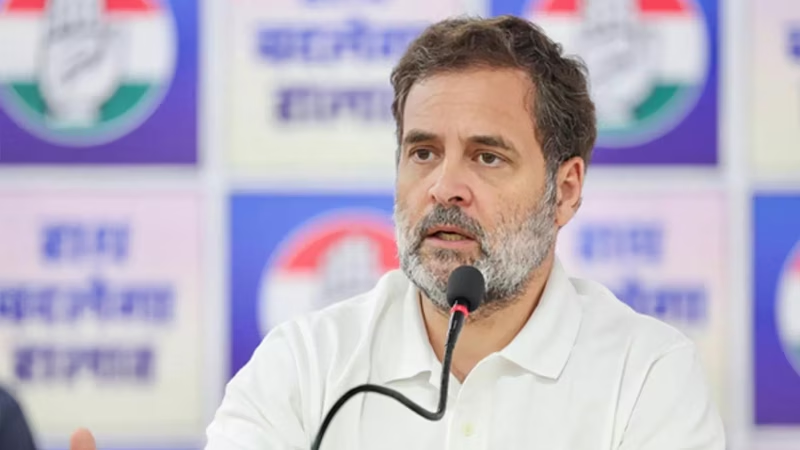
“Fark samjho sirji.”
With these four words—delivered with a mix of sarcasm and seriousness—Congress leader Rahul Gandhi has reignited a fierce political debate over India’s foreign policy stance, particularly regarding the looming threat of new tariffs from former US President Donald Trump. At a public rally in Rajasthan on January 7, 2026, Gandhi didn’t just critique the Modi government—he contrasted it sharply with the “strong, decisive leadership” of his grandmother, former Prime Minister Indira Gandhi.
The context? Reports that Donald Trump, now a leading 2028 presidential candidate, is pushing for sweeping tariffs on imports from countries including India, targeting sectors like steel, pharmaceuticals, and IT services. While the Modi administration has remained largely silent, Rahul Gandhi seized the moment to accuse the Prime Minister of diplomatic passivity. “When Indira Gandhi was PM, the world listened. Today, they don’t even look up,” he declared, drawing loud applause from the crowd .
But is this just political rhetoric—or does it reflect a legitimate gap in India’s global strategy? In this in-depth analysis, we unpack Gandhi’s claims, examine the real stakes of Trump’s tariff threats, and assess whether India’s current foreign policy is equipped for a new era of economic nationalism.
Table of Contents
- What Did Rahul Gandhi Actually Say?
- Donald Trump’s 2026 Tariff Threat: What It Means for India
- Invoking Indira Gandhi: A Nostalgic or Strategic Move?
- How Has the Modi Government Responded to US Trade Pressures?
- Potential Economic Impact of Trump Tariffs on India
- Why Now? The Political Timing Behind Gandhi’s Comments
- What Trade Experts Say About India’s Preparedness
- Conclusion: Diplomacy in the Age of Economic Nationalism
- Sources
What Did Rahul Gandhi Actually Say?
Speaking at a Congress-organized event in Jaipur, Rahul Gandhi directly addressed Prime Minister Modi: “Sirji, aap samajhdaar hain… lekin thoda fark samjho. America ke Trump bol rahe hain ki India par 25% tariff lagayenge—and aap kya kar rahe hain? Kuch nahi!”
He went on to praise Indira Gandhi’s handling of the 1971 Bangladesh crisis and her firm stance during the Cold War, arguing that her leadership earned India global respect. “She didn’t beg. She negotiated from strength,” he said, implying that today’s government lacks that backbone.
Donald Trump’s 2026 Tariff Threat: What It Means for India
While not yet official policy, Donald Trump has repeatedly vowed in recent speeches and interviews to impose “reciprocal tariffs” if elected in 2028. His campaign has singled out India for maintaining high tariffs on American goods—like motorcycles and agricultural products—while exporting software, textiles, and generic drugs to the US duty-free or at low rates .
Key sectors at risk include:
- IT & Software Services: Potential restrictions on H-1B visas and digital service taxes.
- Pharmaceuticals: Tariffs on generic drug exports, which account for over $7 billion annually.
- Steel & Aluminum: Renewed Section 232 tariffs, similar to those imposed in 2018.
- Textiles: Quotas or duties on apparel and home goods.
According to the Office of the US Trade Representative (USTR), India remains on the “Priority Watch List” for intellectual property concerns—a factor Trump could leverage .
Invoking Indira Gandhi: A Nostalgic or Strategic Move?
Rahul Gandhi’s reference to his grandmother is both personal and political. Indira Gandhi’s tenure (1966–77, 1980–84) was marked by:
- The 1971 Indo-Pak war and creation of Bangladesh.
- The 1974 Pokhran nuclear test (“Smiling Buddha”).
- A non-aligned but assertive foreign policy that balanced relations with the USSR and the West.
By invoking her, Gandhi isn’t just appealing to family legacy—he’s framing the current government as weak and reactive. It’s a narrative the Congress hopes will resonate with voters concerned about India’s global standing.
How Has the Modi Government Responded to US Trade Pressures?
Contrary to Gandhi’s claims, the Modi administration has not been idle. Key actions include:
- Signing the India-US Initiative on Critical and Emerging Technology (iCET) to deepen tech and defense collaboration.
- Reducing tariffs on select US products like Harley-Davidson bikes and almonds to ease trade tensions.
- Engaging in ongoing negotiations under the US-India Trade Policy Forum (TPF).
However, critics argue these moves are defensive rather than proactive. As one MEA official (speaking anonymously) told The Hindu, “We’re managing fires, not setting the agenda” .
Potential Economic Impact of Trump Tariffs on India
A 25% across-the-board tariff could cost India an estimated **$12–15 billion in annual exports**, according to a 2025 FICCI report. The IT sector alone could see profit margins shrink by 8–10%, forcing layoffs or offshoring to third countries like Mexico or Vietnam .
Small and medium enterprises (SMEs)—which form the backbone of India’s export economy—would be hit hardest due to limited capacity to absorb shocks or shift markets quickly.
Why Now? The Political Timing Behind Gandhi’s Comments
The timing is no accident. With state elections in several Hindi heartland states approaching and national elections just two years away, the Congress is positioning itself as a credible alternative on foreign policy—a domain long dominated by Modi’s image as a global statesman.
By linking trade vulnerability to national pride, Gandhi aims to chip away at Modi’s strongest political asset: his image as a strong, internationally respected leader.
What Trade Experts Say About India’s Preparedness
Dr. Rekha Menon, Senior Fellow at the Observer Research Foundation, argues that India needs a “contingency trade diplomacy cell” specifically for US election cycles. “Trump 1.0 taught us this lesson. We can’t be caught off-guard again,” she said .
Meanwhile, former commerce secretary Rajesh Subramaniam warns that “emotional comparisons to Indira Gandhi won’t fix structural trade imbalances. We need data-driven strategies, not nostalgia.”
Conclusion: Diplomacy in the Age of Economic Nationalism
Rahul Gandhi’s “fark samjho sirji” may be memorable, but the underlying issue is serious. As Donald Trump’s protectionist rhetoric gains traction in the US, India must decide whether to double down on quiet diplomacy or adopt a more vocal, strategic posture. The legacy of Indira Gandhi offers inspiration—but in 2026, economic statecraft requires more than just strength. It demands agility, foresight, and a plan. Whether the current or future government can deliver that remains to be seen.
Sources
- Times of India: ‘Fark samjho sirji’: Rahul Gandhi takes dig at PM Modi over Trump tariffs
- US Trade Representative (USTR): India Trade Relations Overview
- The Hindu: Gandhi’s Foreign Policy Gambit
- FICCI Report 2025: Impact of US Election Outcomes on Indian Exports
- Observer Research Foundation: Preparing for Trump 2.0: India’s Trade Strategy